Space is what you choose not to fill—on the page, in your diary, and in conversation—so meaning can land cleanly. It isn’t laziness or emptiness; it’s deliberate margin that guides attention, lowers mental noise, and sharpens decisions. Start by finding your biggest squeeze: the overbooked hour, the cluttered surface, the wordy paragraph. Cut first: qualifiers, repeats, needless meetings, twitchy replies. Keep going and you’ll see what changes.
Key Takeaways
- Space isn’t emptiness; it’s a deliberate tool that guides attention, sets hierarchy, and makes meaning easier to absorb.
- What you leave out reduces cognitive load, turning clutter into clarity and helping readers or users focus on what matters.
- White space in writing and design signals confidence, creates emphasis, and makes key ideas land without louder language.
- Protecting calendar and attention space prevents overcommitment, improves decisions, and leaves room for deep work and recovery.
- Silence and pauses in conversation create nuance, invite correction, and show composure when restraint is more powerful than filling gaps.
What “Space” Means (and What It Isn’t)
Where does “space” begin in a piece of writing or design? It starts where you choose not to fill: the margin you keep clean, the pause between lines, the breath after a strong point.
You use space to guide attention, not to create emptiness for its own sake.
Space isn’t laziness, nor a lack of ideas. It isn’t white background slapped on to look modern, and it isn’t silence that leaves readers guessing.
Proper space has intent: it separates, prioritises, and gives hierarchy room to register.
When you remove visual clutter, you don’t merely tidy the page—you reduce mental overload and make meaning easier to grasp.
You decide what deserves focus, and you let everything else step back quietly.
A Quick Way to Find Your Biggest Squeeze
If you’re not sure where your writing or layout feels tight, try this: scan it once, quickly, and circle the first place your eye snags. That snag is your biggest squeeze: a sentence doing two jobs, a headline fighting a subhead, a margin that’s pinching the page.
Now read only the circled section aloud. If you run out of breath, you’ve packed in too much. If you stumble, the rhythm’s telling you where to cut or break. Replace stacked modifiers with one precise noun. Split a compound thought into two clean lines. Swap a long preface for a direct claim.
Then step back. You should feel mental clarity in the structure and emotional openness in the tone, without adding a word.
Why Creating Space Feels Like Luxury
Once you’ve found the squeeze and cut it cleanly, the odd thing is how quickly the blankness can feel indulgent. You notice air around your decisions, like a well-cut coat with room to move. A clear surface, a spare calendar line, a quiet corner of the inbox: each reads as considered, not lacking.
Minimalist aesthetics work because they make intention visible; you can tell what’s been chosen, and what’s been politely declined.
You feel luxury in the pause before you reply, in the margin that lets you think properly. Space gives mental clarity without making a spectacle of it. It’s the soft power of restraint: fewer objects to manage, fewer cues tugging at you, more time to savour what remains.
What Constant Fullness Is Costing You
When busy becomes your default, you stop noticing the price until it shows up in the small things: the tightened jaw on the commute, the unread messages, the meal eaten standing.
You fill every gap, so your mind never resets and your judgement grows blunt at the edges. What looks like momentum is often quiet depletion, and you’re the one paying for it.
The Hidden Toll
Although a diary packed to the margins can look like ambition, constant fullness quietly charges you interest. You pay in mental clarity first: thoughts blur at the edges, decisions take longer, and small tasks feel oddly weighty. Your attention fractures into polite fragments, never quite arriving anywhere.
Then the bill lands in your body. Sleep turns light and interrupted; your shoulders sit higher than they should. You become less tolerant of noise, of delay, of other people’s needs. Emotional resilience thins when there’s no slack for recovery, so a minor email can feel like a reprimand.
Even pleasure loses definition, because you move through it briskly, already thinking ahead.
Space isn’t indulgence; it’s maintenance. Without it, you’re always slightly overdrawn.
When Busy Becomes Default
If you’ve started treating busy as your natural state, you’re no longer choosing a full diary—you’re defaulting to it. You say yes to meetings that should’ve been emails, stack errands like badges, and mistake motion for progress.
The cost isn’t dramatic; it’s cumulative: shallow attention, irritability at small delays, and evenings that feel oddly unfinished. You stop noticing what you need until your body insists.
Mindful minimalism asks you to edit, not endure. You don’t need a sabbatical; you need boundaries with teeth: a clear end time, a walk without podcasts, a lunch you actually taste.
Build intentional downtime into the week as if it were client work. Protect it. That’s where judgement returns, and life regains proportion.
What You Notice Once You Have Space

Once you’ve carved out a little space, you start noticing how much of your day was being spent on low-grade noise. The hum of notifications, the cluttered worktop, the half-read tabs—each one tugging at your attention. You look up and see visual openness where there was once a press of objects, and it feels oddly civilised, like a room that can finally breathe.
Then the subtler shifts arrive. You hear your own thoughts again, not just the loudest demands. Decisions take fewer steps; you stop bargaining with yourself.
Mental clarity shows up in small, decisive acts: you finish the email, you put the mug away, you leave the unnecessary comment unsaid. You notice how little you actually need to feel composed.
Create Space on Your Calendar (Start Here)
Start with your diary: audit every standing commitment and ask what still earns its keep.
Then block a little white space each day—non-negotiable, named, and visible—so your time doesn’t get quietly spent for you.
Finally, protect no-meeting windows with the same firmness you’d give a client call, because that’s where your best thinking happens.
Audit Current Time Commitments
Before you carve out more time, you need a clear, unsentimental view of where your hours currently go. For one working week, track every commitment in plain terms: meeting, commute, admin, care, training, social, scrolling. Note start and finish times, plus how you felt afterwards—energised, neutral, drained.
Treat it as evidence, not self-critique.
Then sort each item by purpose: essential, elective, habitual. Ask three brisk questions: does this move your priorities forward, does it require you (not merely your presence), and what’s the cost of saying yes?
This is time prioritization in practice. As you name and categorise each claim, you’ll feel mental decluttering: less vague pressure, more defined choices.
From there, you can trim with confidence and quiet authority.
Block White Space Daily
Two blocks of white space on your calendar each day will do more for your focus than another productivity hack. Treat them as immovable appointments: one in the morning to think, one mid-afternoon to reset. Name them plainly—“Clear Desk”, “Walk”, “Review”—so you don’t negotiate with yourself later.
You’re not filling time; you’re creating margin. With a Minimalist mindset, you’ll stop confusing motion with progress and start choosing the few tasks that deserve depth.
Let the gaps do their quiet work: notes consolidate, decisions sharpen, priorities surface. You’ll also notice your calendar looks calmer, with spacious aesthetics that signal control rather than chaos. Keep each block modest—20 to 45 minutes—and defend it by scheduling around it, not through it.
Protect No-Meeting Windows
Although your calendar may look busy by default, you can reclaim control by ringfencing no-meeting windows as non-negotiable working time. Label them clearly, make them recurring, and treat them as you’d a client call: protected, punctual, respected.
Use these blocks to do the work meetings pretend to support—deep thinking, drafting, analysis, and decisions. Set expectations early: decline invitations that collide, and offer alternative slots without apology. If you’re senior, model it; if you’re not, explain the output you’ll deliver because of it.
Consider them privacy zones as much as productivity tools. Turn off notifications, close the door, and create quiet zones where attention can settle. Review weekly and adjust, but don’t erode them.
Create Calendar Space Without Guilt
When you treat every invitation as an obligation, your diary stops being a tool and starts running your life. You can change that without becoming difficult.
Practise mindful detachment: read the request, note what it costs, then decide. If it doesn’t serve your priorities, decline promptly, with warmth and finality: “I can’t make it, but I hope it goes well.” No long story, no apology tour.
Use intentional pausing before you reply. Give yourself an hour, or overnight, so your yes is deliberate rather than reflexive.
Keep a small margin in each day for the unplanned: travel overruns, deep work, a proper lunch. Treat that space as booked by you.
You’ll show up sharper to what remains, and resent far less.
Create Space at Home: Clear One Surface
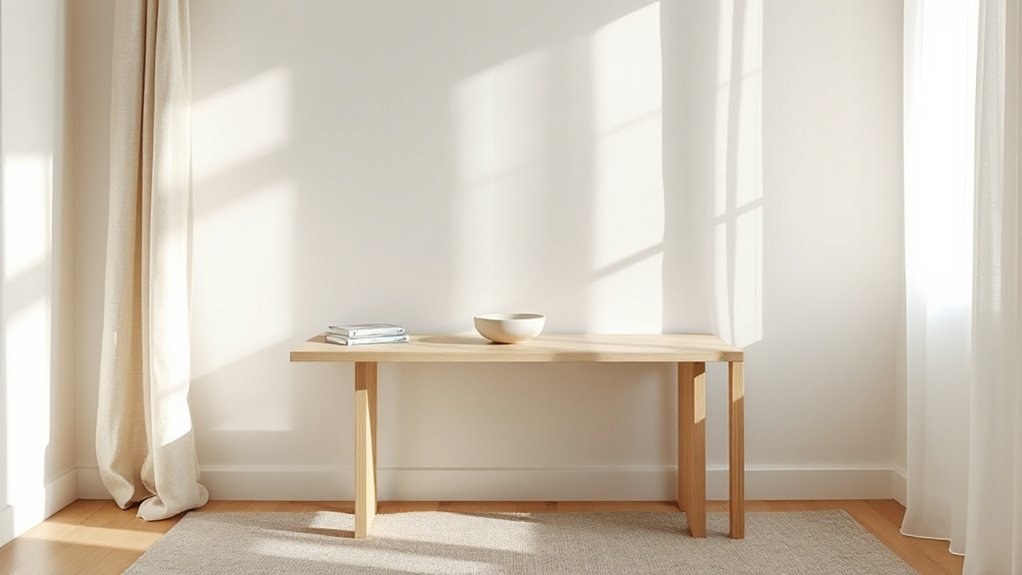
Start with one high-traffic surface you touch daily—the hall console, kitchen counter, or bedside table—and make it your quiet benchmark. Lift everything off, return only what earns its place, and reset the rest with intention.
Then keep it clear with a brisk end-of-day sweep, so the space stays practical rather rather than performative.
Choose One High-Traffic Surface
Where does clutter hit you first each day—by the front door, on the kitchen counter, or across the coffee table? Choose the surface you pass, touch, and glance at most; it sets the tone for everything that follows.
If you’re rushing out, the hall console becomes your landing strip. If you cook, the counter dictates whether you feel calm or cornered. If you unwind in the lounge, the coffee table decides if rest feels effortless.
Treat this choice as mindful decluttering, not a grand overhaul. You’re simply selecting the stage where your life performs. Look for the spot that gathers the widest mix—keys, post, chargers, half-read lists—and commit to intentional spacing there first.
One surface, well chosen, makes the whole home feel edited.
Remove, Reset, Maintain Surface
Once you’ve picked your high-traffic surface, clear it completely—yes, every key, crumb, receipt and stray cable—so you can see what you’re actually working with. Wipe it down; the act of cleaning marks a reset, not a shuffle.
Now curate what returns. Limit it to essentials that earn their place: a tray for keys, a single pen, perhaps one small vase. Everything else gets a proper home, not a nearby pile. Aim for minimal clutter and a calm line of sight; you’re designing visual balance, not staging a cupboard door.
Maintain it with a sixty-second rule. Each evening, return strays, empty the tray, and leave the surface ready for tomorrow. Space, kept.
Keep Space by Defining “Enough
Although you can keep trimming and tweaking indefinitely, space only survives when you decide what “enough” looks like. You set a boundary, not a target: one clear worktop, one chair that earns its keep, a shelf with breathing room. The moment you stop chasing perfection, you start protecting calm.
Define your non-negotiables. Choose the few objects that support how you live, then let everything else become optional. This is mindful minimalism with a backbone: you don’t just declutter, you commit.
Leave intentional emptiness where your hands need to move, where light should fall, where your eye can rest.
When you buy or bring something in, ask what it displaces. If the answer is space, it’s not enough.
Create Digital Space: Cut Inputs, Not Tools
You don’t need fewer apps; you need fewer interruptions, so mute the needless pings and keep only the alerts that earn your attention.
You can curate your information streams with intent—tighten subscriptions, trim feeds, and let a small set of trusted sources set the pace.
Then streamline your digital workflows by reducing steps, batching messages, and setting clear hand-offs, so your tools serve the work rather than siphon it.
Reduce Notification Noise
While your devices promise connection, their constant pings quietly erode your attention. You don’t need fewer tools; you need fewer interruptions. Silence non-essential alerts, and let only the truly time-sensitive ones through. Turn off banners, badges, and lock-screen previews, so your phone stops performing for you in public.
Set quiet hours that match your day’s natural rhythm: mornings for focus, evenings for ease.
Treat notification settings like a well-cut suit: tailored, not trendy. This is mindful minimalism in practice—removing noise without losing capability. Each switch you flip restores a sliver of composure, and you’ll notice your thoughts land more cleanly.
With a spacious mindset, you check on your terms, not theirs, and your attention returns to its proper owner: you.
Curate Information Streams
Once the notification din quiets down, the next leak in your attention comes from what you’ve agreed to consume. You don’t need fewer devices; you need fewer feeds. Audit your subscriptions with a cool eye: keep the newsletters that teach, bin the ones that agitate. Unfollow accounts that trade in outrage, even when they’re “important”. Choose one or two trusted sources per subject and let the rest go.
Set firm rules: no breaking news before breakfast, no infinite scroll after supper. Read long pieces on purpose, not as a reflex. This isn’t asceticism; it’s taste. By curating inputs, you protect emotional boundaries and regain Mental clarity, leaving room for your own thoughts to arrive, unhurried and intact.
Streamline Digital Workflows
If your digital day feels cluttered, the culprit is rarely the toolset itself but the constant churn of inputs and hand-offs between them. You don’t need another app; you need fewer touchpoints and cleaner routes between the ones you keep.
Start with mindful decluttering: list every step from request to delivery, then delete, merge, or automate one link at a time.
Route new work through a single intake, enforce one source of truth, and stop copying updates across channels. Use templates, saved replies, and rules so routine decisions vanish.
Apply intentional spacing by batching notifications, setting fixed check-in windows, and leaving quiet gaps for focused work.
When you cut inputs, you reclaim attention, reduce errors, and make the tools you’ve chosen feel quietly luxurious again.
Protect Your Attention With Simple Boundaries
Even though your day may look full on paper, your attention still leaks through tiny, avoidable gaps—an always-on inbox, a phone within reach, a meeting that creeps past its slot. You protect it by drawing quiet lines: check email at set times, keep notifications off by default, and place your handset in another room when you write.
Treat your calendar like a contract. Start and end on time, and decline anything that arrives without a purpose, an owner, and a decision. Use short blocks for admin, longer stretches for deep work, and leave buffers between calls.
These simple boundaries restore mental clarity and reinforce emotional boundaries: you’re available with intention, not on demand. What you omit becomes space you can actually use.
Create Space in Conversations to Listen
The same boundaries that protect your attention on the page should also shape how you show up in a conversation. You don’t need to fill every gap with commentary; you need to make room for meaning. Arrive with one intention: to understand, not to perform.
Practise active listening by slowing your responses. Let the other person finish, then take mindful pauses before you speak. Hold eye contact, keep your phone out of reach, and notice when you’re drafting a reply instead of receiving what’s said.
Ask one clean question, then stop. Reflect back the gist in plain language—“So you’re weighing X against Y”—and let them correct you. You’ll hear nuance: the hesitations, the small emphases, the unspoken priorities. That’s where the conversation deepens.
Use Silence to Handle Awkward Moments
Although awkwardness begs you to smooth it over, silence often does the cleaner work. When a comment lands poorly or a room goes oddly still, resist the urge to patch it with nervous chatter. Hold a measured beat, keep your posture open, and let your face stay neutral but attentive. Those Silent pauses give others time to recalibrate, to clarify, or to withdraw a remark without spectacle.
You don’t need to win the moment; you need to steady it. Ask one simple question, then wait. If no answer comes, nod and move on without fuss. That restraint reads as poise, not coldness.
Over time, you train emotional resilience: you learn you can sit with discomfort, and it won’t swallow you.
Create White Space in Writing So Ideas Land
Silence works because it gives people room to process; on the page, white space does the same for your reader. When you give a thought its own line, you signal importance without shouting. Short paragraphs, generous margins, and a measured pace let meaning arrive, then settle.
You’re practising mindful minimalism: not cold, but considered.
Use layout to guide attention and create clutter clarity:
- Break after a key claim so it echoes.
- Use headings that promise, then deliver.
- Let lists breathe, one idea per line.
You’ll notice readers linger longer when you stop crowding them. A clean page feels confident, almost courteous, as though you’ve made space at the table. It’s not emptiness; it’s invitation, a quiet stage for your best sentences.
Edit for Space: What to Cut First
When you edit for space, start by cutting whatever competes with the point: throat-clearing openings, repeated qualifiers, and any sentence that explains what the next sentence already proves. Keep the claim, ditch the commentary. Replace stacked adjectives with one precise noun. Swap “very” for a better verb.
Next, hunt for echoes: the same idea in two guises, the recap after the example, the scene-setting that doesn’t earn its keep. If a paragraph can lose its first line and still stand, cut it. If a quote needs a preface to sound wise, it isn’t.
Aim for Minimal clutter: fewer transitions, tighter lists, cleaner syntax. Leave Mindful pauses where meaning turns; silence can do the emphasis for you.
Frequently Asked Questions
How Do I Create Space When My Job Demands Constant Availability?
You create space by setting mindful boundaries: define office hours, use status messages, and batch replies. You’ll schedule intentional solitude daily—short walks, no-phone breaks—and delegate triage, so only genuine urgencies reach you.
Can Leaving Space Improve Relationships Without Seeming Distant?
Yes, you can; you’ll deepen trust by practising Emotional boundaries and Personal boundaries. You communicate intentions, not withdrawal. You leave pauses for listening, allow others to initiate, and return consistently, so you don’t seem distant.
What if I Crave Busyness Because Stillness Feels Uncomfortable?
You’re likely using busyness as a polite distraction from uneasy feelings. Try scheduling mindful solitude in small doses, with gentle structure. Practise silent reflection—tea, a notebook, a short walk—so stillness becomes familiar, not alarming.
How Much Space Is “Enough” for Different Personality Types?
Enough space varies: you’ll need firmer personal boundaries if you’re sensitive, looser space boundaries if you’re sociable. You can’t copy others—track irritation, fatigue, and focus; adjust solitude, conversation, and commitments accordingly.
How Do I Maintain Space During Major Life Transitions or Crises?
Keep a clear threshold like a well-kept front step: limit visitors, news, and obligations. Set mindful boundaries, schedule quiet intervals, and practise emotional detachment—observe feelings without merging. In crisis, choose one steady ritual daily.
Conclusion
You might protest you’ve no room to spare—your diary’s packed, your inbox heaves, your head won’t shut up. Yet space isn’t an extra; it’s the condition that lets everything else work. Leave a pause in a conversation and you’ll hear what you’d missed. Cut a paragraph and the point finally lands. Allow an evening unscheduled and your judgement steadies. Luxury, it turns out, is what you don’t force in.