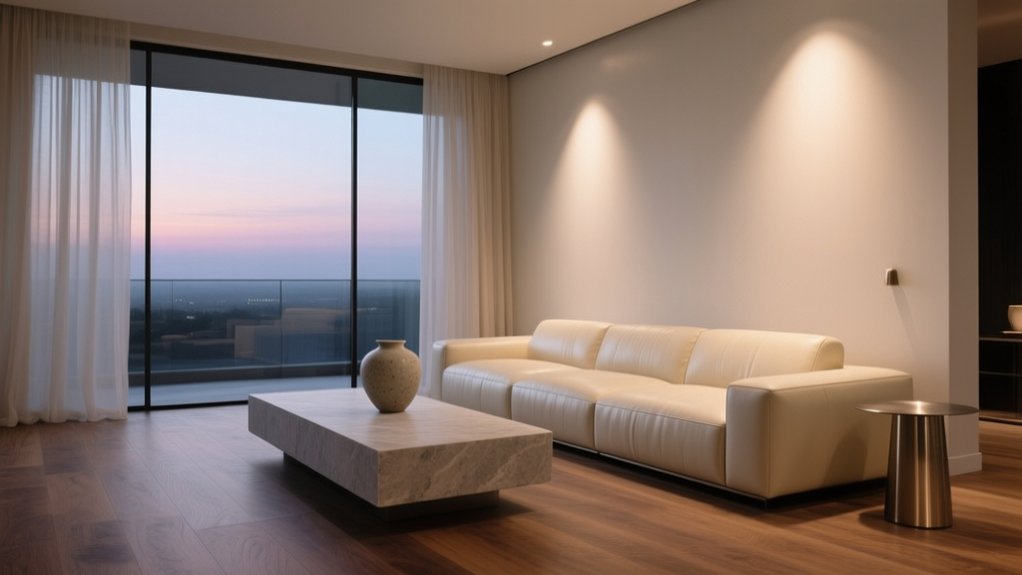

You get luxury modern by editing hard and letting craftsmanship lead. Choose quiet, tactile materials—honed stone with tight slab matching, warm rift-sawn oak or walnut, matte ceramics, and consistent metal finishes. Invest in fewer, better anchors: a tailored sofa, a solid table, and a proper bed. Keep surfaces clear, use concealed storage, and favor flush reveals and crisp shadow gaps. Layer warm, dimmable lighting (2700–3000K) for calm, costly atmosphere. What comes next shows you how.
Key Takeaways
- Prioritize restraint and craftsmanship: disciplined proportions, flawless joinery, and details like shadow gaps and flush reveals over decorative excess.
- Choose fewer, better materials: honed stone, warm woods, matte ceramics, and consistent metals to create quiet richness through texture.
- Edit hard: protect negative space, remove redundancy, and style surfaces with a tight trio—sculptural, functional, and organic objects.
- Invest in three anchor pieces: a high-quality sofa, table, and bed in enduring materials that set the room’s standard.
- Layer warm, dimmable lighting: ambient, task, and accent at 2700–3000K with high CRI to preserve shadows and elevate finishes.
Define Luxury Modern: The Quiet-Luxury Essentials
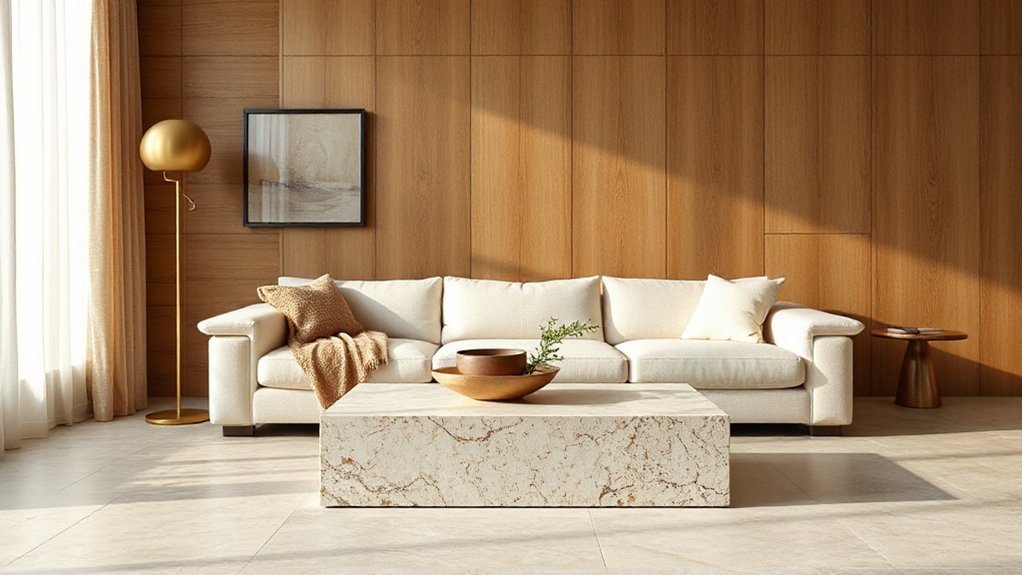
Although trends cycle fast, luxury modern holds its ground by prioritizing restraint, craftsmanship, and performance over display. You define it through disciplined proportions, impeccable material selection, and a palette that lets texture do the talking.
Luxury minimalism isn’t emptiness; it’s specification: book-matched stone, tight reveals, shadow gaps, and hardware that disappears until your hand finds it. You choose fewer pieces, then demand more from each—joinery, finish depth, and longevity certifications.
Understated elegance shows up in calibrated lighting, acoustics you can feel, and furnishings scaled for circulation, not spectacle. You anchor the room with quiet icons, add tailored textiles, and keep sightlines clean so every surface reads intentional.
The result feels calm, costly, and inevitable.
Do a Luxury Modern Edit: 5 Rules to Declutter
Now you’ll do a Luxury Modern edit by prioritizing statement essentials—pieces with superior materiality, proportion, and purpose.
You’ll curate with intent, keeping only what earns its footprint and aligns with your palette and lifestyle.
Then you’ll refine surfaces and storage, clearing visual noise and using concealed, fitted solutions to preserve clean lines and a premium finish.
Prioritize Statement Essentials
When you edit a luxury modern space, you’re not chasing emptiness—you’re curating impact. Start by identifying the few pieces that do the heavy visual and performance lifting: a sculptural sofa, a monolithic stone table, a single oversized artwork. Build around them with Minimalist color palettes so form, texture, and proportion read first, not noise.
Next, tighten your plan with Functional furniture choices that earn their footprint—clean-lined seating with impeccable tailoring, concealed storage, and lighting that layers task and ambient output. Remove anything that competes at the same scale or finish; duplicates dilute luxury.
Aim for negative space that frames your statement essentials, improves circulation, and spotlights material quality. If a piece can’t justify its silhouette, craftsmanship, or utility, it doesn’t stay.
Curate With Intent
Before you remove a single item, define the intent of the room and let that directive make every decision for you. Your luxury-modern edit relies on precision: keep fewer pieces, but make each one visually inevitable.
Follow five rules: edit by function, edit by proportion, limit duplicates, honor negative space, and align everything to a disciplined Color palette. If an object doesn’t support the room’s purpose or elevate the composition, it goes.
- Anchor the view with one sculptural hero piece
- Pair two supporting forms that echo its geometry
- Add Personalized accents in a single, controlled note
- Leave deliberate breathing room so silhouettes read cleanly
You’ll end with a curated narrative, not a collection—high-end, calm, and confidently intentional.
Refine Surfaces And Storage
Once you’ve defined the room’s intent and edited the big pieces down to a disciplined set, the next level of luxury-modern control happens at the surfaces and inside the storage.
Start with Surface refinement: clear every tabletop, then return only a tight trio—one sculptural object, one functional piece, one organic element. Align edges, center groupings, and keep negative space intentional. Standardize finishes: repeat one metal tone, one wood tone, and one matte ceramic to reduce visual noise.
Next, upgrade Storage solutions. Assign categories, not drawers: daily-use, weekly-use, archived. Use fitted inserts, lidded boxes, and vertical file rails so everything has a precise home. Hide chargers and remotes in dedicated trays. Maintain a “one in, one out” rule to protect the edit. Recalibrate weekly.
Pick Quiet Materials (Stone, Wood, Metal, Plaster)
You set the tone with natural stone that reads refined rather than loud—think quiet veining, honed finishes, and tight slab matching.
You warm the composition with wood grain that’s consistent and intentionally scaled, then keep hardware and trim understated in matte metal.
You complete the envelope with plaster for a soft, light-catching surface that reduces glare and makes the details feel intentional.
Natural Stone Subtlety
Although luxury modern interiors often lean on bold forms, they read more refined when the material palette stays quiet and tactile. You achieve that restraint by specifying stone with controlled veining, honed finishes, and disciplined edge profiles.
Let marble elegance show in a calm slab, not a busy bookmatch, and rely on granite durability where wear demands it, keeping sheen low and joints tight. Detail the progression so stone feels intentional, not loud.
- Honed marble on a vanity with a 2 mm reveal to shadow the edge
- Leathered granite on a kitchen run, eased corners, minimal overhang
- Limestone slabs at the hearth, aligned grain, thin-set, clean returns
- Travertine tile in a bath, filled finish, tight grout, flush thresholds
Warm Wood Grain
When the stone stays restrained, warm wood grain can carry the room’s comfort without softening its modern edge. You get a quieter luxury by selecting rift-sawn oak, walnut, or smoked ash with a low-sheen finish that reads tailored under daylight and controlled lighting.
Keep grain direction consistent across millwork, wall panels, and flooring so the envelope feels intentional. Specify tight, book-matched veneers on large planes, and reserve bolder cathedral grain for smaller moments where you want movement.
You’ll protect the clean lines by detailing flush reveals, minimal pulls, and crisp shadow gaps. Choose warm undertones that bridge stone’s cool cast, building natural warmth and a cozy ambiance without adding extra decor.
Finish with durable sealers to prevent blotching and maintain color fidelity over time.
Matte Metal And Plaster
Warm wood grain sets the baseline for comfort; matte metal and plaster keep the palette quiet while sharpening the modern profile. You’ll get restraint with edge when you specify low-sheen metal finishes against hand-troweled plaster textures.
Keep junctions crisp, tolerate micro-variation, and let light do the styling—raking daylight reveals depth without busy patterning.
- Brushed blackened steel pulls that read soft, not shiny
- Satin nickel trim aligned to tight, even reveals
- Lime plaster walls with subtle burnish and clouding
- Cast plaster niches that hide LEDs and soften glare
You should pair these materials with minimal grout lines and concealed fasteners, so the details feel engineered. Maintain consistent sheen levels, and you’ll avoid visual noise while still delivering high-end tactility.
Buy Fewer, Better Anchor Pieces (Sofa, Table, Bed)
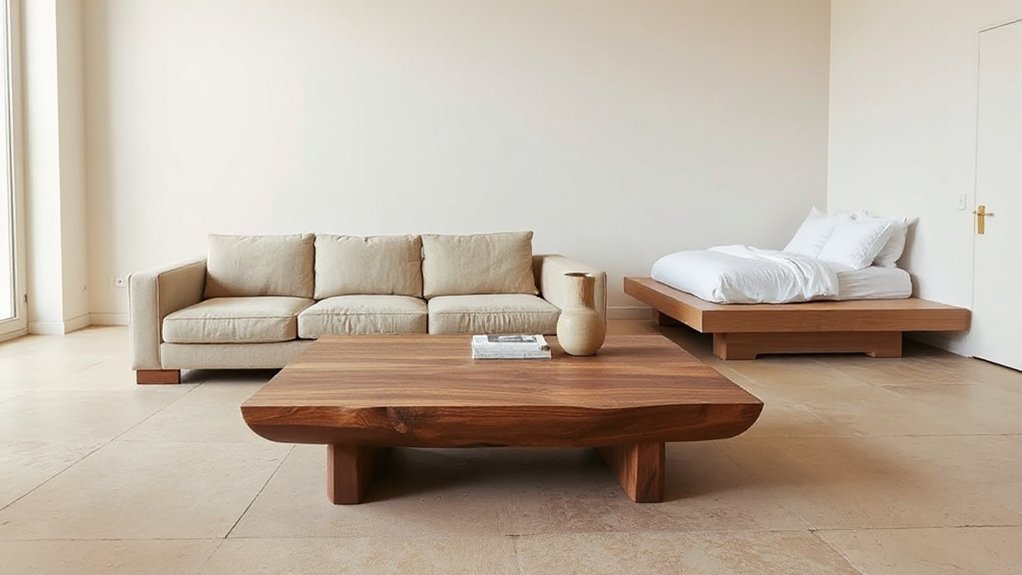
If you want a luxury-modern room to read as intentional rather than expensive, you can’t scatter your budget across dozens of mid-tier pieces. Instead, invest in three anchors that define scale, proportion, and circulation: a sofa with disciplined lines, a dining or coffee table with architectural presence, and a bed that reads like a tailored volume.
You’ll get luxury modern aesthetics by prioritizing high end material selection where touch matters most—full-grain leather or tightly woven wool, solid hardwood or stone tops, and powder-coated or brushed metal bases with clean welds. Specify durable performance fabrics, high-resilience foam, and kiln-dried frames.
Choose neutral, low-contrast palettes so the forms lead. Then keep supporting pieces minimal, letting negative space act as the true luxury.
Layer Warm Lighting: Ambient, Task, Accent
A truly luxury-modern room uses three lighting layers—ambient, task, and accent—to shape space with control rather than glare. You’ll layer warm lighting by specifying dimmable sources, consistent color temperature, and clean beam control, so every surface reads intentional while creating ambiance. Keep output calibrated: 2700–3000K, high CRI, and glare-cutting optics.
- Ambient: recessed or cove light washing ceilings evenly, no hot spots
- Task: precise pendants or under-cabinet lines aimed at work planes
- Accent: narrow-beam spots grazing art or architectural reveals subtly
- Control: scene presets, low-end dimming, and separate circuits per layer
When you balance these layers, you avoid overlighting, preserve shadow, and let finishes look richer without excess. Your room feels calm, not showroom-bright.
Add Texture With Rugs, Drapery, and Textiles: Sparingly
Once you’ve tuned your lighting layers and dimming scenes, textiles become the next control surface for atmosphere—adding depth without visual noise.
Start with one grounding rug that delivers textural contrast: a low-pile wool, silk-blend, or flatweave that reads quiet but feels rich underfoot. Keep the palette restrained, then let fiber do the work.
Use drapery to soften acoustics and daylight without heaviness. Specify lined linen, wool, or a subtle bouclé, hung high with precise break and minimal hardware. You’ll get a tailored fall and cleaner sightlines.
For upholstery and pillows, practice tactile layering with a limited mix: one nubby fabric, one smooth weave, one leather or suede accent. Edit repeats, avoid high-sheen patterns, and prioritize hand, durability, and performance ratings.
Style With Restraint: Scale, Spacing, and One Focal Point
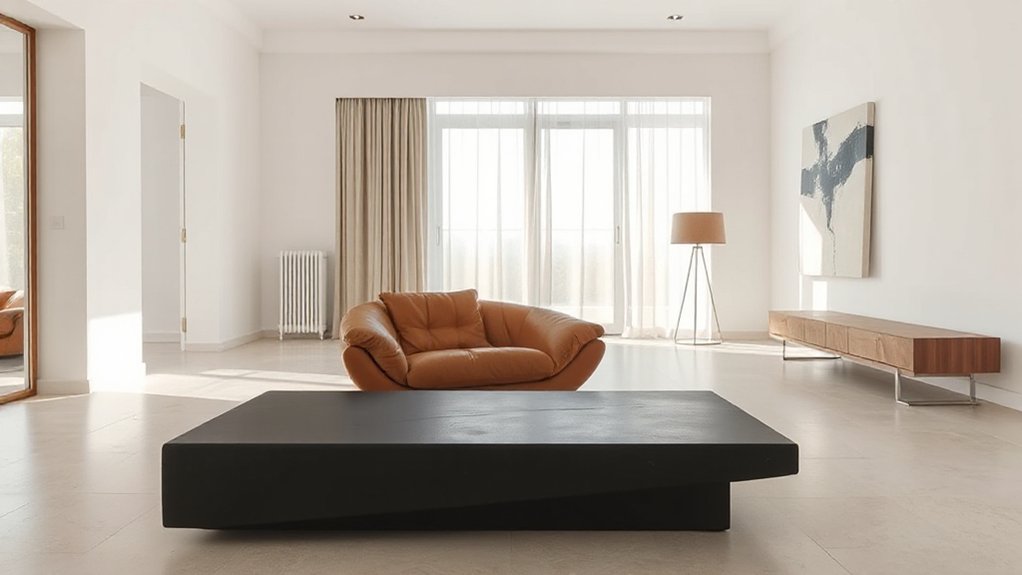
While luxury modern spaces prize simplicity, they don’t tolerate underscaled pieces or crowded sightlines. You’ll get a quieter kind of opulence by sizing for architecture, editing what competes, and letting negative space do the heavy lifting.
Anchor the room with one focal point—an art wall, monolithic stone fireplace, or sculptural lighting—then support it with disciplined Color palettes and exact furniture proportions.
- Float a sofa with generous clearances, keeping walkways clean and intentional.
- Scale tables to seat depth and arm height, so every line reads resolved.
- Limit accessories to a few museum-worthy objects, spaced like a gallery.
- Layer lighting: one statement, plus recessed and task sources to maintain calm.
You’re not decorating more—you’re calibrating.
Frequently Asked Questions
What’s the Typical Budget Range for a Luxury Modern Renovation?
You’ll typically budget $300–$800+ per square foot for a luxury renovation, depending on scope. You’ll pay more for custom millwork, premium finishes, and integrated systems that support modern design, execution.
How Do I Verify the Authenticity of High-End Materials and Finishes?
Verify authenticity by demanding chain-of-custody documentation, mill certificates, and invoices from authorized dealers—material sourcing matters. You’ll confirm finish verification with batch numbers, samples, and third-party lab tests, plus on-site inspections and warranties.
Which Luxury Modern Brands Offer the Best Long-Term Warranties?
You’ll find strong long-term warranties with Vitra, Herman Miller, Knoll, B&B Italia, and Poltrona Frau; they back premium construction and high end material sourcing. Ask about luxury brand collaborations, exclusions, and transferable coverage before purchase.
How Can I Incorporate Smart Home Tech Without Visible Hardware?
About 60% of buyers pay more for smart homes; you’ll hide tech by using in-wall sensors, flush keypads, and PoE lighting, ensuring discreet integration. Specify voice-first control and scene programming for seamless automation via concealed hubs.
What Maintenance Schedule Keeps Luxury Surfaces Looking Pristine?
You’ll keep luxury surfaces pristine with daily dusting, weekly pH-neutral Luxury cleaning, and monthly deep cleans. Seal stone quarterly, condition wood biannually, polish metals monthly, and schedule annual professional inspections to maintain Surface protection and sheen.
Conclusion
You’ve edited the noise until only signal remains, and that’s luxury modern: a space that feels like a tailored suit, not a costume. You choose stone, wood, metal, and plaster as your steady grammar. You invest in fewer anchor pieces that hold the room like a keystone. You layer warm light—ambient, task, accent—so evenings read softly. You add texture with restraint, and you let one focal point land.