Hand-carved natural stone defines luxury interiors with tactile texture, precision, and a timeless narrative. You’ll see artisan craftsmanship in edge precision, deliberate relief, and patina that signals age and authenticity. Combine stone with warm wood, subtle metal accents, and layered lighting to reveal depth, shadows, and intrinsic vein patterns. Plan for durable, low-maintenance finishes, and think about outdoor integration, custom pathways, and sculptural walls. If you keep exploring, you’ll uncover how to apply these principles across spaces.
Why Hand-Carved Stone Elevates Luxury Interiors

Hand-carved stone instantly signals luxury through its craftsmanship, texture, and unique character. You engage with a material that speaks through form, depth, and subtle irregularities, revealing the artisan’s precision and control. The technique creates tactile variation and refined shadows, enhancing both function and aesthetics in your spaces.
Its permanence underpins luxury by offering longevity, low maintenance, and resistance to wear, ensuring a lasting impression. Historically, stone carving has linked material value to human skill, reinforcing perceived worth in interiors.
You benefit from a direct expression of expert handwork, not mass production. Cultural symbolism attaches meaning to motifs and patterns, enriching narrative layers within a room.
The combination of Historical significance and Cultural symbolism elevates status, communicates legitimacy, and aligns your environment with curated, timeless design principles.
How to Choose Stone: Marble, Limestone, and Beyond
When choosing stone for luxury interiors, start by aligning material properties with function, aesthetics, and maintenance expectations. You’ll compare hardness, porosity, and stain resistance across marble, limestone, and alternatives like basalt or quartzite, then match them to locale and use.
Marble offers refined veining but demands protection against etching and moisture; limestone provides softer textures with lower reflectivity but requires careful sealing. Beyond traditional options, consider engineered stones for consistency and improved durability.
Evaluate installation impact, lifecycle costs, and environmental impact, including quarrying practices and transport efficiency. For stone preservation, plan preventive measures: coatings, regular sealing schedules, and controlled humidity.
Finally, translate performance into spatial narratives—lighter stones for airy surfaces, darker options for statement features—without compromising longevity or indoor air quality.
Hand-Carved Fireplace Mantels as Timeless Focal Points
A carved fireplace mantel elevates a room by combining artistry with structural intent, turning a functional heat source into a lasting focal point. You select hand-carved stone to guarantee durability and a refined silhouette that endures through trends.
The mantel’s profiles—breves, cavetto, lapidary detailing—translate stone’s natural texture into architectural articulation, preserving craft integrity. Historical significance informs design decisions, linking your space to artisanal lineages and regional quarry traditions.
Cultural symbolism emerges in motifs that resonate with the home’s narrative, from heraldic emblems to nature-inspired reliefs, conveying meaning beyond aesthetics.
Precision in carving ensures load-bearing compatibility, firebox clearances, and seamless integration with surround materials. When installed correctly, the mantel becomes a timeless anchor, balancing heat efficiency with commemorative resonance.
Sculpted Feature Walls for Texture and Light
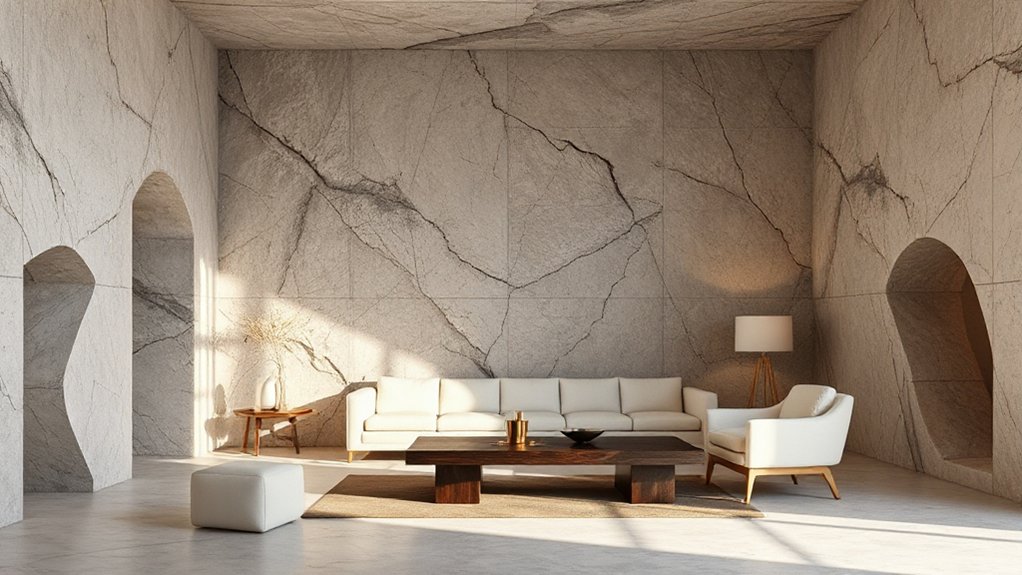
Sculpted feature walls transform a room by trading flat surfaces for tactile depth and controlled illumination, leveraging reliefs, textures, and architectural geometry to shape perception. You guide the eye along purposeful plane shifts and carved profiles, creating a disciplined rhythm that influences light distribution and shadow modulations.
Select stone variations with deliberate grain, veining, and relief depths to establish Textural contrast across zones, defining focal points without overwhelming the space. Implement lighting integration through recessed fixtures and grazing accents to amplify sculptural contours and mineral nuances.
Guarantee Color harmony by pairing stone tones with adjacent materials and fixed color palettes, avoiding chromatic clashes. Precision in milling, joint integrity, and sealing preserves the surface’s tactile and luminous fidelity, delivering enduring, gallery-grade wall sculpture within a living environment.
Soft, Undulating Stone Surfaces Underfoot and Overhead
Undulating stone surfaces beneath your feet and overhead redefine spatial perception by introducing tactile curvature that guides movement and light. You explore how soft, continuous planes translate weight distribution into a perceived flow, while controlled shadows emphasize form.
This approach leverages natural textures and artistic craftsmanship to create cohesive environments, balancing durability with refined tactility. Precision fabrication ensures seamless joints and consistent curvature, essential for safety and comfort in both floors and ceilings.
Surface treatments reinforce color depth without glare, preserving legibility of architectural lines. The result is a refined, legible hierarchy where stone read as both sculpture and substrate.
- Material selection aligned with ambient lighting
- Precision-curved milling for consistent radii
- Low-reflectance finishes to enhance texture
- Seamless junctions between planes
- Maintenance strategies honoring long-term wear
Tactile Details: Edges, Inlays, and Heirloom Craft
Edges speak volumes through precise milling and restrained curvature, shaping tactility as a core design language.
Delicate inlays, executed with high-contrast materials and exact fit, elevate surface narrative without compromising durability.
Timeless heirloom craft is defined by consistency, provenance, and the disciplined integration of technique into everyday luxury.
Edges That Speak Volumes
Edges communicate intent through contrast and tactility. You’ll shape spaces where profiles define precision, and corners read as deliberate statements rather than accidents. In this progression, the edge becomes an instrument of clarity, anchoring the modern minimalist aesthetic with robust, measured geometry.
Use eco friendly materials to guarantee sustainability while maintaining a refined silhouette, and select stone with plane integrity that echoes architectural balance. The tactile payoff emerges in subtle chamfers, rounded transitions, and controlled bevels that invite touch without compromising durability.
Mastering edge treatment elevates perceived value, enabling heirloom craft to endure through generations.
- Precise chamfers enhance light catch and grip
- Flat, uninterrupted planes convey restraint and sophistication
- Gentle radii reduce wear, extending life
- Inset details emphasize craft over ornament
- Material choices align with eco friendly materials principles
Delicate Inlays, Timeless
Delicate inlays redefine tactile language in a space where edges already set the tone. You approach hand‑carved stone as a dialogue between surface and restraint, where inlays punctuate grain with precise geometry.
The technique emphasizes controlled contrast, ensuring that botanical patterns read clearly against the stone’s natural veining, rather than overpowering it. You select color palettes that harmonize—stone’s warmth balanced by cool accents or restrained earth tones—so the inlay serves as a measured accent, not a distraction.
Precision is essential: tight seams, flush surfaces, and consistent depth preserve legibility and durability. You document tolerances, tool marks, and finish choices to guarantee repeatability across slabs.
In this discipline, timelessness arises from deliberate proportion, refined craftsmanship, and the disciplined integration of texture, pattern, and material.
Heirloom Craft Narrative
The heirloom craft narrative centers on how tactile details—edges, inlays, and time-honored technique—translate touch into lasting value. You engage with stone’s texture and the precision of carved edges, recognizing how each contour conveys durability, story, and ritual. Ancient techniques inform every measure, yielding consistency across generations.
Inlays prove culturally symbolic, linking motifs to shared memory and provenance. You assess craft as a system: material, method, and meaning operating in unison to endure.
- Edges that invite touch, resisting wear through geometry and polish
- Inlays that encode motifs, referencing lineage and place
- Tool marks preserved as evidence of process, not imperfection
- Patina development signaling age and authenticity
- Cultural symbolism woven into form, enhancing resonance
Integrating Stone With Wood and Metal for Warmth

Stone and wood pairings create immediate warmth by distributing natural textures across surfaces.
Meanwhile, steel or bronze accents heighten contrast without overwhelming the palette.
This fusion leverages Stone-Wood Warmth Fusion to ground spaces and Metal Accents Elevation to sharpen architectural lines.
Consider how each material’s grain, color, and finish interact to sustain a refined, cohesive luxury aesthetic.
Stone-Wood Warmth Fusion
- Stone textures inform the palette and surface behavior.
- Wood brings warmth, texture, and scale.
- Metal accents provide restraint and structure.
- Craftsmanship emphasizes precision and finish.
- Spatial rhythm balances heaviness with air.
This approach requires deliberate material hierarchy, precise jointing, and authentic craftsmanship to guarantee cohesion and longevity.
Metal Accents Elevation
Integrating metal accents with stone and wood elevates the perceptual balance, reinforcing warmth without sacrificing structural clarity. You’ll apply precise elevation techniques to create harmonious contrasts that read as intentional design rather than decor.
Metal accents should be selected for subtlety: brushed or satin finishes, low-reflective tones, and clean profiles that emphasize material honesty. In junctions, align metal with stone planes to guide visual flow and reduce perceived weight.
Use metal inserts in shelving, fireplace surrounds, and cabinetry hardware to reinforce a cohesive hierarchy. Vary thickness and texture deliberately to avoid monotony, ensuring joints remain crisp under natural light.
This approach maintains durability while enhancing tactile richness, delivering a refined, modern warmth with disciplined, engineering-minded execution. Metal accents provide durable focal points, and elevation techniques anchor spatial rhythm.
Color, Veining, and Pattern That Define Your Palette
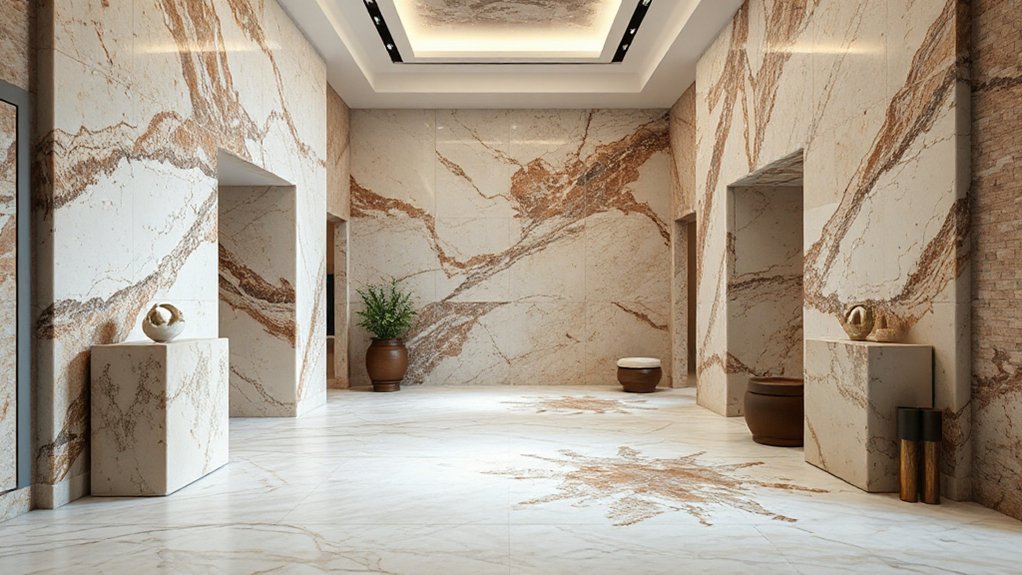
Color, veining, and pattern establish the defining palette for luxury interiors, guiding material selection and cohesive design decisions. You’ll leverage color psychology to evoke mood, balance contrast, and anchor spaces, while veining symbolism communicates lineage and exclusivity. Pattern interplay determines rhythm, scale, and visual flow across surfaces, ensuring harmony with architectural lines.
- Assess color zoning to modulate light and perception
- Align veining direction with architectural cues
- Contrast bold patterns with restrained textures
- Pair warm minerals with cool undertones for balance
- Curate consistency through repeating motifs
This approach yields legibility across areas, enabling informed material choices and durable, sophisticated results that resist short-term trends. You’ll achieve a cohesive luxury aesthetic by translating natural stone traits into purposeful, measurable design decisions.
Indoor-Outdoor Stone: Patios, Courtyards, and Transitions
Indoor-outdoor stone surfaces extend the luxury palette beyond interiors by establishing durable, seamless cores for outdoor living. You design progressions that read as continuous material, minimizing abrupt changes between indoors and out.
Select stone with appropriate slip resistance, thermal stability, and color consistency to maintain a cohesive narrative across patios and courtyards. Precisely cut profiles enable tight joints and water drainage paths that vanish behind trim, preserving a polished, uninterrupted look.
For focal points, integrate garden sculptures and water features where stone conveys form and scale, ensuring reverence to surrounding landscape.
Finishes should balance tactile appeal with maintenance practicality, using sealer systems that resist staining and weathering while preserving natural veining.
Accessibility and safety considerations guide step heights, ramp integration, and edge detailing.
Customization Pathways: From Sketch to Sculpted Pieces
Customization pathways begin with a precise brief that translates sketches into sculpted pieces, establishing constraints for form, material, and finish early in the process. You then map data-driven decisions to craftable CAD models, ensuring dimensional accuracy and repeatability for hand-carved stone.
Throughout, you balance aesthetics with structural integrity, aligning artisan technique with production timelines. Focus areas include material selection, tool-compatibility, and finish sequencing to preserve texture and pattern.
- Stone preservation considerations that inform carving tolerances and sealing
- Eco friendly sourcing criteria guiding quarry selection and transport
- Tolerance planning to maintain consistency across iterations
- Documentation of surface treatments and patination
- Validation steps, including mockups, clash checks, and finish approval
Maintenance and Durability: Caring for Hand-Carved Stone

Maintenance and durability considerations for hand-carved stone begin with a practical cadence established during fabrication. You maintain surface integrity by selecting appropriate sealants and reapplying per manufacturer guidelines, avoiding over-application that can obscure Stone texture.
Daily care hinges on gentle cleaning with pH-neutral cleaners, avoiding acidic or abrasive agents that damage delicate reliefs and perceivable craftsmanship details. Protect edges and recesses from heavy impact, and use mats or felt pads under heavy objects to minimize micro-pitting.
Regular inspection targets hairline fissures, glaze detachments, and subtle patination that influence longevity. When polishing, preserve relief depth and avoid homogenizing texture; re-create the original contrast through professional refinement rather than DIY rubbing.
Document maintenance cycles; durable outcomes rely on consistent, skilled upkeep that respects the stone’s natural grain and craftsmanship details.
Lighting Strategies to Highlight Sculpted Stone
A layered lighting approach reveals the depth and contours of sculpted stone, balancing ambient, task, and accent sources to emphasize form without glare.
Sculptural accent techniques leverage directional cues and color-neutral tones to carve emphasis, maintaining a cohesive palette across textures.
Shadow play dynamics introduce controlled contrast, guiding the eye along relief and edge lines while preserving material integrity.
Layered Lighting Approach
Layered lighting is essential for showcasing sculpted stone, using a combination of ambient, task, and accent illumination to define contours, textures, and depth. You balance light quality with kelvin warmth, avoiding glare while preserving natural color.
Methodically, you align luminaires to emphasize grain and chisel work, ensuring even coverage without hotspots. You consider color rendering and contrast to preserve material integrity, supporting clear perception of form and texture.
Effective layering requires planning, from fixture selection to installation angles, then calibration for varying daylight. You also integrate color palettes and material sourcing considerations to maintain cohesiveness with the overall design identity.
- Establish ambient, task, and accent layers early
- Position grazing accents to reveal edge detailing
- Calibrate lumen output for consistent shadows
- Coordinate color temperature with stone finish
- Document color palettes and material sourcing choices
Sculptural Accent Techniques
Use grazing illumination along prominent reliefs to elongate shadows and clarify depth, then counteract with subtle front lighting to reduce harsh contrasts.
In garden sculptures, integrate linear LED strips to outline profile while avoiding hot spots; guarantee color temperature complements natural material hues.
For outdoor fountains, position uplights at base to sculpt wet surfaces and highlight carved textures, maintaining moisture safety and glare control.
Calibrate distances, beam angles, and dimming curves for consistent tone across sequences of pieces.
Document luminaire performance, assure maintenance access and durable, weather-rated construction.
Continuity with layered concepts preserves cohesive luxury.
Shadow Play Dynamics
You’ll balance spill with zoning, using tunable LEDs and dimming to maintain saturation, contrast, and color fidelity. Highlight key facets through grazing angles and low-angle uplighting to create shadow illusions that redefine form.
Pair these with cooler accents to accentuate mineral undertones and warmth for organic progression. You achieve dynamic, legible scenes that shift with perspective, ensuring permanence in daylight and nocturnal ambience alike.
- Shadow illusions through grazing light
- Light interplay with texture
- Tunable LED zoning
- Dimmed ambiance control
- Mineral hue fidelity
Space Planning: Where Hand-Carved Stone Shines Best
Hand-carved stone defines space with tangible texture and visual gravity, so effective space planning centers on flow, scale, and focal points. You map traffic patterns to avoid interruptions, guiding movement toward established vistas and seating zones without visual clutter.
Natural textures reinforce hierarchy: large, uninterrupted surfaces suggest calm, while intricate carvings create signature moments at architectural nexuses. Balance is achieved by proportioning stone panels to room dimensions, aligning joints with corners, and reserving lighter accents for balance against heavier, carved elements.
Consider acoustics; carved stone amplifies sound differently across planes, so place reverberant surfaces where you want intimacy or quiet. Artistic craftsmanship should read as a deliberate statement, not ornament; let spacing, light, and material rhythm convey refinement rather than excess.
Budgeting for Artisanal Stone Concepts
You engage a structured framework to optimize cost without compromising quality, emphasizing early budget planning and transparent tradeoffs.
- Define target outcomes and acceptable variance for stone-related expenses
- Map material sourcing options and lead times against project milestones
- Allocate contingency funds proportionate to supplier risk and inscription complexity
- Benchmark custom carving vs. off-the-shelf equivalents to balance refinement and cost
- Establish approval gates to prevent scope creep mid‑design
This approach preserves integrity, enables precise forecasting, and aligns procurement with design intent, ensuring you maintain control over cost drivers while delivering premium, hand‑carved stone experiences.
Case Studies: Luxury Homes With Hand-Carved Stone Narratives
Across a spectrum of luxury homes, case studies reveal how hand-carved stone narratives shape spatial experience, emphasizing precision in detailing, material continuity, and the cadence between sculpture and architecture. You review how artisans translate historical significance into tactile form, ensuring each element aligns with structural cues while preserving tactile legibility.
In contemporary interiors, you’ll observe stone as a storytelling medium: carved thresholds, corbels, or fireplace surrounds that guide circulation and reflect site heritage. Cultural symbolism is embedded through motifs, proportion, and finish, creating coherent reading rooms where color and texture reinforce narrative intent.
Case studies demonstrate disciplined project governance, documented workmanship, and rigorous validation of performance criteria—acoustics, durability, and maintenance. The result is a measurable escalation of perceived value driven by craft, light interaction, and spatial clarity.
Getting Started: Partnering With the Right Craftspersons
Choosing the right craftspersons sets the foundation for a luxury interior project, because skilled artisans translate vision into precise, durable realities. To start, define scope, budget, and deadlines with clarity, then vet credentials and project portfolios.
Align on standards for material sourcing, finish quality, and lead times to minimize surprises. Communication channels should be established early, with regular check-ins and documented decisions.
Evaluate potential partners for mastery of artisan techniques and sensitivity to historical influences, ensuring they can honor your design intent while adapting to site realities.
Establish written agreements detailing warranties, risk management, and escalation paths. Finally, request pilot work or samples to confirm alignment before full production.
- Qualification and portfolio review
- Artisan techniques and historical influences
- Material sourcing and finish standards
- Communication cadence and documentation
- Pilot work and phased approvals
Frequently Asked Questions
How Long Does Hand-Carved Stone Production Typically Take?
Hand-carved stone production typically takes several weeks to months, depending on size, detail, and sourcing. You guarantee stone sourcing aligns with project timelines, while carving precision remains paramount to achieve accurate patterns, textures, and flawless joins.
Is Maintenance Seen as a Luxury or Necessity?
Maintenance is a necessity, not simply luxury, since you’ll preserve finish and longevity through consistent upkeep. This luxury perception shifts when you track maintenance frequency, ensuring performance, durability, and value align with high-end expectations in your project.
Which Climates Best Suit Carved Stone Installations?
Case study: you install carved stone in a Mediterranean climate, showcasing excellent climate adaptability and long-term durability. You’ll prioritize Environmental sustainability, optimizing finishes and drainage. You assess humidity, freeze-thaw cycles, and thermal gains to guarantee dependable performance.
Can Carved Stone Be Repaired if Damaged?
Yes, carved stone can be repaired. You’ll rely on restoration techniques like color-matching fills and careful veneer repairs, while implementing damage prevention measures to avoid future issues and preserve the material’s integrity and appearance.
What Is the Resale Value Impact of Artisanal Stonework?
Resale value rises with artisan craftsmanship and material authenticity, offering a premium that outlasts trends. Like a meticulously tuned instrument, it commands higher bids; buyers trust durability, provenance, and verifiable workmanship, boosting marketability and resale confidence in refined spaces.
Conclusion
You’ll transform spaces so dramatically that guests swear the stone itself designed the room. Hand-carved natural stone isn’t just decor—it’s a statement of power, precision, and permanence. You’ll witness textures shimmer, light dance, and acoustics soften as if the room learned to breathe. With expert craft and thoughtful placement, the luxury narrative becomes yours—bold, enduring, and unforgettable. Embrace the artistry, trust the process, and let each carved detail whisper your design intelligence louder than any trend.