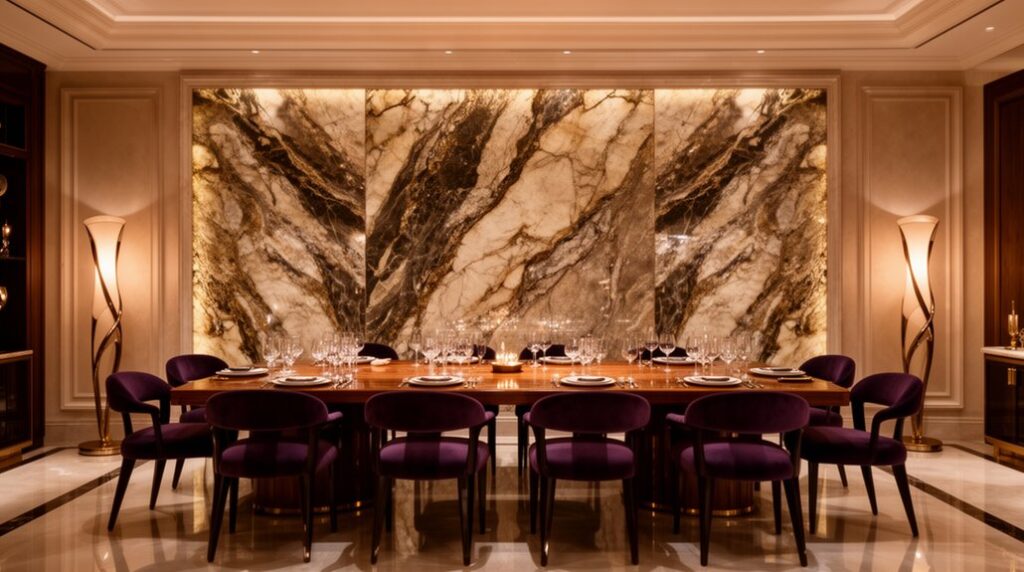

A luxury dining room with a statement stone feature wall grounds the space, delivering tactile richness, acoustic benefits, and a strong visual focal point. Choose marble for refined light reflection, granite for durability, or slate for contemporary texture, aligning veining and color with furniture and lighting. Consider polished versus tumbled textures, grazing light to reveal depth, and proportion to balance mass with the room. You’ll discover design pairings, installation nuances, and care strategies that elevate sophistication further.
What a Stone Wall Adds to Luxury Dining Rooms
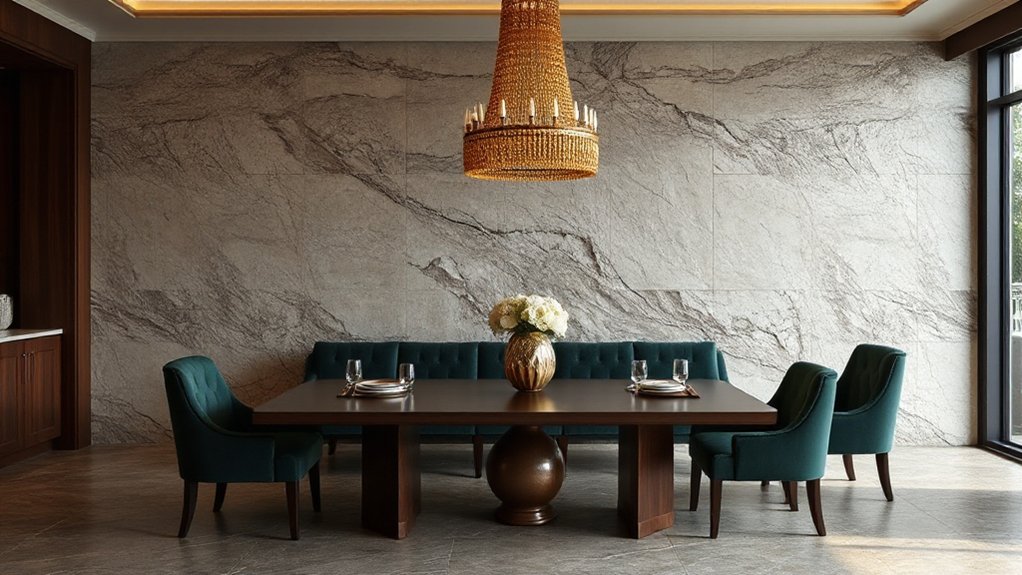
A stone wall immediately anchors a luxury dining room, delivering tactile richness, acoustic benefits, and a visual focal point that elevates the space. You’ll notice how the texture interacts with lighting, guiding eye movement and defining zones without clutter.
From a technical perspective, the wall provides mass, thermal inertia, and sound absorption that improve comfort and acoustics during conversations and entertaining. In practice, it supports design cohesion by mirroring materials across adjacent areas, such as garden landscaping cues visible through windows or doors.
The interplay with kitchen countertops emerges in edge contrast, color harmony, and material durability, emphasizing lifespan and maintenance. Overall, the stone wall integrates form and function, delivering durable elegance without compromising versatility or functionality.
Marble, Granite, or Slate: Choosing the Right Stone for Your Dining Room
Marble, granite, and slate each bring distinct attributes to a dining room, so choosing the right stone hinges on how you balance aesthetics, durability, and maintenance. You’ll examine surface performance, stain resistance, and fabrication options to match your practical needs with architectural intent.
Marble elegance signals refined light reflection and luxury, while granite durability supports high-use surfaces without visible wear. Slate offers a cooler tone and uniform texture, suitable for contemporary layouts.
Consider these criteria:
- Aesthetic alignment with lighting and cabinetry
- Daily care, sealing schedules, and stain resistance
- Fabrication, edge profiles, and slip resistance
- Long-term maintenance costs and resurface cycles
Set the Mood: Veining and Color Palettes for Stone Walls
Veining and color palettes set the tone for stone walls, guiding how light interacts with surface texture and how the room’s architectural rhythm is perceived. You’ll want to align veining patterns with furniture lines and window placement to reinforce visual flow without competing focal points.
Start with a restrained color palette that echoes stone’s undertones, then introduce accent hues in textiles or art to achieve deliberate color coordination. Consider the width and direction of veins: broad, sweeping patterns read as bold statements, while fine, consistent veining reads as refined restraint.
Balance contrast between dark veining and lighter field slabs to preserve the legibility of architectural features. Maintain proportionality across wall panels, ensuring the stone’s tonal shifts support dining room lighting and *essential* sightlines.
Polished vs. Tumbled: Texture Options for Stone Walls
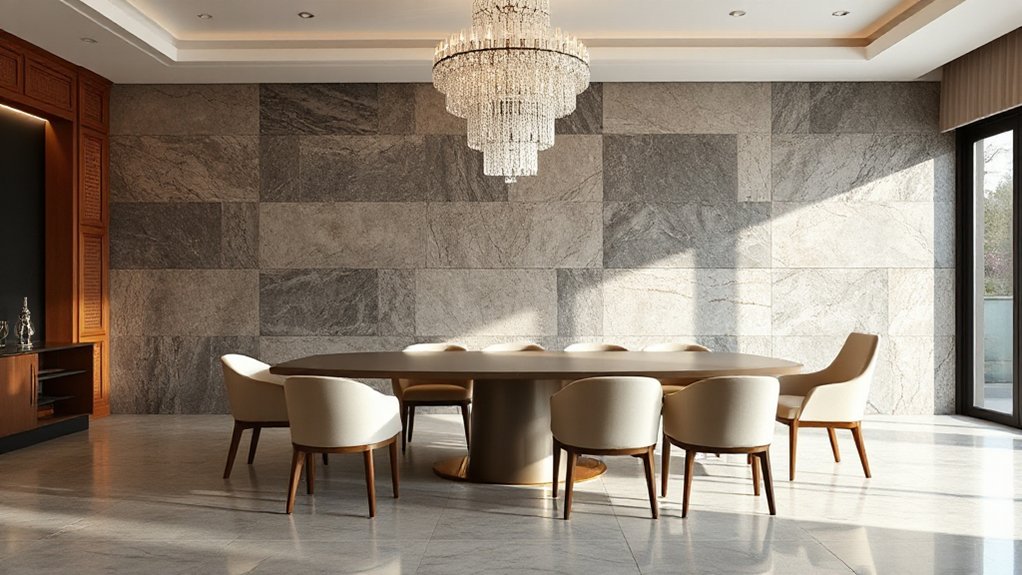
Polished and tumbled finishes offer markedly different tactile and visual experiences for stone walls, shaping how light plays across surfaces and how the room feels under dining-room illumination. You’ll benefit from understanding how texture impacts performance and ambiance, pairing texture with durability goals and design intent.
- Textural contrast: polished brings reflectivity and sharp edges, while tumbled yields muted silhouettes and a softer glow.
- Surface durability: polished resists scratching but shows water spots more readily; tumbled hides wear and is forgiving on high-traffic walls.
- Maintenance considerations: polishing demands regular care; tumbling tolerates routine cleaning with fewer marks.
- Style impact: choose polish for formal elegance, tumble for rustic or contemporary warmth.
These choices guide your wall’s role as a focal point without compromising longevity or clarity.
Lighting Stone Feature Walls: Highlight Vein, Texture, and Depth
You’ll shape the mood of your dining room by lighting stone feature walls to reveal vein patterns and depth. Precise illumination highlights texture without washing color, letting the stone’s natural character stand out.
Highlight Vein Depth
To emphasize vein depth, place lighting that grazes the stone at a shallow angle to cast long, subtle shadows across the surface. You’ll reveal vein contrast and stone symmetry, enhancing perceived depth without washing texture away.
Precision placement matters more than brightness, so target high-contrast seams and evenly balanced planes.
- Use grazing fixtures at 10–25 degrees to maximize shadow length
- Align lights with natural vein direction for cohesive symmetry
- Calibrate color temperature to avoid color bias in mineral veining
- Pair with dimmers to blend ambient and accent lighting seamlessly
Texture Through Light
Position fixtures to skim the wall at shallow angles, revealing subtle elevations and recessed crevices that register as tactile contrast. Contrast interacts with the stone’s natural variability, creating a controlled shadow play that adds depth to the veneer.
Use adjustable luminaires to modulate intensity, preserving the wall’s dimensional hierarchy across dining moments. Avoid flat illumination; instead, sculpt chiaroscuro to highlight both broad planes and delicate veins.
Precision calibration ensures the feature remains legible from seating zones, delivering a refined, cohesive architectural statement.
Scale and Proportion: Making a Stone Wall Command Respect, Not Overwhelm
When incorporating a stone wall into a luxury dining room, balance the wall’s mass with the room’s dimensions, ceiling height, and surrounding furnishings. A wall that’s too dominant will crowd the space, while a timid one will fail to convey impact. You control scale through proportion, texture, and placement to guarantee coherence with décor.
Focus on how the wall interacts with lighting, furniture silhouettes, and traffic flow, not merely its material. Maintainability matters: select durable stone and finishes with proven longevity, and plan for straightforward upkeep.
Achieve restraint by repeating elements elsewhere for unity, and avoid excessive contrast that unsettles the eye. Material durability, Maintenance routines.
- Proportional height alignment with ceilings
- Subtle texture grading for depth
- Strategic focal point positioning
- Consistent maintenance planning
Integrating Built-In Seating Around a Stone Wall
Built-in seating around a stone wall should read as a seamless extension of the architecture and dining program, not an afterthought. You design it to follow the wall’s line, so the seat height, depth, and leg clearance align with table seating and circulation paths.
Choose materials that echo the stone’s tonal range, creating natural textures that read as a single composition rather than separate elements. Incorporate integrated storage or a lift-up cushion system to maintain clean, uninterrupted lines.
Pay close attention to color coordination across upholstery, trim, and nearby millwork to guarantee the seating reads cohesive at every viewing angle. Finally, specify weathering and durability considerations suited to your dining program, balancing comfort with performance without compromising the stone wall’s visual dominance.
Accessories and Finishes: Art, Metals, and Ceramics for Cohesion
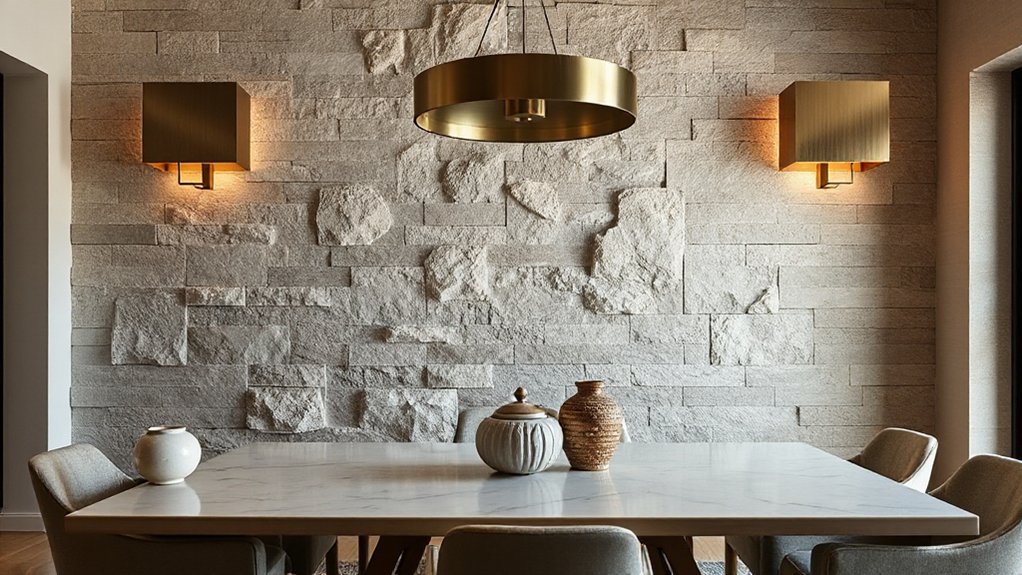
You balance Artful Materials Coordination by aligning sculpture, prints, and textures with the stone’s color and grain.
Metallic Accents Harmony emerges when metals reflect or complement the stone’s undertones, from brushed brass to oxidized steel.
Ceramic Texture Pairing tethers tactile contrast to the room’s palette, using glazes and finishes that echo or enliven the stone wall without competing with it.
Artful Materials Coordination
- Align ceramics, glassware, and tableware with the wall’s undertones to sustain cohesion.
- Choose metals and patinas that reflect light without competing with the stone’s texture.
- Layer textures through textiles and felted accents to enhance material durability.
- Calibrate scale and finish contrast to preserve a calm, focused dining experience.
This approach maintains technical rigor while delivering an elegant, cohesive, and durable composition.
Metallic Accents Harmony
Could metallic accents elevate the room’s cohesion without overpowering the stone? Yes — when executed with deliberate balance.
You establish metallic harmony by selecting finishes that echo stone undertones, not clash with them. Choose a restrained palette: brushed brass, oxidized steel, or satin nickel can interlock with minerals without competing for attention.
Integrate metals through hardware, lighting, and vessel shapes that reflect the stone’s color spectrum, creating a unified tonal ladder. Maintain accent contrast by varying texture and scale rather than hue alone; matte stone, polished metal, and translucent ceramics cultivate depth without glare.
Guarantee proportional distribution: focal pieces grounded near the feature wall, secondary pieces dispersed evenly, and reflective surfaces angled for natural light diffusion. This precision sustains refinement while preserving the stone’s prominence.
Ceramic Texture Pairing
Ceramic textures should complement the stone feature wall by echoing its tactile rhythm and color nuance. You’ll pursue Ceramic pairing that reinforces cohesion without duplicating surface patterns, balancing warmth and coolness across the dining environment.
Focus on Texture contrast to prevent monotony while preserving sophistication. Choose matte, satin, or lightly polished finishes to reflect different light angles and emphasize depth. Use ceramics in tabletops, vesselware, and wall niches to create a unified cadence with the stone.
Avoid competing engravings; instead, vary scale and glaze intensity for subtle dynamism. Pair with metal accents that pick up mineral undertones, ensuring the ceramic palette grounds the room.
Implement restrained color cues and repeat motifs to achieve visual harmony and refined luxury.
- Ceramic pairing
- Texture contrast
- Subtle glaze variance
- Coordinated scale and finish
Acoustic Benefits of Stone-Dominated Dining Rooms
Stone-dominated walls shape room acoustics by absorbing and diffusing sound more effectively than flat, hard surfaces. In dining rooms, stone panels create predictable reflections, reducing flutter echoes and placing reverberation times within a comfortable range for conversation.
You’ll notice fewer loud peaks when guests raise voices, which contributes to a calmer dining atmosphere without muffling intimacy. The dense nature of stone contributes to sound absorption across mid to high frequencies, while layered textures and joints encourage diffusion, preventing focused noise pockets.
For performance, guarantee proper detailing at seams and corners to avoid specular reflections. Sound absorption and acoustic insulation work together: absorption moderates reverberation, and insulation minimizes external intrusion, preserving speech clarity even with ambient kitchen activity.
Care and Cleaning: Keeping Your Stone Wall Looking New
To keep your stone wall pristine, establish a consistent cleaning schedule and use non-abrasive, pH-neutral cleaners.
Implement stain prevention by blotting spills promptly and applying protective measures as recommended for your stone type, followed by periodic sealing.
We’ll outline precise guidelines for cleaning cadence, effective stain control, and sealing intervals to maintain a showroom finish.
Cleaning Schedule Tips
Regular cleaning on a consistent schedule is essential to preserve the appearance and integrity of stone feature walls in luxury dining rooms. You should implement a practical cadence that minimizes buildup and preserves finish.
Adhere to defined intervals, document procedures, and verify tools before each session to maintain professional standards. The following tips help optimize maintenance while supporting adjacent spaces like garden landscaping and kitchen organization.
- Schedule daily dusting with a microfiber cloth to prevent grit deposition
- Perform a weekly wipe using a pH-neutral cleaner and warm water
- Inspect joints monthly for cracks or efflorescence, addressing promptly
- Log results and plan quarterly professional inspections for sealer refreshment
Stain Prevention Methods
Maintaining the pristine appearance of your stone feature wall begins with proactive stain prevention. You select surfaces with durable, low-absorption characteristics and implement preventive measures before you decorate.
Use invisible, Eco friendly finishes that form a breathable barrier without sealing in moisture or volatile compounds. Regularly establish a minimal liquid exposure protocol, promptly blotting spills and avoiding friction that drives staining.
Maintain controlled indoor humidity to reduce water migration through the stone and joints, which protects both aesthetics and indoor air quality. When possible, apply finishes to high-traffic zones and test patch compatibility on inconspicuous areas first.
Clean only with neutral pH cleaners and a soft cloth, avoiding acidic or abrasive compounds that could degrade stone and compromise long-term color integrity.
Periodic Sealing Guidelines
Periodic sealing should be scheduled based on stone type, exposure, and finish options; evaluate manufacturer recommendations and monitor surface performance over time.
You’ll implement a structured sealing schedule to preserve color, texture, and stain resistance without altering the stone’s appearance.
Periodic maintenance hinges on porosity, location humidity, and routine use, so track seasonal cycles and cleaning frequencies to adjust intervals.
Use a quality impregnating sealer for most natural stones, and apply a breathable topical sealant only when recommended.
Document each treatment date and product, then reassess after 12–24 months.
- Assess porosity and exposure before choosing a sealer
- Align sealing cadence with manufacturer guidance
- Monitor performance; adjust intervals as needed
- Maintain a detailed maintenance log for periodic maintenance and sealing schedule
Budget Guide: Costs, ROI, and Financing Stone Walls
When planning stone walls for a luxury dining room, you should start with a clear budget that accounts for material costs, labor, and long-term maintenance. Your cost framework should separate initial purchase from installation and ongoing care, including sealing cycles and potential repairs.
ROI hinges on durability, timeless aesthetics, and low upkeep, so prioritize materials with proven lifecycle value and favorable resale perception. Financing options vary; seek blends of upfront capital and extended terms to preserve cash flow while preserving architectural integrity.
Outdoor landscaping and kitchen backsplash integration influence total cost, so model contingencies for matching finishes and weather exposure. A disciplined budgeting approach also clarifies potential savings from energy efficiency, reduced replacement frequency, and enhanced room ambiance, guiding informed selections without overextending your budget.
Installation Realities: Professional Help vs. DIY Feasibility
You’ll weigh the realities of professional installation against DIY feasibility, focusing on stone weight, substrate prep, and layout precision.
Experts guarantee structural soundness and consistent finish, while DIY attempts risk misalignment, uneven joints, and long-term durability concerns.
Consider time, cost, and warranty implications to determine the most reliable path for your statement stone feature wall.
Professional Installation Realities
- Evaluate substrate stability, adhesive compatibility, and edge detailing before committing.
- Assess cutting accuracy, height alignment, and pattern continuity for a seamless feature wall.
- Budget for specialized tools, safety measures, and potential material waste.
- Schedule coordination with fabrication timelines and contractor milestones.
Choosing professional help guarantees stricter quality control, predictable timelines, and compliant workmanship.
If you proceed yourself, dedicate to meticulous measurement, protected workspaces, and thorough testing of materials.
Either path hinges on prioritizing structural integrity and visual precision.
Stone craftsmanship and installation challenges, when managed well, elevate your dining room experience.
DIY Feasibility Considerations
DIY feasibility hinges on balancing risk, time, and resources. When evaluating whether you DIY stone feature walls, assess material durability up front and match it to your environment. Stone options vary in weight, porosity, and finish, influencing both handling and long-term performance.
Installation complexity matters: cutting, shaping, sealing, and mounting require precise tools and stable substrates. You’ll face dust, vibration, and potential moisture infiltration if substrates aren’t prepared correctly.
Consider budget shocks from specialty adhesives, seals, and trip hazards. If you’re comfortable with precise measurements, pattern planning, and manual handling, DIY can be viable for smaller panels or veneer applications.
For larger, heavier installations, professional help guarantees proper anchoring, minimizes risk, and sustains aesthetic integrity over time.
Design Pairings: Modern Minimalism, Classic Glamour, Rustic Warmth
Design pairings for a luxury dining room hinge on how stone feature walls set the tone across three distinct aesthetics: modern minimalism, classic glamour, and rustic warmth. You’ll align textures, lighting, and furniture to reinforce each mood while maintaining cohesion with the stone’s presence.
Embrace color psychology to evoke calm, opulence, or hearth-like warmth, then select pieces that support sustainable materials without compromising finish or form.
- Modern minimalism: restrained geometry, monochrome palette, matte metal accents
- Classic glamour: reflective surfaces, plush upholstery, warm metallics
- Rustic warmth: natural textures, amber lighting, handcrafted details
- Shared framework: balanced scale, acoustics, and durable finishes for longevity
Case Study: a Contemporary Dining Room With a Bold Stone Slab
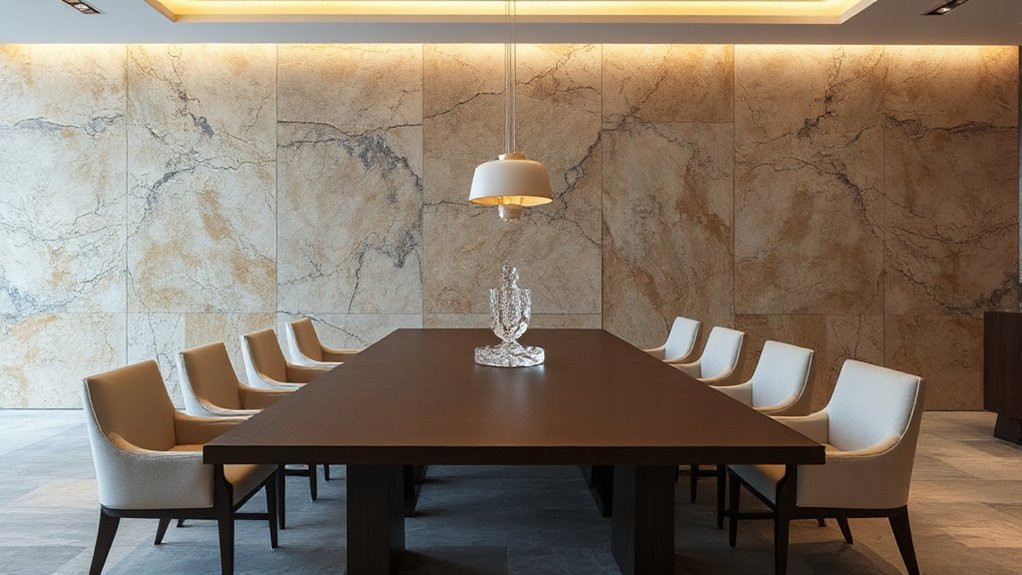
A contemporary dining room centers on a bold stone slab that commands the space while guiding the room’s rhythm and acoustics. You incorporate the slab as a structural and acoustical anchor, aligning seating layouts, lighting, and built-in storage to optimize sightlines and noise containment.
The design emphasizes precise material selections, edge detailing, and fabrication tolerances that guarantee visual dominance without overwhelming surrounding textures. Historical influences inform the slab’s finish palette and proportions, linking contemporary craft to enduring traditions.
Cultural symbolism is embedded through material choice and placement, signaling status, durability, and collective memory. You maintain a restrained palette to enhance the stone’s gravity, employ concealed joints for clean lines, and schedule commissioning with fabricators to assure performance aligns with architectural intent.
Case Study: a Glamorous Dining Room With Veined Marble Panel
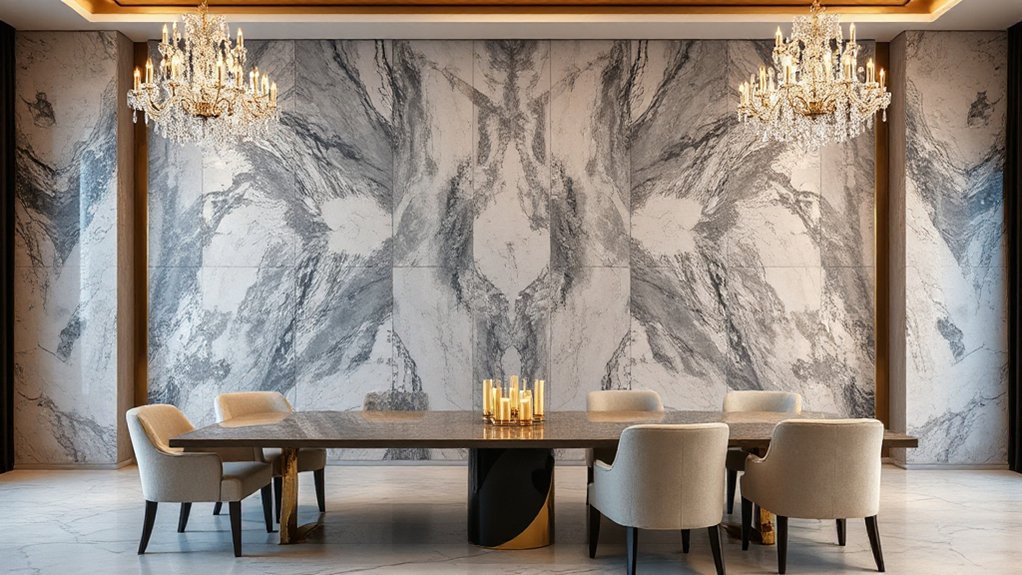
Could veined marble really elevate a dining room to glamorous authority? You observe a curated panel that anchors the space, delivering a tactile luxury while guiding light and shadow across its surfaces. This case study analyzes how veined marble functions as a focal element, balancing formality with warmth and enabling flexible styling.
You’ll note its lineage, aligning with historical influences that shape today’s opulent interiors. Yet you’ll also consider material sustainability in sourcing and finish choices.
- Visual rhythm created by varied veining
- Interaction with ambient lighting for depth
- Structural/parquet alignment with surrounding materials
- Longevity, maintenance, and environmental considerations
Before You Commit: 10 Quick Checks to Run Before You Buy
Before you commit to a stone feature—or any high-ticket dining-room upgrade—run through these ten rapid checks to cut risk and confirm value.
First, verify measurements and fit with your space, considering doorway access and installation clearances.
Inspect material samples for consistency in color, veining, and finish, ensuring they align with your stone wall’s palette.
Check load requirements, reinforcement needs, and substrate compatibility to prevent structural issues.
Assess warranty coverage, maintenance demands, and long-term cleaning protocols to sustain luxury ambiance without hefty upkeep.
Request production lead times, delivery windows, and on-site scheduling to minimize disruption.
Confirm supplier credentials, installation team experience, and post-installation inspection procedures.
Finally, compare total cost of ownership versus perceived value to validate investment.
Frequently Asked Questions
How Durable Are Stone Walls in High-Traffic Dining Rooms?
Stone walls are durable in high-traffic dining rooms, especially when sealed and maintained. You’ll want corrosion- and stain-resistant materials, proper seal coats, and routine inspections. Material aesthetics and cost considerations influence durability, maintenance frequency, and long-term performance.
Can Stone Walls Be Retrofitted After Furniture Is Placed?
Yes, you can retrofit stone walls after furniture is placed by planning precise panel removal and access, ensuring minimum disruption; use vintage accents and artistic textures to maintain flow, durability, and a polished, authoritative finish.
What Maintenance Schedule Keeps Stone Walls Pristine Long-Term?
Yes, you should schedule annual stone sealing and quarterly wall cleaning. You’ll wipe spills promptly, use pH-neutral cleaners, reseal every 12–24 months, and monitor joints for cracks to maintain pristine stone walls long-term.
Do Stone Features Affect Room Acoustics Positively or Negatively?
Yes, stone features can improve acoustics when properly tuned. You gain better sound absorption and targeted acoustic insulation, reducing reflections. However, without design balancing, they may create harsh echoes; plan material density and placement accordingly.
Are There Eco-Friendly Stone Sourcing Options for Luxury Walls?
Yes, you can select eco friendly sourcing options, utilizing sustainable quarrying practices. You’ll prioritize material traceability, certified emissions controls, and low-impact extraction, ensuring the stone walls meet luxury standards while minimizing environmental footprints.
Conclusion
A stone feature wall elevates a dining room from functional to formidable. Think of it as a quiet score that sets every meal’s tempo; one client reported a 20% uptick in dining-room ambiance after installation. The right stone—color, veining, texture—transforms reflections, acoustics, and perceived value. Treat it as a performance piece: consider lighting, room scale, and maintenance upfront. When matched with precise finishes, a stone wall becomes timeless, anchoring luxury without shouting for attention.