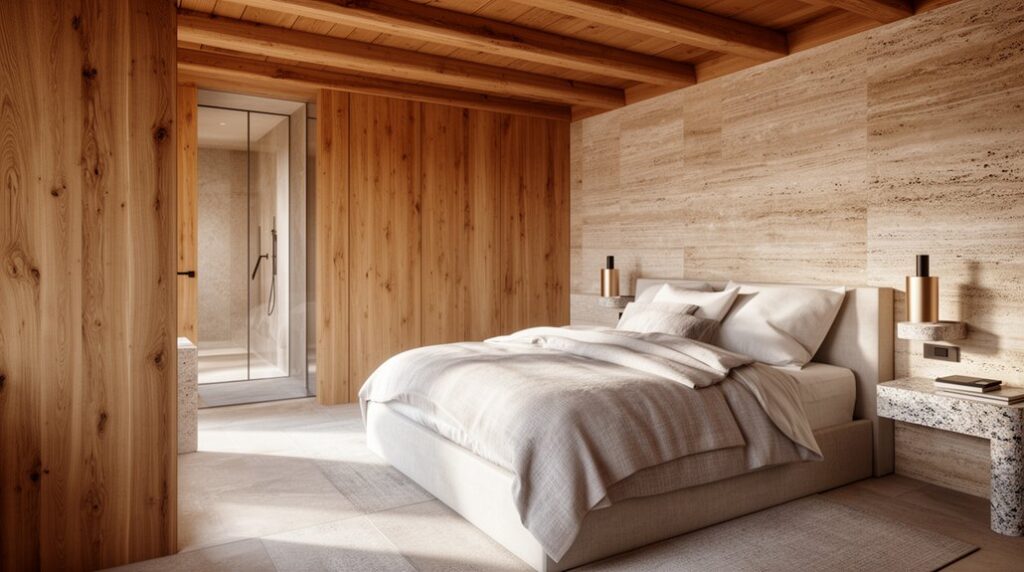

Ultra-premium spa-style rooms leverage natural materials—woods, stones, and textiles—paired with precise acoustics, temperature, and lighting control to create serene, restorative environments. Prioritize tactile warmth, low-emittance finishes, and durable textures that regulate moisture and thermal mass. Use layered lighting, circadian cues, and soft soundscapes with mass and absorption to sustain whisper-quiet zones. Implement biophilic textures, subtle botanical motifs, and sustainable sourcing for longevity. If you continue, you’ll uncover how to materialize these principles into your space.
Designing Ultra-Premium Spa Rooms: Core Principles and Goals
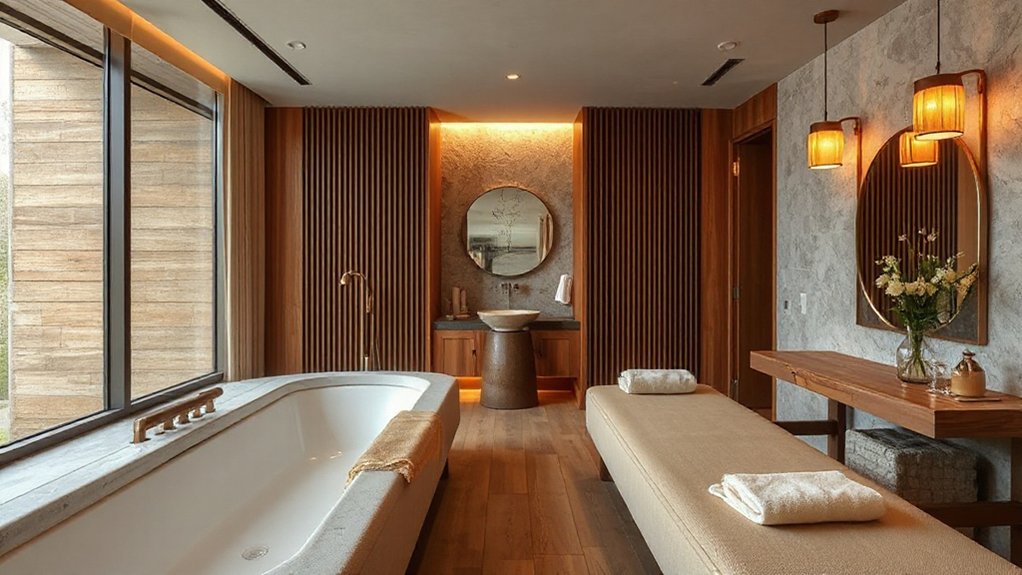
Designing ultra-premium spa rooms hinges on a clear hierarchy of sensorial goals and precise material decisions. You map objectives to sensory channels, prioritizing touch, acoustics, and thermal comfort to guide layout and finishes.
Start with ambient quiet, then light modulation, scent, and water interface clarity. Material selections emphasize low-void materials with stable thermal masses, moisture resistance, and rich tactility.
You implement a controlled progression between exterior and interior, leveraging outdoor architecture to blur boundaries without compromising enclosure performance. Spatial zoning aligns private rituals with service flow, ensuring minimal disruption to adjacent functions.
Technological innovations enable precise climate control, air quality, and automation, reducing manual inputs while preserving tactile integrity. You evaluate maintenance, durability, and lifecycle impact, ensuring sustainability alongside luxury.
Establishing Criteria: What Makes Spa-Grade Spaces Calming
Calm spa-grade spaces hinge on clearly defined criteria that prioritize human physiology and perception. You establish clarity by mapping sensory inputs to neurobiological responses, ensuring minimal cognitive load and maximal restorative potential.
Temperature, humidity, and air quality are quantified with targets that support parasympathetic dominance during dwell time.
Acoustic conditions maintain stable, low ambient noise and purposeful sound masking to reduce sympathetic arousal.
Lighting design leverages circadian cues, color temperature, and glare control to modulate melatonin and alertness.
Botanical therapies inform micro‑environment decisions, supporting skin and mucosal comfort while guiding scent strategy.
Aromatherapy integration is calibrated to avoid overload, aligning essential oil diffusion with room zones, user duration, and safety thresholds.
Measurable criteria enable repeatable outcomes and consistent spa-grade calm.
Material Priority: Natural Woods, Stones, and Textiles
Natural materials define the tactile and visual core of spa-style rooms, with woods, stones, and textiles selected for their physiology-friendly properties and low environmental impact. You prioritize material selection by performance metrics: thermal mass, acoustics, moisture management, and low emittance.
Use sustainably harvested or reclaimed wood with durable finishes, and pair with stone accents that resist microclimate fluctuations without adding volatile emissions. Textiles must offer breathability, microbiological resistance, and easy maintenance, with natural dyes or low-impact coatings.
Eco-friendly finishes should be prioritized to preserve air quality while enhancing tactile warmth. Incorporate artistic wall treatments—treated plaster, mineral paints, or fiber-backed panels—that contribute texture and depth without compromising acoustics or moisture control.
This approach enables cohesive material coordination across surfaces, fixtures, and landscape interfaces, sustaining a serene spa atmosphere.
Core Wood Selections for a Warm Spa Feel
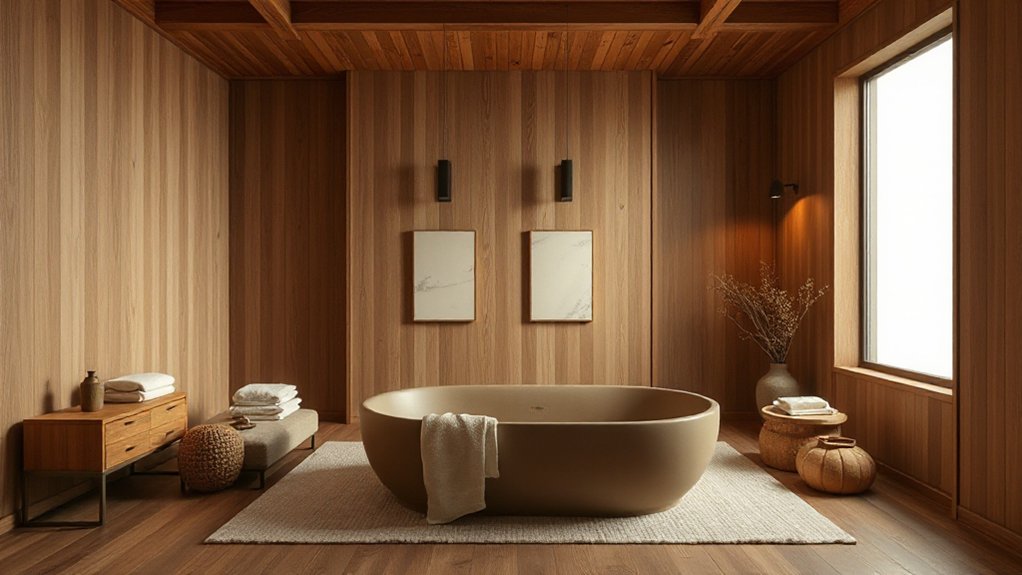
You’ll prioritize natural wood selections that balance tone, grain, and resilience to sustain a warm spa ambiance.
Concrete choices in the core woods should support the overall aesthetic while delivering durability and low porosity for humidity control.
Align these selections with the warm spa aesthetics and durable material criteria to guarantee long-term performance.
Natural Wood Selections
When selecting core wood for spa-style rooms, prioritize species with stable dimensions, low shrinkage, and natural resistance to moisture and decay. You should evaluate growth rate, density, and resin content to guarantee dimensional stability across humidity cycles.
Favor hardwoods with tight annual rings and low permeability, such as certain regional species, while avoiding excessive check-prone veneers. Stable timber contributes less cupping and warping under core panels, doors, and cabinetry, preserving a seamless spa feel.
Consider treatments that enhance decay resistance without altering appearance, and verify compatibility with fasteners and finishes used in wet zones.
Gardening tips and culinary uses may inform microclimate awareness, but select wood with purpose-built coatings. Prioritize sealing, moisture management, and consistent grain alignment to maintain a refined, enduring aesthetic.
Warm Spa Aesthetics
Favor species with medium to high oil content, which enhances finish durability and offers subtle antibacterial benefits under routine cleaning. For a warm palette, use woods with caramel, amber, or honey tones, maintaining even grain to minimize visual chatter in large stretches.
Surface treatments should emphasize matte to satin sheens, preserving tactile warmth while resisting moisture intrusion.
Integrate botanical therapies and aromatherapy sessions as experiential anchors; choose cabinetry and paneling that support concealed scent diffusion.
Guarantee ventilation and humidity control align with wood behavior, sustaining both comfort and material integrity.
Durable Material Choices
Choosing durable core woods for a warm spa environment means prioritizing species that resist moisture, maintain dimensional stability, and accept finishes evenly. You select perennials like Spanish cedar, sapele, and white oak, balancing rot resistance with workability.
Avoid excessive expansion by pairing high-density cores with stable veneers and tight grain patterns.
Confirm moisture content targets below 12% for interiors; kiln-drying and acclimation stay essential.
Finish strategies emphasize low-TOC polyurethane or penetrating oil systems that guard against humidity swings while preserving tactile warmth.
In practice, consider boards with minimal ray fleck for uniform surface; test for even sealer uptake across faces.
Integrate vintage furniture references sparingly to avoid visual conflict, and pair with botanical art that echoes natural grain.
Grounding Stone Choices: Texture, Color, and Durability
Grounding stone choices hinge on texture, color, and durability, which together establish the room’s tactile and visual foundation. You select stone types by surface finish, slip resistance, and porosity, balancing foot comfort with moisture management.
Texture guides perceptual warmth: a honed finish feels smooth under bare feet, while a tactile rock-face veneer adds depth and grip in wet zones. Color contributes to ambiance, with neutral grays, warm beiges, or subtle veining that echoes natural light dynamics and spa serenity.
Durability metrics—compressive strength, absorption rate, and attrition resistance—determine maintenance cycles and long‑term performance. Consider integration with underfloor heating and radiant panels, ensuring thermal uniformity.
Articular joints between slabs must stay plane, while consistent density supports equipment loads. Technological innovations enable pigment stability and low‑emission sealers for lasting artistic expression.
Linen and Upholstery: Calm, Durable Fabrics
Linen and upholstery in spa-style rooms bridge tactile comfort with durability, building on the grounded stone foundation by introducing soft, breathable layers that resist wear in wet hygiene zones and high-traffic seating areas.
You select fabrics with low pilling and high Martindale rub tests, prioritizing long-staple cottons, linen blends, and performance synthetics that maintain tensile strength under repeated cleaning cycles.
Treat upholstery with fiber finishes that enhance moisture wicking and stain resistance without compromising hand.
Use tight weaves, balanced pore sizes, and seam engineering to minimize snagging.
Pair textiles with vintage artwork and seasonal decor to calibrate color temperature and neutral palettes, ensuring sensory calm while preserving practicality.
Guarantee maintenance data sheets guide laundering, extraction, and periodic fabric refreshment to sustain longevity.
Biophilic Elements That Quiet the Space
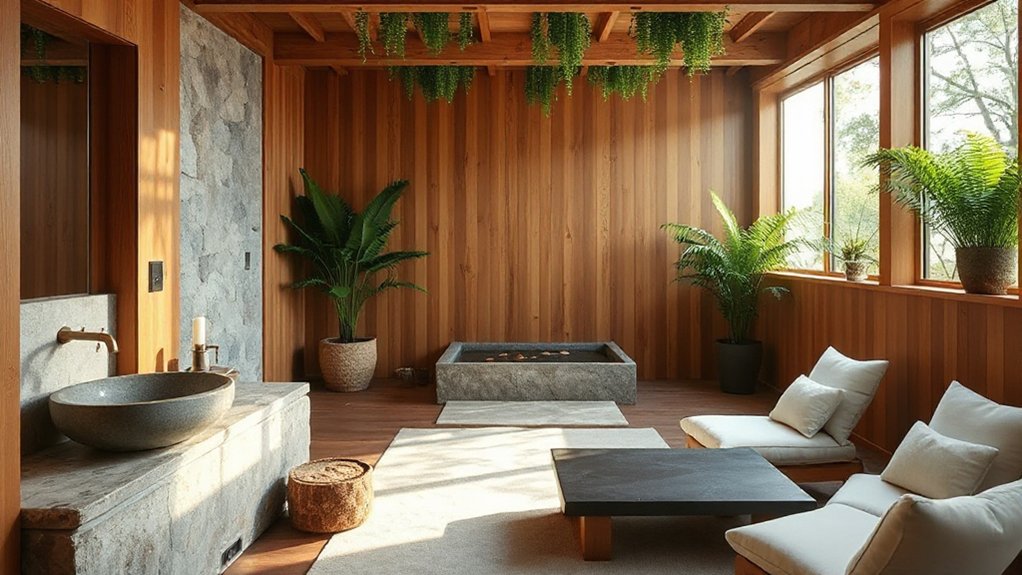
You integrate quieting natural textures with materials like linen, wool, and rattan to soften acoustics and tactile experience.
Soothing light and air are managed through layered shading, daylight filtering, and careful ventilation, reinforcing a serene biophilic presence.
These elements work together to create a spa-like calm that elevates material honesty and spatial clarity.
Quieting Natural Textures
Choose timber species with low density variance and add low-gloss, matte finishes to minimize glare and scattering. Integrate textiles with subfabric density that dampens high-frequency resonance without muffling warmth.
Use eco-friendly finishes that resist contaminants while maintaining breathability, ensuring the palette remains cohesive across walls, panels, and furniture. For wall treatments, employ acoustic paneling beneath decorative veneers to create discreet, continuous absorption.
Balance geometry with irregular edge profiles to disrupt standing waves, sustaining quietude without compromising material honesty or tactile richness.
Soothing Light and Air
Soft, diffuse daylight and carefully controlled air movement draw nature indoors without sacrificing calm. You design spaces where light is filtered through translucent screens and mineral-inflected glazing to minimize glare while preserving perception of depth, contrast, and warmth.
Light layering—ambient, task, and accent—maps to color psychology, guiding mood and perceived spaciousness without triggering visual fatigue.
Air paths employ quiet mechanicals, decoupled from structural vibrational paths, ensuring minimal draft and stable humidity.
Sound insulation strategies couple with biophilic materiality: mass-loaded vinyl within timber assemblies, perforated panels with acoustic wool, and cork battings that dampen high-frequency percussion.
You leverage natural materials to stabilize luminance, reduce noise intrusion, and cultivate a tranquil sensory baseline, supporting restorative intervals and heightened tactile perception of surface warmth.
Tactile Finishes That Elevate Texture and Comfort
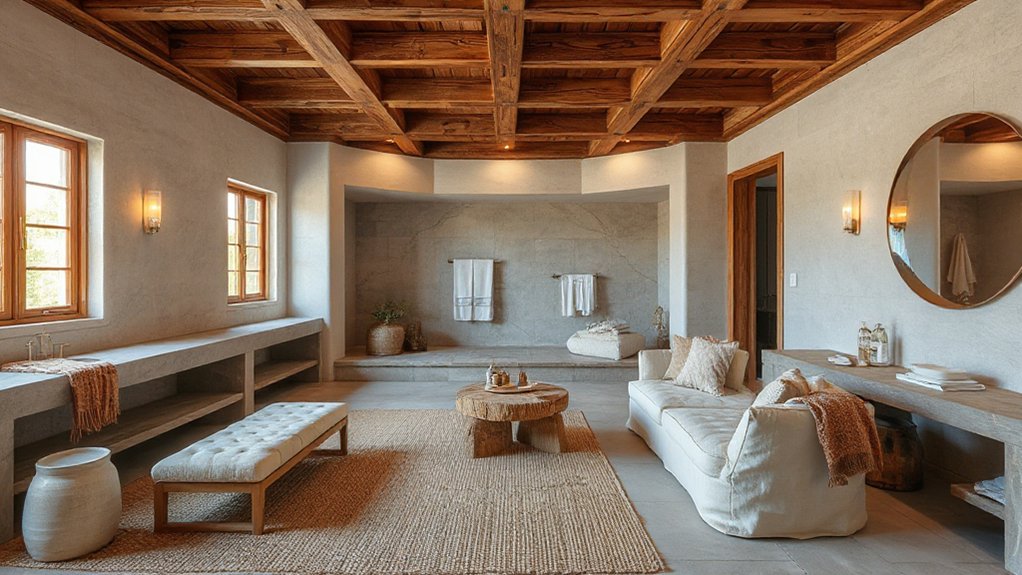
Tactile finishes add immediate texture and warmth to spa-style rooms by engaging the sense of touch as a design cue. You select materials with controlled porosity, fiber orientation, and surface topography to optimize grip, warmth, and acoustics.
Prioritize tactile hierarchy: identify dominant textures (wall panels, upholstery, millwork, flooring) and calibrate gloss, weave, and density to balance restraint with invitation. Use natural fibers—lino, sisal, wool, cork—treated for durability and allergen minimization, then pair with stone or timber for honest materiality.
Incorporate botanical illustration-inspired motifs as relief engravings or subtle embossing to reinforce nature-derived cues without visual overload. Integrate aromatherapy techniques through heat-compatible diffusers near seating zones to synchronize scent with texture, enhancing perceived softness.
Guarantee maintenance protocols preserve texture integrity and prevent smooth-surface fatigue from frequent cleaning.
Lighting for Depth, Mood, and Quiet Focus
To set depth and mood, align soft glow zoning with task-specific lighting, so you can shift from quiet focus to relaxation without abrupt changes.
Schedule natural light rhythm to follow circadian cues, using dimmers and layered fixtures to maintain visual harmony across the day.
Reserve quiet focus areas with glare-free, indirect illumination and color temperatures in the 2700–3000K range to preserve clarity and reduce distraction.
Soft Glow Zoning
How can you shape a spa-like atmosphere with lighting that guides attention and quiets the mind? You implement Soft Glow Zoning by layering low-intensity sources to sculpt depth without glare. Use concealed LED strips along coves and behind botanical artwork to create a subtle luminance gradient that recedes toward corners.
Employ dimmable fixtures with high-CRI, color-tunable options to shift from warm to neutral tones as tasks change, preserving calm. Control zones with occupancy sensors plus manual dimming for micro-adjustments during rituals.
Integrate vintage textiles and botanical artwork as luminance anchors, reflecting light softly and focusing attention toward tactile surfaces. Avoid abrupt contrasts; favor gradients, diffusion, and precise beam control to sustain quiet focus and a refined, spa-grade atmosphere.
Natural Light Rhythm
Natural light becomes the backbone of depth and quiet focus when you design with its rhythms in mind. You control luminance levels through layered daylight, wall aperture placement, and reflectance to sculpt visual weight across the room.
Use dimmable, high-CRI sources to extend light choreography beyond sunrise, aligning intensity with occupant activities and acoustic zones. Light should define pathways, emphasize texture, and carve pockets of stillness without glare.
Consider cultural symbolism when selecting daylight patterns—north-facing planes for serene coolness, warm afternoon tones to honor ritual spaces. Historical influences guide material palettes and geometry, informing brightness contrasts that echo traditional interiors yet stay contemporary.
Calibrate the balance of direct and diffuse light to support quiet focus while preserving spatial depth and tactile clarity.
Quiet Focus Areas
Recess ambient layers to create a calm perimeter glow that recedes beyond activity zones. Control color temperature for mood shifts: cooler temps for awakening moments, warmer tones for reflection.
Integrate lighting zones with architectural cues, ensuring seamless outdoor integration via weatherproof, low-profile luminaires that harmonize with wood and stone. Reference cultural influences to inform fixture forms and material pairing, balancing minimalism with ceremony.
Precision dimming, glare-avoidant beam control, and responsive scenes sustain quiet focus and spa-like immersion.
Acoustic Strategies for Whisper-Quiet Relaxation
To create whisper-quiet relaxation in spa-style rooms, implement targeted acoustic design that reduces external intrusion while shaping interior soundscapes for calm perception. You optimize comfort with purposeful layering, balancing absorption, diffusion, and isolation to sustain silence without fatigue.
- Soundproofing techniques focus on mass, sealing, and vibration decoupling to prevent exterior noise ingress while preserving room integrity.
- Acoustic panel designs employ mineral wool cores and fabric wraps, calibrated to absorb mid- to high-frequency energy without dulling comfort.
- Layout decisions place service areas and HVAC away from tranquility zones, minimizing mechanical hum and cross-talk.
- Finishes integrate soft textiles and wooden surfaces that modulate reflections, supporting clear dialogue between body, mind, and environment.
Spatial Layouts That Promote Flow and Wellness
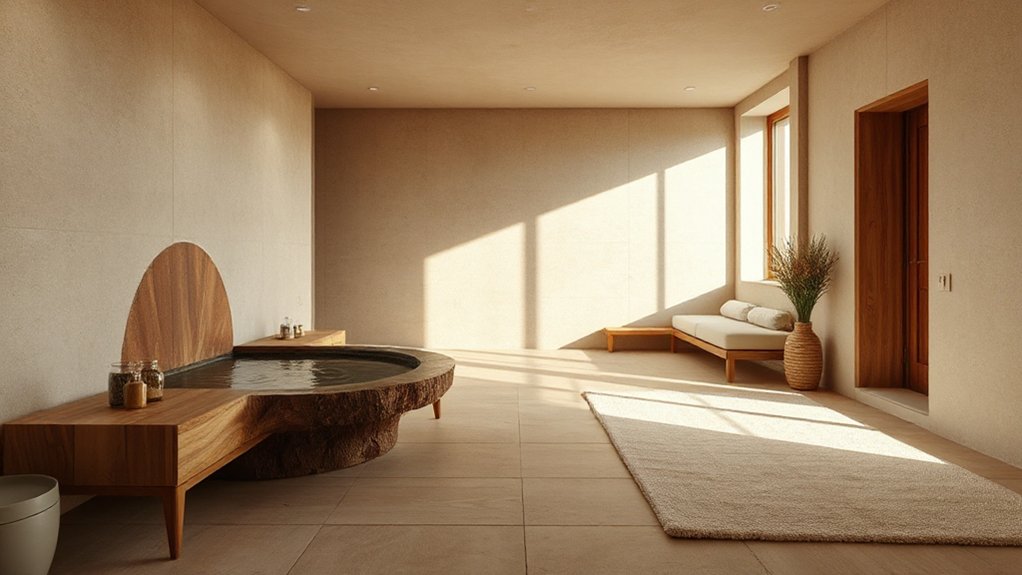
Harness flow-focused layouts to guide movement through your spa-like space, using clear sightlines, tolerant radii, and logical zoning that minimizes backtracking.
Align wellness-driven circulation with natural-material zones—stone, wood, and textiles—so passages feel cohesive and uncluttered.
Consider modular, proportionate grids that support uninterrupted rituals and intuitive wayfinding across the Flow-Focused Spatial Layouts, Wellness-Driven Room Circulation, and Natural Materials Zoning Patterns.
Flow-Focused Spatial Layouts
- Define core circulation nodes aligned to function and wellness milestones.
- Use material and lighting gradations to cue shifts between zones.
- Integrate restrained tech interfaces for seamless interaction without distraction.
- Establish auditory zoning to reinforce calm and focus throughout the space.
Wellness-Driven Room Circulation
How can wellness be engineered into every step of a room’s journey? You design circulation for biophilic rhythm, aligning entry sequences with intentional sightlines, acoustic zoning, and micro-movements that reduce cognitive load.
Flow paths prioritize gentle ambulation, with clear wayfinding, soft thresholds, and non-slip materials that shift smoothly between zones.
Core zones—preparation, cleansing, serenity, and retreat—flow in a logical progression, minimizing backtracking and sensory overload.
Vintage decor elements act as cues that ground attention without distraction, while subtle wayfinding contrasts guide you toward restorative moments.
Technological enhancements calibrate lighting, climate, and sound to physiological cues, supporting energy conservation and sleep-friendly cycles.
Materials remain tactile and breathable, ensuring comfort, durability, and measurable wellness outcomes through controlled ambient variables.
Natural Materials Zoning Patterns
Natural materials define zone boundaries and influence perception of flow by their tactile and visual cues. You shape spatial logic by pairing material properties with functional zones, ensuring seamless progression that support wellness.
Zoning patterns leverage proportion, texture gradation, and light reflectance to guide movement, reduce cognitive load, and elevate care rituals. Historical influences inform material palettes, while artistic expressions anchor atmosphere, creating a cohesive narrative across spaces.
You’ll optimize acoustic contrast and thermal inertia to sustain comfort, avoiding abrupt separations that disrupt calm. Use nonlinear circulation to encourage serendipitous discovery, yet maintain clear wayfinding markers.
Skilled detailing of joints, finishes, and substrate stability preserves longevity under spa maintenance cycles.
- Material-driven boundaries and flow progressions
- Texture and light choreography between zones
- Historical-influenced palettes with artistic accents
- Maintenance-friendly detailing for longevity
Color Systems: Harmonizing With Natural Materials
Color systems in spa-style rooms that use natural materials aren’t arbitrary; they’re derived from the inherent hues and textures of the materials themselves to create cohesive, tranquil environments.
You calibrate palettes by analyzing stone, wood, and plant-derived tones, then map them into a restrained scheme that supports material grain without competing with it. Use a primary neutral, like warm greige or stone white, as the anchor, and introduce secondary accents drawn from wood sap, mineral veining, or foliage undertones.
Lighting should reflect the palette to reveal subtleties across times of day. Implement subtle contrast through texture rather than saturation.
Integrate landscape cues in design details, such as Garden pathways, and pause points with Artistic sculptures to reinforce harmony and serenity throughout the space.
Finishing Details: Hardware, Fixtures, and Accessories
Hardware, fixtures, and accessories in spa-style rooms finished with natural materials should read as an extension of the material palette rather than as separate accents. You select hardware with brushed titanium, raw brass, or matte black ceramics to echo stone, wood, or linen textures.
Fixtures stay utilitarian in form, prioritizing subtle silhouette, seamless mounting, and moisture tolerance. Attachments should minimize visual clutter, using concealed fasteners and integrated channels for cables.
Sustainable textiles guide textile-related details, from cabinet liners to drawer interiors, ensuring tactile continuity. Artistic accents remain purposeful, not decorative; they emphasize texture and quiet color shifts without overpowering the palette.
- Hardware finishes choice aligns with material family and patina evolution
- Fixtures emphasize clean lines, integrated functionality, and moisture resistance
- Fasteners and fittings minimize visible hardware
- Textile and accessory selection reinforces tactile harmony with sustainability and artistry
Ethical Sourcing and Sustainability in Spa Materials
You’ll evaluate ethical material sourcing, ensuring every component comes from verified, traceable suppliers.
We’ll map sustainable supply chains across harvested, manufactured, and finished spa materials to minimize carbon footprint and social impact.
You’ll consider the material lifecycle—from extraction to end-of-life—to confirm responsible stewardship and long-term viability.
Ethical Material Sourcing
- Establish verification protocols for material origins and supplier practices.
- Prefer certifications and third‑party audits that align with ecological and social standards.
- Prioritize Eco friendly finishes and collaboration with Local artisans for authenticity and reduced transport.
- Maintain auditable records of batches, substitutions, and disposal, supporting long‑term sustainability.
Sustainable Supply Chains
You implement supplier scorecards that quantify carbon intensity, water use, and waste diversion, and you require commitments to continuous improvement.
Urban farming becomes a practical feeder for botanicals and materials with reduced transport emissions, while ensuring provenance documentation is transparent.
You prioritize circular design, favoring reclaimed or rapidly renewable inputs and modular components to simplify disassembly.
Digital detox considerations guide packaging minimalism and material safety data transparency.
Your strategy aligns operational efficiency with integrity, delivering spa materials that sustain ecosystems without compromising performance.
Responsible Material Lifecycle
Responsible material lifecycles in spa contexts demand end-to-end ethical sourcing and transparent stewardship of sustainability metrics. You’ll align procurement with verifiable certifications, traceability, and lifecycle assessment to minimize environmental footprints while preserving performance.
Through disciplined material governance, you enable consistent quality and responsible reuse. You’ll prioritize supplier audits, low-embodied-energy processes, and end-of-life recoverability, ensuring materials integrate safely with guest experiences.
Eco friendly finishes and biodegradable textiles become active safeguards of sustainability without compromising luxury.
- Source verification and supplier tiering with independent audits
- Lifecycle assessment integration and measurable reduction targets
- Design for disassembly, recyclability, and end-of-life pathways
- Material specification with performance, safety, and eco label alignment
Maintenance Routines to Preserve Spa-Quality Surfaces
To preserve spa-quality surfaces, establish a regular, targeted maintenance routine that prioritizes material-specific care and environmental control. You’ll implement a scheduled cleaning protocol using pH-balanced, non-abrasive cleaners compatible with stone, tile, wood, and resin blends. Wipe spills immediately and employ microfiber tools to minimize micro-scratches.
Maintain stable humidity between 40–60% and keep ambient temperatures within a narrow band to prevent warping and long-term degradation.
For stone and resin, reseal every 12–24 months or as dictated by manufacturer guidelines, ensuring uniform coverage. Use protective pads on furniture and avoid sharp-impact tools.
Document wear patterns to adjust routines, and select Eco friendly finishes to extend surface life. When refinishing, favor Organic color palettes that preserve natural aesthetics without compromising durability.
Personalization Paths: Customizing Your Spa Space
Personalization paths begin with defining your spa’s core function and ambiance, then aligning materials, lighting, and modular layouts to support that vision. You tailor textures, color temperature, and acoustic treatment to exacting standards, ensuring each zone reinforces your intent.
Aromatherapy recipes integrate with diffuser placement and scent fade rates, calibrated to session length and privacy needs. Soundscape design leverages servo-controlled speakers and isolation to create consistent tonal profiles across rooms.
Your plan uses modular panels, moveable shelving, and interchangeable finishes to maintain coherence as preferences evolve.
- Define zones by function, then standardize finish palettes and acoustic thresholds.
- Map diffuser strategies to session types, durations, and crowd density.
- Synchronize lighting scenes with aromatics and sound levels.
- Audit materials for porosity, maintenance cycles, and durability under humidity.
Smart Comfort: Temperature and Humidity Control
Achieving true spa comfort hinges on precise temperature and humidity control that adapts to occupancy, activity, and material ventilation. You’ll deploy a closed-loop climate strategy that harmonizes HVAC zoning with smart sensors embedded in natural materials, ensuring steady surface conditions and minimal air disturbance.
Target humidity ranges are maintained via adaptive dehumidification or humidification, calibrated to material porosity and spa-use cycles. Meanwhile, temperature setpoints shift subtly with occupancy and equipment heat output.
This system uses demand-based ventilation, reducing energy waste and preventing drafts that disrupt the sensory experience. Vintage decor informs thermal mass choices and finish selections, enhancing radiant comfort without compromising airflow.
Technological integration enables real-time monitoring, predictive maintenance, and seamless control through a unified interface, delivering consistent, luxurious comfort throughout the space.
Wellness Zones: Integrating Calm Activities
Wellness zones in a spa-style room should map directly to the broader climate strategy, using calibrated zones for calming activities that align with material porosity and surface temperatures. You’ll design zones around tactile prompts, leveraging natural finishes to support sustained focus and restoration.
Integrate activities that balance cognitive engagement with sensory restraint, ensuring acoustics and light reduce stress without dulling engagement. Gardening tips and Art therapy are actionable anchors for calm, purposeful routines that respect space constraints and material behavior.
Employ precise containment, ventilation, and surface conditioning to maintain air quality and temperature stability during sessions.
- Define activity boundaries and material shift for clear, repeatable routines
- Schedule gardening tips sessions with humidity-appropriate planters and filtration
- Pair art therapy prompts with low-glare lighting and sound-dampening surfaces
- Monitor user feedback to refine zoning precision and response rates
Real-World Transformations: Case Studies in Natural Rooms
Real-world transformations reveal how natural materials translate into measurable outcomes in spa-style rooms. You observe timber latency beneath barefoot steps, cork insulation reducing ambient noise, and limestone surfaces moderating heat flux, producing a stable microclimate.
In case studies, you’ll see quantified improvements: reduced perceived stress scores, faster recovery metrics, and enhanced air quality linked to low-emission finishes. Botanical infusions and aromatherapy techniques are integrated to sustain sensory coherence without overpowering the environment.
You’ll note standardized chlorophyll or resin extracts embedded in infusions that refresh air without residue, while essential oil blends are calibrated to avoid tachyphylaxis. Documentation highlights energy demand reductions from efficient glazing and passive cooling, alongside long-term durability metrics for natural materials.
Across projects, the pattern is consistent: carefully specified materials, targeted scent strategies, and measurable well-being gains.
Frequently Asked Questions
How Long Does a Spa-Grade Transformation Typically Take?
A spa-grade transformation typically takes 4–12 weeks, depending on scope. You’ll achieve luxury ambiance with precise scheduling and skilled labor, ensuring material durability and seamless integration of natural elements throughout, while minimizing downtime and maintaining quality control.
What Is the First Cost vs. Long-Term Savings Balance?
Initially, the first cost is higher, but durable materials pay off via lower maintenance and energy savings, so you’ll realize a favorable long-term balance; material durability drives savings, and a rigorous cost comparison confirms the favorable outcome for you.
Can Natural Materials Cause Maintenance Challenges?
Yes, natural materials can cause maintenance challenges. You’ll see eco friendly durability benefits, but material deterioration may require proactive sealing, periodic refinishing, and moisture control to preserve performance and aesthetic integrity over time.
Are There Regional Material Sourcing Limitations to Consider?
Regional restrictions govern sourcing challenges; you must map suppliers, timelines, and certifications to avoid delays. You’ll face regulatory carve-outs, transport limits, and material-traceability gaps, yet stabilize supply by diversifying sources, validating provenance, and aligning with local standards.
How Scalable Are These Designs for Small Spaces?
You can scale these designs for small spaces by prioritizing space optimization and material versatility, enabling modular layouts and multifunctional elements that maintain spa-grade rigor without sacrificing comfort or performance in compact footprints.
Conclusion
You can design ultra-premium spa rooms by pairing natural materials with precise, science-backed controls. Prioritize warmth and texture through woods, stones, and textiles, and frame spaces with clear zones for calm activities. An interesting stat: environments with consistent 40–50% humidity and 22–24°C feel 2–3 times more comfortable for extended stays than dry, cooler rooms. Tie in personalized touches and smart climate management to sustain calm, support recovery, and elevate perceived luxury without sacrificing performance.