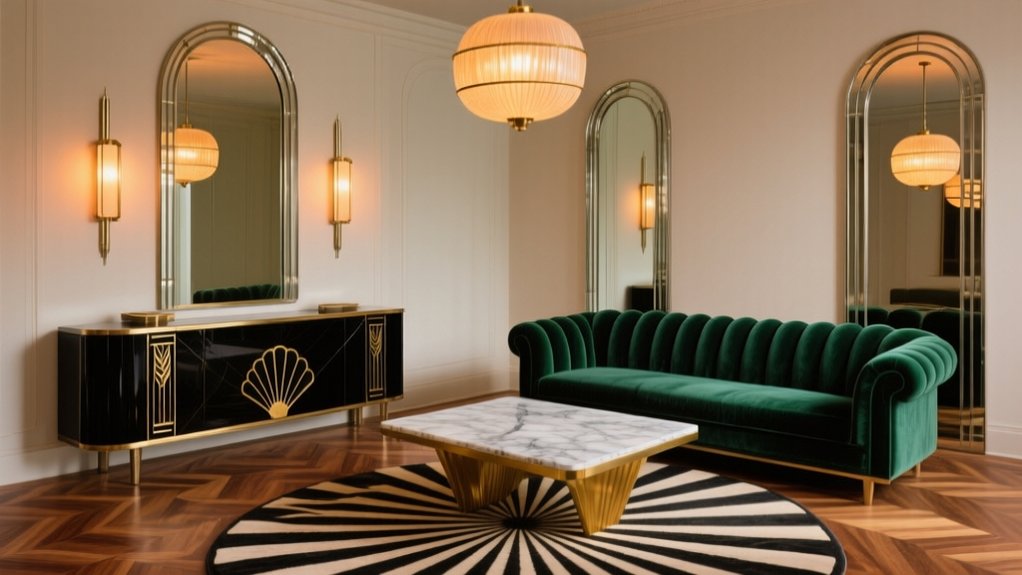

Add Art Deco elegance by committing to bold geometry, symmetry, and a tight palette: pick 2–3 core colors (black, ivory, navy) plus one jewel tone and one metallic (brass or chrome). Start with a Deco anchor like a tiered chandelier, stepped console, or velvet chair, then repeat chevrons, fans, or sunbursts in a rug, pillows, or wallpaper. Layer reflective finishes—lacquer, glass, mirrors—for glow and polish. Next, you’ll see how to apply it room by room.
Key Takeaways
- Start with bold geometry and symmetry—chevrons, sunbursts, stepped forms—using a clear focal axis like a sofa, bed, or fireplace.
- Build a disciplined palette: 2–3 core colors plus one metallic, repeating each color three times and keeping accents under 15%.
- Choose streamlined furniture with curved fronts, waterfall edges, tapered legs, and velvet or leather upholstery in rich jewel tones.
- Add statement lighting and reflective finishes—brass, chrome, lacquer, mirrors—layering warm ambient, task, and accent lighting for glamour.
- Layer Art Deco patterns and luxe textures with one statement wall or rug, then finish with sculptural objects and high-contrast framed art.
Know the Core Art Deco Hallmarks
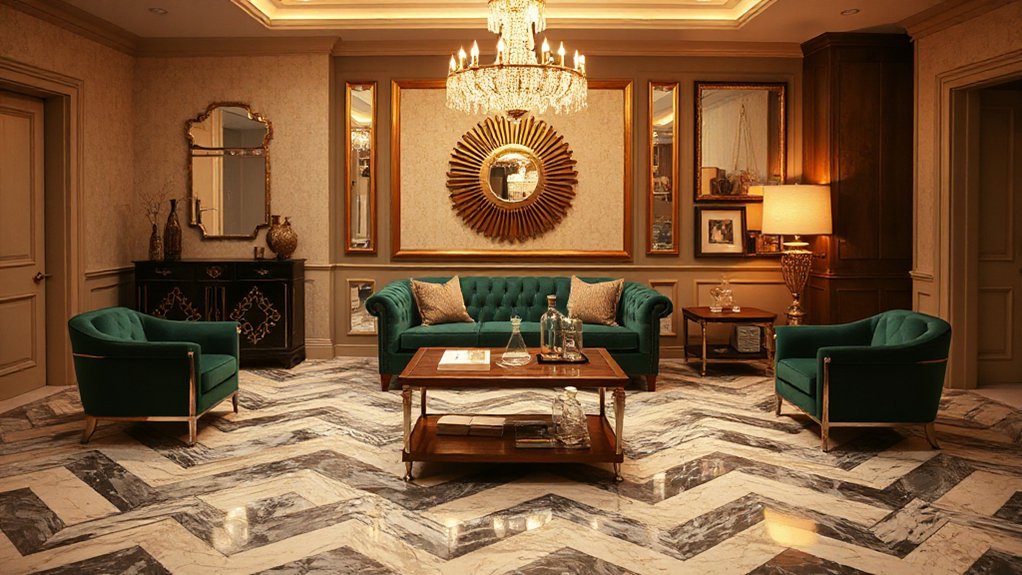
If you want Art Deco to look intentional rather than “vintage-ish,” you need to recognize its non-negotiable signatures: bold geometric shapes (chevrons, sunbursts, stepped forms), strong symmetry, and high-contrast palettes like black-and-white with jewel tones.
Prioritize streamlined silhouettes, crisp edges, and repeating motifs that read as engineered, not rustic. Use glossy lacquer, glass, chrome, brass, and marble to create that signature sheen and weight.
Keep patterns disciplined: one dominant geometry, then smaller echoes in trim, grillework, or textiles. Understand Art Deco symbolism—sunbursts signal optimism and progress; zigzags suggest speed and modernity.
Track cultural influences too: Egyptian revival, Cubism, and jazz-age glamour shaped the style’s confident, forward-looking attitude.
Start With One Deco “Anchor” Piece
Once you’ve nailed the hallmarks—geometry, symmetry, contrast, and shine—pick a single Deco “anchor” piece that sets the rules for everything else in the room. Choose something visually decisive: a stepped credenza, a scalloped mirror, a lacquered bar cart, or a bold sunburst clock. Place it on the room’s main sightline and give it breathing room so it reads as intentional, not clutter.
Then echo its shapes in supporting elements. Pull angles from the anchor into geometric textiles on pillows or a rug, and repeat its curves in a pair of matching lamps. Add wall art that nods to Vintage typography without overwhelming the focal point.
Keep proportions tight, and limit add-ons to a few high-impact companions.
Choose a Fast Art Deco Color Palette
Because Art Deco thrives on high contrast and polished finishes, you’ll get the fastest, most convincing result by locking in a tight palette of two to three core colors plus one metallic. Start with black, ivory, or deep navy as your base, then add one saturated jewel tone—emerald, ruby, or sapphire—for punch.
Choose one metallic—brass, gold, or chrome—and commit to it for hardware, lamp bases, and frames to prevent visual noise. Use Color psychology to guide the mood: navy and brass feel confident, emerald and gold read luxurious, black and chrome look crisp and modern.
For clean palette coordination, repeat each color at least three times across the room, and cap accent color at 10–15% of what you see.
Add Deco Geometry on Walls and Textiles
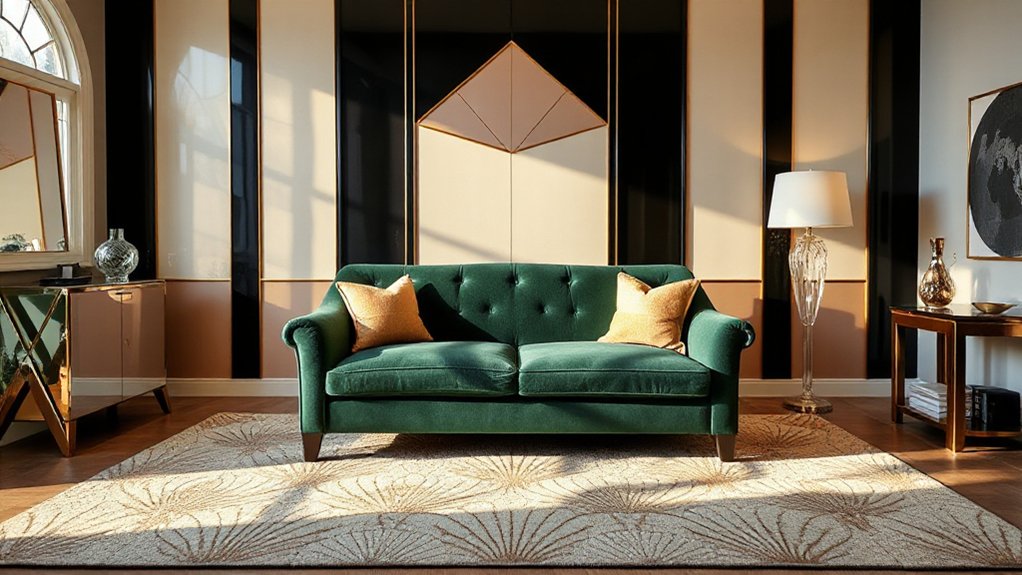
With your palette set, you can make Art Deco read instantly by layering in bold geometry on walls and textiles. Start with one disciplined wall treatment: paint a stepped fan, sunburst, or chevron panel using painter’s tape and a satin finish for crisp edges. Keep scale large; tiny motifs look busy and lose impact across a room.
Echo those geometric patterns in soft goods so the look feels intentional, not themed. Choose textile designs with high contrast and clean lines—zigzag rugs, channel-striped drapery, or scallop-patterned pillows. Limit yourself to two motif families and repeat them three times across the space (wall, floor, seating).
Balance strong pattern with solid upholstery to keep it sharp and readable.
Pick Statement Art Deco Lighting First
Start your Art Deco plan with a statement light, because it sets the room’s hierarchy instantly. Choose a geometric chandelier silhouette—stepped, sunburst, or tiered—and commit to luxe metallic finishes like brass, chrome, or polished nickel for crisp glamour.
Then layer the effect with ambient overhead light plus targeted sconces or picture lights so the space feels rich, not harsh.
Choose Geometric Chandelier Shapes
If you want instant Art Deco impact, choose a chandelier with crisp geometric lines before you add any other décor. Look for stepped tiers, sunburst spokes, octagons, or stacked rectangles—forms that echo classic geometric patterns without needing extra ornament.
Match chandelier shapes to your room’s architecture. In a square dining area, pick a boxy frame or layered cube to mirror the footprint. In a narrow hallway, use a linear fixture that repeats angles down the axis.
Keep scale disciplined: the chandelier’s diameter should sit about half to two-thirds the table width, and its bottom should hang 30–36 inches above the tabletop. Choose clear or frosted shades that sharpen silhouettes and prevent glare.
Prioritize Luxe Metallic Finishes
Geometric silhouettes set the Art Deco framework; luxe metallic finishes deliver the unmistakable polish. When you’re picking statement Art Deco lighting, treat metal choice as a design decision, not an afterthought: polished brass and champagne gold read warm and glamorous, while chrome and nickel feel crisp and architectural.
Aim for one dominant metal across your main fixtures, then repeat it on nearby hardware so the room looks intentional.
Choose Luxe finishes with high-reflectance plating or quality lacquer, and check that seams, joints, and edges look clean up close.
Use Metallic accents in restrained doses—think thin inlays, stepped caps, or banded details—so the geometry stays sharp.
If your space runs cool, favor brass; if it’s bright and modern, go chrome.
Layer Ambient And Accent Lighting
Because Art Deco thrives on controlled drama, you’ll get the most authentic look by choosing your statement fixture first—then building the rest of the lighting around it. Start with a geometric chandelier, tiered pendant, or opal-glass sconce in polished brass or chrome, sized to the room’s scale and centered on the main axis.
Then layer light with purpose:
- Set a dimmable ceiling layer for an even ambient glow that softens sharp lines.
- Add wall sconces or picture lights to create accent highlights on artwork, mirrors, and fluted details.
- Finish with task lamps—banker or globe styles—aimed at seating and consoles.
Use warm 2700–3000K LEDs and keep finishes consistent to avoid visual noise. Control it all with dimmers.
Use Metallics Without Making It Gaudy
To keep Art Deco metallics polished, you should commit to one dominant metal finish—brass, chrome, or nickel—so your hardware, lighting accents, and frames read as intentional.
You’ll prevent a gaudy look by repeating that finish in a few key spots rather than sprinkling mixed metals everywhere. Then balance the shine with texture—matte paint, fluted glass, lacquered wood, or velvet—so the metal feels crisp, not flashy.
Choose One Metal Finish
One metal finish will do more for Art Deco elegance than a mix-and-match scatter of shiny accents. Pick a single signature tone and repeat it across the room so your lines read intentional, not busy. Review Metal finish options—polished brass, chrome, or satin nickel—and commit based on your home’s era and palette.
- Choose your “hero” finish for high-visibility pieces (light fixtures, cabinet pulls, faucet).
- Match secondary hardware to it within one sheen level to avoid visual noise.
- Check Metal finish durability: prefer PVD-coated or lacquered brass for wear zones, and solid stainless or quality plating in baths.
Stick to one finish per room; shift finishes only at clear architectural breaks.
Balance Shine With Texture
While Art Deco loves a high-gloss moment, you’ll keep it elegant by pairing every reflective surface with something that absorbs light. Put brass or chrome beside matte lacquer, velvet, wool bouclé, or ribbed glass to control glare and add luxury textures.
Limit shiny accents to a few high-impact zones: a mirror frame, bar cart hardware, or a single sculptural lamp. Then ground them with darker, tactile elements like walnut, black marble, or textured plaster. Use pattern as texture, too—chevron rugs and fluted panels break up shine without adding more metal.
If a corner feels flashy, swap one reflective item for a soft one: silk drapery, a nubby throw, or a leather ottoman. You’ll get Deco glamour with restraint.
Choose Luxe Materials on a Budget
Even on a tight budget, you can capture Art Deco’s signature glamour by prioritizing materials that look substantial and reflective. Focus on high-impact surfaces first, then layer in tactile richness so the room reads polished, not patched together. Shop secondhand, use small-yardage textiles, and choose finishes that mimic vintage opulence without the price tag.
- Metals + mirror: Add brass-toned trays, mirrored tiles, or chrome-look frames; keep finishes consistent for a cohesive shine.
- Stone-look surfaces: Use marble-contact paper on a bar shelf or side ledge, then seal edges cleanly for realism.
- luxury fabrics: Bring velvet or satin through pillow covers and curtains, then anchor with budget friendly accents like tassels or geometric trim.
Pick Art Deco Furniture: Curves + Clean Lines
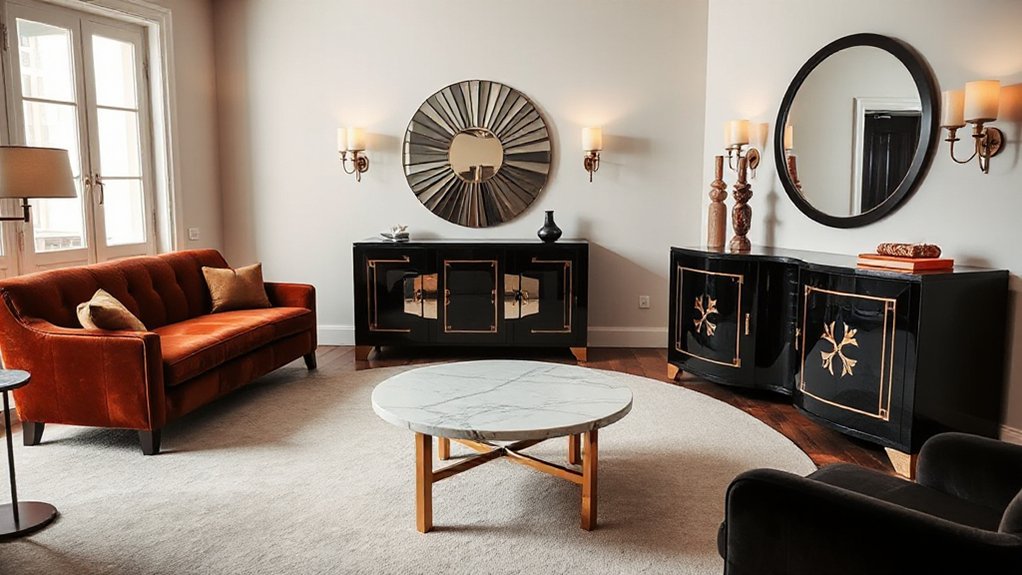
If you want your space to feel unmistakably Art Deco, choose furniture that balances streamlined geometry with soft, confident curves. Start with a sofa or club chair featuring a rounded back, tight upholstery, and a crisp, squared seat.
Look for stepped silhouettes, waterfall edges, and slim, tapered legs in lacquered wood or polished metal. Add a low console with clean lines and a subtly curved front to echo the era without feeling heavy.
Keep upholstery purposeful: velvet, leather, or performance boucle in saturated jewel tones works well. Bring in vintage patterns through a single accent chair or bench in fan, chevron, or sunburst motifs.
Favor modern interpretations that keep profiles sleek while using updated fabrics for durability.
Use Symmetry to Make It Feel Deco
Because Art Deco celebrates order and glamour in equal measure, symmetry gives your room that instant, era-specific polish. Start by choosing a clear axis—often a fireplace, sofa, or bed—and build mirrored groupings on both sides. You don’t need identical pieces, but you do need matched visual weight, height, and spacing so the arrangement reads intentional, not busy.
Anchor the look with Vintage motifs—fans, stepped forms, chevrons—then sharpen it with Modern reinterpretations in simplified silhouettes and cleaner proportions.
- Place paired lamps or sconces at equal height to frame the focal point.
- Repeat one shape twice: two arched mirrors, two club chairs, two vases.
- Keep margins consistent: align edges, center artwork, and balance negative space.
Layer Velvet, Lacquer, Glass, and Stone
Once you’ve set a clean, symmetrical framework, you can make the room feel unmistakably Art Deco by layering high-contrast materials that catch light differently.
Start with velvet: choose a jewel-tone sofa or bench so textile textures read rich, not fussy. Add lacquer through a side table or credenza in black, ivory, or deep oxblood; keep edges crisp and hardware polished.
Bring in glass with a faceted vase, smoked tray, or mirrored top to amplify highlights without adding clutter.
Ground everything with stone—marble, travertine, or onyx—used in a lamp base, plinth, or tabletop.
Aim for deliberate material combinations: one soft, one glossy, one reflective, one mineral. Repeat each finish twice for cohesion.
Art Deco Patterns: Rugs vs. Wallpaper
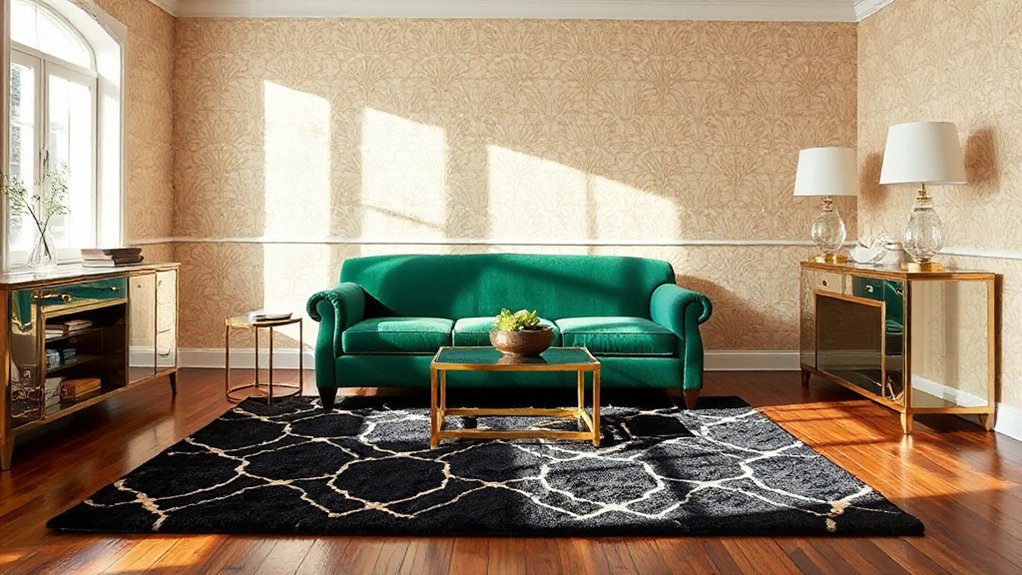
When you choose between an Art Deco rug and wallpaper, you’re controlling pattern scale and how much visual impact the room can handle.
Place rugs to anchor seating zones and protect high-traffic paths, and use wallpaper to sharpen sightlines on a focal wall or in smaller rooms where repetition reads intentional.
You’ll also weigh install and upkeep—rugs swap out fast and clean easily, while wallpaper demands precise prep and careful maintenance, especially in kitchens and baths.
Pattern Scale And Impact
Although Art Deco motifs share the same geometry and glamour, their scale changes everything—especially when you choose between a rug and wallpaper.
With rugs, you read the pattern scale from above and at a distance, so bolder repeats feel intentional and create strong visual impact without overwhelming details.
With wallpaper, you encounter the pattern up close, so smaller repeats and tighter linework can look refined rather than busy.
Use these rules to calibrate scale precisely:
- Match repeat size to viewing distance: larger for rugs, smaller for walls.
- Control contrast: high-contrast rugs ground a scheme; high-contrast wallpaper dominates quickly.
- Balance detail density: rugs can handle intricate borders; wallpaper needs breathing space between motifs.
Test samples under your lighting before committing.
Room Placement Considerations
Two placement choices determine whether Art Deco patterning feels polished or overpowering: anchor it underfoot with a rug, or wrap it around you with wallpaper.
Choose a rug when you need flexibility around furniture placement; center the pattern under the main seating group and keep at least the front legs of sofas and chairs on it to unify the layout.
Use wallpaper when your architecture can carry it: highlight a single focal wall behind a headboard, bar, or console, or paper all walls only in rooms with simple lines and minimal visual clutter.
Coordinate window treatments tightly—solid, tailored drapery or streamlined shades—so they don’t compete with geometrics.
In open plans, let rugs define zones while wallpaper stays contained.
Installation And Maintenance
Because Art Deco geometrics read best when lines stay crisp, installation and upkeep matter as much as the pattern itself. With rugs, you’ll get cleaner geometry when you square the room, center the motif to the main sightline, and lock edges with a quality pad to prevent creep.
With wallpaper, you’ll protect the pattern by starting from a true plumb line, matching repeats at eye level, and smoothing without stretching.
Follow these installation tips and maintenance essentials:
- Prep: patch, sand, and prime walls; vacuum floors and check for moisture.
- Install: dry-fit rug placement; book wallpaper seams and cut with sharp blades.
- Maintain: rotate rugs quarterly, spot-clean fast, and dust wallpaper with a microfiber cloth.
Style a Deco Vignette (Bar Cart Optional)
Once you’ve anchored the room with larger Deco cues, pull the look together with a tight vignette that reads intentional at a glance. Choose one surface—console, mantel, or bar cart—and commit to symmetry: two matching lamps or bookends framing a central object.
Build height in three tiers: a tall mirror or framed print, a medium sculptural vase, and a low tray to corral small pieces.
Use color blocking to echo your room’s palette, pairing black with brass, emerald with ivory, or blush with chrome.
Add Vintage motifs through fan shapes, stepped forms, or geometric inlays.
Keep materials glossy: lacquer, glass, marble, and polished metal.
Limit yourself to five items, and edit anything that looks casual.
Upgrade Windows With Deco Drapery Details
If you want a fast Art Deco upgrade that changes the room’s proportions, start at the windows and treat drapery like architectural trim. Choose full-length panels that kiss the floor and mount them high and wide to visually enlarge the opening. Keep window treatments crisp: solid velvets, satins, or tight geometrics read most Deco, especially in deep jewel tones or warm neutrals.
- Use substantial drapery hardware—metal rods, stepped finials, and double brackets—to echo Deco geometry and handle heavier fabrics.
- Add a tailored leading edge: contrast banding, inset tape, or a narrow metallic border for definition.
- Control light cleanly with a discreet liner or blackout layer so the folds stay sculptural all day.
Add Art Deco Mirrors to Boost Light
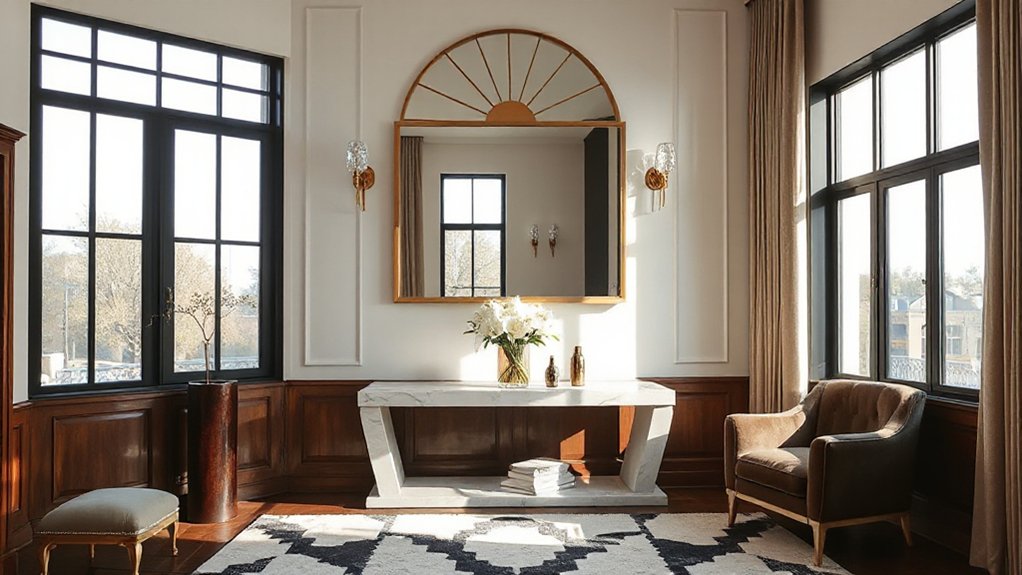
Where can you get a dramatic Art Deco payoff without changing a single fixture? Add a faceted, geometric mirror and let it work as a light multiplier. Choose stepped, sunburst, or octagonal frames in brass, chrome, or black lacquer to echo Deco lines while staying functional.
For lighting enhancement, place the mirror opposite a window to bounce daylight deeper into the room, or perpendicular to it to spread glow across darker corners. Treat mirror placement like a plan: hang the center at eye level, keep it 4–6 inches above a console, and avoid reflecting clutter or blank walls.
In dining areas, align it to capture chandelier sparkle; in hallways, use pairs to widen sightlines.
Choose Deco Wall Art and Sculptural Objects
How do you get instant Art Deco drama without repainting or reconfiguring your room? Choose bold wall art and sculptural objects that echo the era’s geometry and glamour. Look for decorative motifs like sunbursts, chevrons, stepped forms, stylized florals, and fan shapes. Then repeat them in at least two spots for cohesion. Favor strong outlines, high contrast, and symmetrical compositions to keep the look crisp rather than busy.
Use this quick filter:
- Pick one statement piece per wall (lacquered panel, framed poster, or metal relief).
- Prioritize material combinations—brass with black, marble with chrome, glass with walnut.
- Place a sculpture on a stable surface and light it from the side for sharp shadows.
Do an Art Deco Entryway in a Weekend
You can transform your entryway into an Art Deco statement in a single weekend by choosing bold geometric accents that read clearly from the front door. Add a chevron runner, stepped wall hooks, or a lacquered console with brass trim to lock in that graphic, high-contrast look.
Then upgrade lighting and mirror with a frosted-glass globe or tiered sconce and a sunburst or scalloped-edge mirror to bounce light and sharpen the silhouette.
Choose Bold Geometric Accents
Even if the rest of your home stays neutral, bold geometric accents will instantly signal Art Deco in an entryway. Anchor the space with crisp, repeating geometric motifs—chevrons, sunbursts, stepped shapes—and keep the palette disciplined: black, ivory, brass, emerald, or sapphire. You’ll get a high-impact look fast if you pick a few coordinated pieces and repeat their lines.
- Add a runner or small rug with strong angular patterning; it sets the grid for everything else.
- Swap in a lacquered tray, sculptural bowl, or key dish with faceted edges to corral daily clutter.
- Introduce a framed print or wallpaper panel featuring symmetrical geometry; place it at eye level for immediate punch.
Limit patterns to two, and scale them up.
Upgrade Lighting And Mirror
Where should you spend your fastest Art Deco dollars in an entryway? Upgrade your lighting design and mirror styles, because they change the space instantly without demolition. Swap a dated flush-mount for a stepped-glass semi-flush or a small brass chandelier with crisp, geometric arms.
Aim for warm 2700–3000K bulbs and add a dimmer so you can shift from daytime clarity to evening glow.
Then hang one bold mirror: choose a sunburst frame for classic Deco, or a faceted, octagonal edge for a sleeker look. Mount it at eye level (center at about 60 inches) and align it with your light so it bounces brightness deeper into the hall.
Keep finishes consistent for a polished result.
Bring Art Deco to Kitchens and Baths (And Avoid Mistakes)
Because kitchens and baths blend hard-working surfaces with high visibility, they’re the ideal places to introduce Art Deco’s crisp geometry without overcommitting. Start with Vintage motifs in small, repeatable elements, then build a contemporary fusion through clean lines and modern performance finishes. Keep contrast sharp: black, cream, brass, and deep jewel tones read instantly Deco without feeling themed.
- Choose one hero surface—zellige, chevron tile, or veined stone—and keep the rest quiet.
- Swap hardware for stepped or fluted pulls and a streamlined faucet in polished nickel or brass.
- Add symmetry: twin sconces, paired mirrors, or balanced shelving brackets.
Avoid mixing too many patterns, using matte-everything palettes, or installing ornate fixtures that fight cabinet proportions. Measure, align grout lines, and you’ll get Deco polish that lasts.
Frequently Asked Questions
Is Art Deco Style Appropriate for Small Apartments or Rentals?
Yes, it’s appropriate—you’ll make it work in small apartments or rentals by choosing compact Art deco furniture, using removable Artistic wall decor, adding mirrors, and focusing on metallic accents and bold patterns without permanent changes.
How Do I Mix Art Deco With Mid-Century Modern Without Clashing?
Mix Art Deco with mid-century by keeping a consistent palette, then layering ornate patterns and geometric motifs as accents. You’ll balance sleek silhouettes with one luxe statement piece, repeating metals and woods to unify.
What’s the Easiest Way to DIY Art Deco Details Without Power Tools?
Use peel-and-stick moulding and stencils for DIY wall accents; you’ll get crisp Deco geometry fast without cutting. Add faux metallic finishes with rub-on wax or acrylic paint, and seal with water-based polyurethane.
Where Can I Find Authentic Art Deco Pieces, and How Do I Spot Replicas?
You’ll find authentic Art Deco in Antique stores and reputable Online marketplaces; the “too-perfect” theory often signals replicas. You check maker’s marks, period materials, patina, joinery, and provenance; compare catalog references, then negotiate confidently.
How Do I Maintain Lacquer, Brass, and Velvet in a High-Traffic Home?
You’ll protect finishes by using coasters, rotating cushions, and keeping traffic off edges. For Lacquer care, dust microfiber, avoid ammonia, wipe spills fast. For brass, polish lightly, seal wax. Velvet maintenance: vacuum, steam, blot.
Conclusion
You don’t need to live in Gatsby’s mansion to bring Art Deco elegance home. Lock in the hallmarks—bold geometry, rich metals, lacquered shine—then build around one anchor piece. Keep your palette tight, your lighting dramatic, and your mirrors purposeful to multiply glow. Use graphic textiles and curated sculpture to avoid clutter. Tackle an entryway first for fast payoff, then kitchens and baths with restraint so Deco reads crisp, not kitschy.