You seek ultra-luxury kitchen designs where sculpted stone islands fuse form, function, and enduring performance. Imagine islands that act as architectural centers—radius progressions, plane shifts, and integrated elevations—bathed in controlled lighting to reveal mineral character and grain. Finishes range from polished to tactile surfaces, with seamless joints and laser-precise edges. Hidden storage, concealed appliances, and grain-aligned detailing preserve a museum-quality flow. If you continue, you’ll uncover how this language translates into real-world elegance and lasting resilience.
Defining Ultra-Luxury: Sculpted Stone Islands as Centerpieces
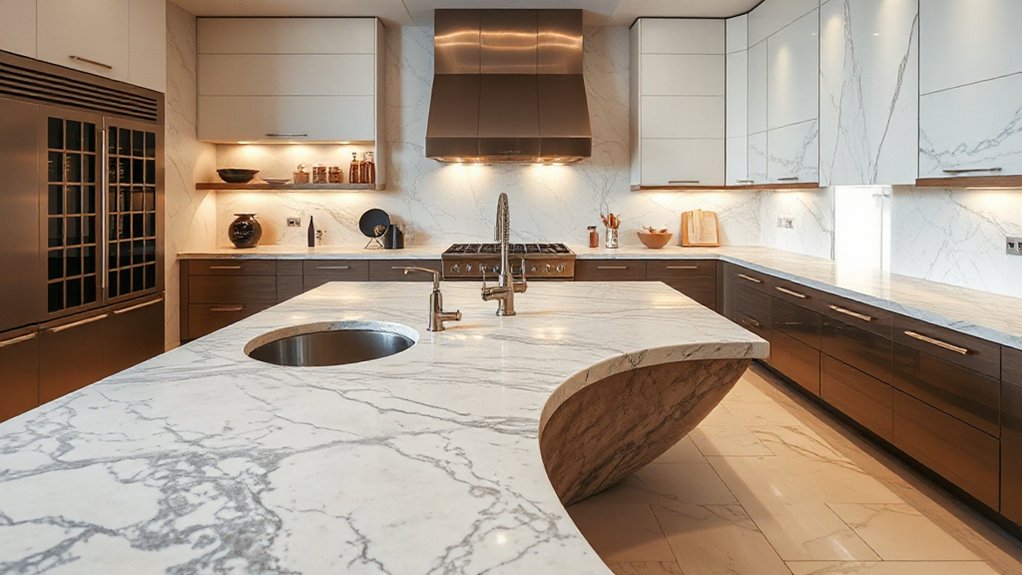
Sculpted stone islands define ultra-luxury kitchens by merging form and function into a single, sculptural focal point. You observe how material continuity and geometry converge to emphasize craft, ergonomics, and precision.
Each contour is deliberate: radius progressions, plane shifts, and integrated elevations that guide circulation without interrupting workflows. You recognize Vintage Charm as a calibrated accent, achieved through aged patinas, subtle veining, and restrained detailing that nods to timeless dining rooms while maintaining contemporary rigor.
The island functions as an Artistic Focal, where lighting, shadow play, and reflected surfaces articulate hierarchy and rhythm across the kitchen. You demand tight tolerances, seamless joints, and a perceived sculpture that supports culinary performance, guest engagement, and long-term value.
Stone and Material Choices That Elevate the Island
You select stone fabrication options with surgical precision, balancing durability, heat resistance, and seamless joints to define the island’s core.
Palette and veining trends guide the material narrative, from restrained monochromes to bold, architectural patterns that read as design statements.
Finishing and texture details—polish, matte, or tactile textures—translate light and tactility into a refined, enduring centerpiece.
Stone Fabrication Options
- Laser-precision edge treatments that minimize seams and maximize tactile continuity
- Monolithic slabs with matched grain and subtle veining for visual harmony
- Structural backings and substrates designed for long-term stability and easy integration with ventilation and utilities
Your choices nod to Kitchen ventilation and Sustainable materials, balancing form with function. The result is a sculpted mass that reads as engineered art, with predictable fabrication tolerances and enduring, low-maintenance beauty.
Palette and Veining Trends
Palette and veining define the island as a focal point, marrying chromatic restraint with natural drama to create a cohesive material narrative. You select palettes that balance contrast and harmony, aligning surface language with architectural intent.
Veining patterns—linear, feathered, or expansive—govern light diffusion, visual weight, and spatial rhythm, while scale and frequency influence perceived room dimensions. Color psychology informs material choice, guiding you toward textures and hues that evoke calm, luxury, or drama without overpowering the design hierarchy.
Cultural influences surface in motif cues, mineral origins, and hand-finishing signatures, enriching the island’s narrative with provenance. Precision seams, calibrated thicknesses, and consistent grain orientation guarantee uninterrupted continuity.
The result: a sculpted, authoritative island that communicates restraint, sophistication, and timeless resonance.
Finishing and Texture Details
Texture and finish choices define the island’s tactile and visual authority, translating stone geology into a refined architectural language. You select surfaces, edge profiles, and joint treatments with surgical precision, shaping perception of weight, light, and continuity.
Finishes convey ambience—from matte ash to high-polish marble—while texture enhances grip and acoustic calm. Material choices prioritize longevity, low maintenance, and timeless luxury, integrating seamlessly with appliances and cabinetry.
- Vintage accents balanced with contemporary resilience
- Eco friendly materials ensuring low VOCs and responsible sourcing
- Textured and sculpted edges that reduce glare and reveal inherent mineral character
Seamless Appliance Integration for a Museum-Quality Look
Seamless appliance integration defines a museum-quality kitchen by concealing devices within cabinetry and using coordination of materials, finishes, and hardware to maintain uninterrupted sightlines. You design with exacting restraint, ensuring panels align flush and gaps vanish, so function and form read as sculptural volume.
Choose panel-ready appliances that mirror the cabinet faces, then tune grain direction, veneer color, and metal trim to achieve a cohesive rhythm. Integrate thermal zones invisibly behind concealed fronts, while access hinges, pulls, and recessed handles preserve the uninterrupted plane.
You balance Vintage accents with Modern minimalism, courting a refined dialogue between nostalgia and forward-focused clarity. The result is a highly legible composition, where technology recedes, and stone islands command attention as the central architectural feature.
Crafting Organic Silhouettes: Soft Curves and Bold Angles
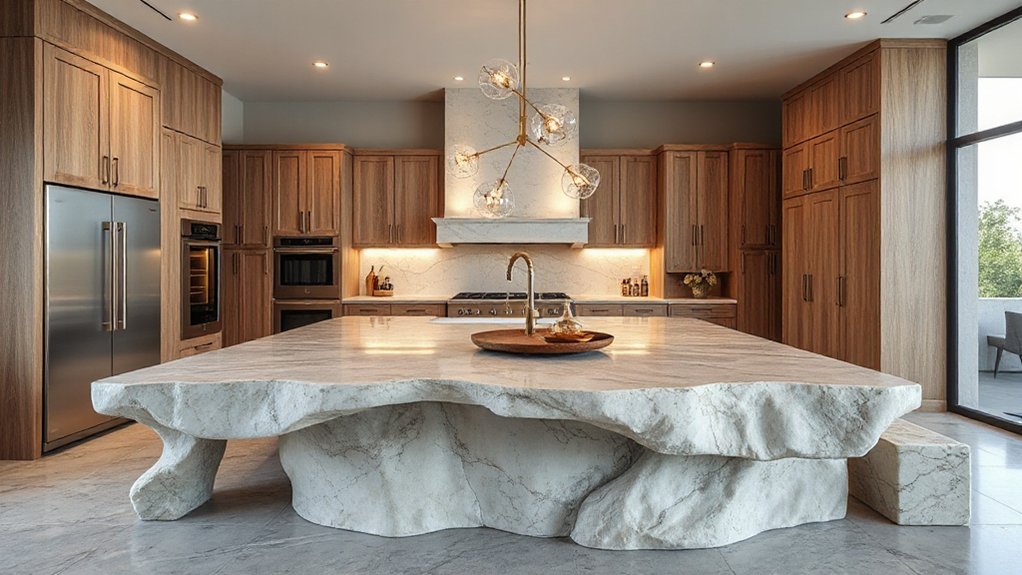
As you move from the museum-quality concealment of cabinetry to a more sculptural kitchen language, organic silhouettes introduce a tactile physics to the space: soft curves countering bold angles to create a dynamic yet disciplined rhythm. You’ll observe how Contemporary art informs form, guiding shifts between island mass and perimeter planes, while Organic architecture inspires grounded, breathable volumes.
Precision detailing ensures seamless joinery and sculptural continuity across elevations, materiality, and light. The result is a refined hierarchy where curvature and geometry coexist as measured, technical statements rather than ornament.
- Sculpted island perchments that read as continuous mass
- Recessed, curvilinear profiles meeting angular datum lines
- Material progressions that emphasize volume, light, and tactility
Finishes and Textures That Catch the Light
You evaluate how light interacts with each element, prioritizing light-reflective finishes that amplify depth and nuance.
Texture choices—from stone surfaces to controlled gloss and matte contrasts—define tactile hierarchy while guiding sightlines across architectural planes.
Light Reflective Finishes
- Mirror-bright panels pairing with satin accents
- Subtle chromatic shifts across dawn to dusk
- Discreetly recessed hardware balancing glare and practicality
Textured Stone Surfaces
Material choices are deliberate: surface texture enhances perceived density while moderating glare, enabling refined, glare-controlled work zones. You evaluate finishes for consistency, wear resistance, and ease of maintenance, balancing tactile richness with long-term performance.
Cultural influences inform grain patterns, tool marks, and patination, delivering a narrative tied to locale and craft methods.
Prioritize sustainability by selecting materials whose quarrying and processing minimize environmental impact while preserving intrinsic texture. Informed textures read as architecture, not ornament, aligning with ultra-luxury design objectives.
Gloss and Matte Contrasts
Gloss and matte finishes orchestrate light with surgical precision, shaping perception of volume, depth, and tactility across high-end kitchen surfaces. You balance reflectivity against restraint, guiding gaze along lines and edges with architectural intent. The juxtaposition heightens texture without noise, allowing material truth to emerge.
Vintage charm threads through aging patinas and softened reflections, while Industrial accents introduce crisp, engineered contrasts that read as contemporary sculpture. When paired with sculpted stone islands, gloss highlights illuminate sculptural forms; matte backs recede, emphasizing silhouette and scale.
- Subtle gloss on perimeter cabinetry to define boundaries
- Matte island planes to anchor volume and reduce glare
- Industrial hardware accents to punctuate rhythm and precision
Hidden Storage and Discreet Tech Without Compromising Style
The kitchen integrates hidden storage and discreet tech with surgical precision, ensuring utility remains unseen while performance remains uncompromised.
You navigate a layout where hidden compartments emerge at the touch of a panel, preserving the sculpture of the island rather than interrupting it. Precision hydraulics and micro-motors operate with whispering cadence, delivering discreet technology that feels inevitable rather than engineered.
You’ll find concealed drawers, flush seams, and gravity-balanced doors that glide without vibration, maintaining clean sightlines. Integrated charging, sensors, and controlled power outlets are stowed within the cabinetry, out of sight yet instantly available.
This approach prioritizes material continuity, ensuring that hardware, software, and stone coexist as a singular architectural statement—functional, resilient, and unmistakably luxurious. Discreet technology supports operation without compromise.
Hidden compartments reinforce the design’s purity and purpose.
Lighting Principles to Showcase Sculpted Islands
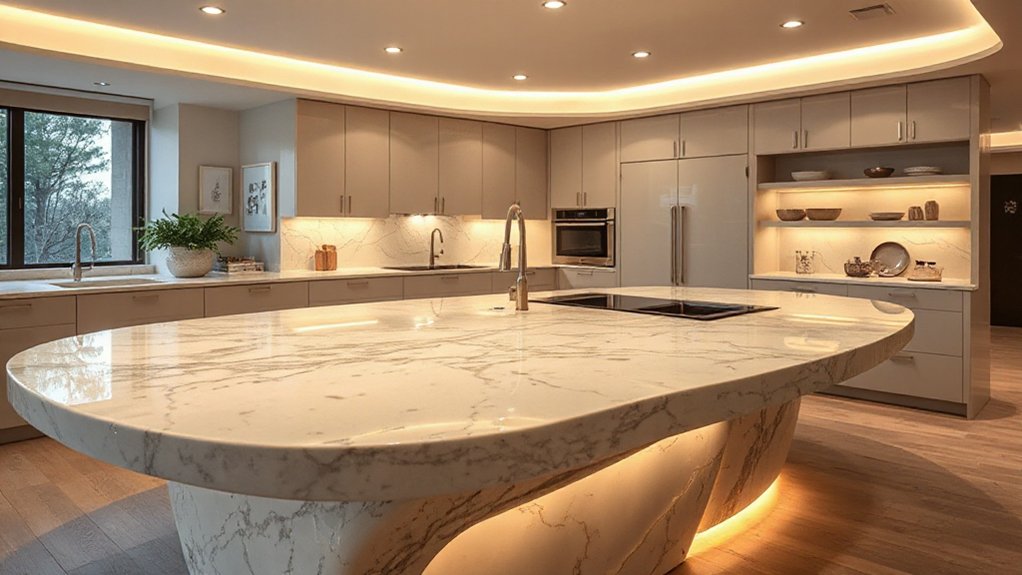
To illuminate sculpted islands with precision, implement layered luminosity that balances ambient, task, and accent cues. Ensuring the island reads as a single architectural volume is essential.
Use shadow play techniques to sculpt edges and reveal form. This helps guide the eye along crisp profiles and material contrasts.
This approach aligns lighting strategy with spatial hierarchy, elevating luxury through measurable, architectural clarity.
Layered Luminosity Strategies
Layered luminosity in sculpted islands begins with a deliberate hierarchy of light sources that defines form, texture, and scale without overpowering the space. You orchestrate ambient, task, and accent layers to emphasize material clarity, grain orientation, and contour edges, while preserving daylight balance and color fidelity.
The approach guarantees color harmony and material durability are preserved under varied tasks, from serveware displays to casual dining.
- Ambient wash reveals silhouette while reducing glare
- Task lamps with directional focus illuminate work zones without flattening relief
- Accent LEDs trace edge radii and sculptural transitions for depth
This strategy achieves precise contrast, controlled glare, and a refined tonal range, reinforcing the stone island as a tactile podium rather than a visual billboard, guaranteeing longevity and luxury.
Shadow Play Techniques
Shadow play hinges on deliberate shadow density and edge definition, enabling sculpted islands to read as three-dimensional forms rather than flat planes. You calibrate luminance with precision, locating luminance planes to orchestrate perceptual depth across variegated stone textures.
Shadow depth becomes a design parameter, not a byproduct, guiding where form recedes and where silhouette asserts itself. Use directional fixtures to carve contours along cantilevered edges, while concealed cove lighting highlights bas-relief profiles without glare.
Light diffusion is engineered through matte finishes and controlled screens, ensuring soft gradations between planes and preventing hotspots. You test proportionality between ambient, task, and accent layers, validating that cast shadows emphasize sculptural grammar rather than obscure it.
The result is cohesive, legible volume with deliberate tonal hierarchy and refined material articulation.
Spatial Planning: Island Placement and Flow
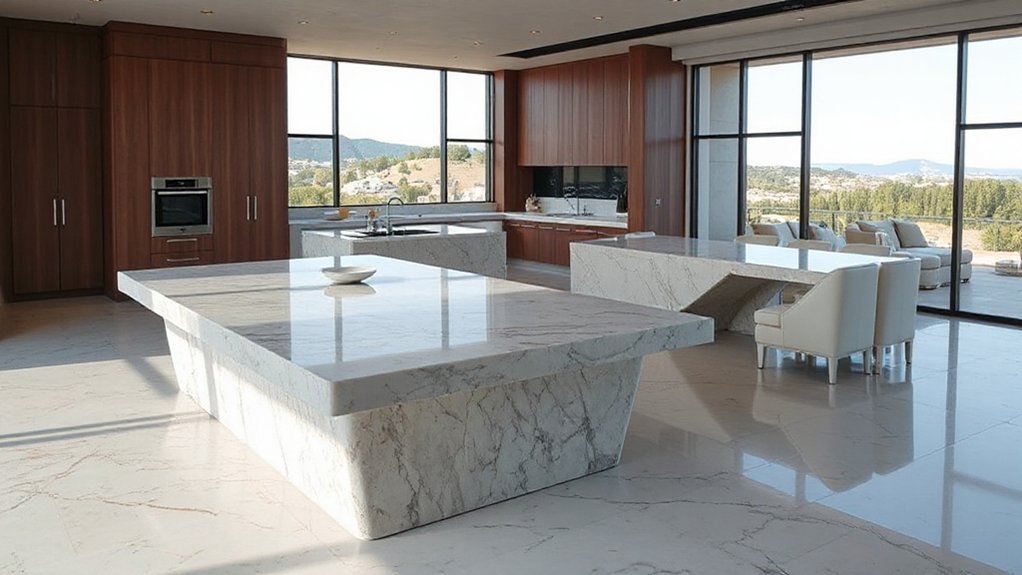
How should you position an island to optimize circulation and task efficiency within a high-end kitchen? You align the island to dual work zones, preserving clear traffic lanes and sightlines while maintaining island symmetry. Prioritize appliance ergonomics and user reach from all seating and prep points, with apron-front clearance and under-counter storage that minimizes reach-distance.
Edge-to-edge proportions should balance bold sculpted stone with cantilevered holdpoints, ensuring robust anchor points without encroachment on workflow.
- Circulation corridor kept at least 42 inches wide, with 48 inches around cooking zones
- Islands oriented to maintain sightlines to entry, sink, and range
- Seating clear of main prep paths, with integrated power and task lighting
Maintenance, Durability, and Timeless Design Considerations
Maintenance, durability, and timeless design hinge on selecting materials and detailing that endure use while aging gracefully. You evaluate stone integrity, wear patterns, and finish resilience, balancing technical performance with refined aesthetics.
Prioritize dense, low-porosity surfaces that resist staining, scratching, and heat, and specify edge profiles that minimize chipping at high-traffic zones. Eco-friendly materials merit performance data, lifecycle assessment, and cleanability metrics, ensuring a responsible luxury for generations.
Durability is reinforced through substrate robustness, precise joint tolerances, and protective seal systems that preserve color and texture without masking sculptural form. Custom engraving adds heirloom value while signaling bespoke intent; document depth, depth-control, and surface treatment to maintain legibility.
Design decisions should favor timeless palettes, modular detailing, and repairability to sustain elegance across evolving culinary programs.
Real-World Installations: Case Studies of Iconic Stone Islands
Iconic stone islands fuse rigorous performance with sculptural presence, translating durable materials and precise detailing from their measured specifications into real-world spectacle. You’ll observe how projects translate performance metrics into installations that read as architectural statements, balancing utility with artistry.
- Sustainable sourcing informs every cut, finish, and provenance decision, ensuring traceable material integrity.
- Cultural influences shape edge profiles, ornament, and layout logic, yielding regionally resonant forms.
- Real-world constraints—plumbing, ventilation, and traffic flow—drive integration without compromising elegance.
In these case studies, you experience site-to-surface fidelity: tolerances maintained, seams minimized, and surfaces treated for durability under daily use.
You witness how collaboration between fabricators, designers, and clients produces timeless, high-precision kitchens that embody luxury through material science and thoughtful context.
Frequently Asked Questions
How Do Sculpted Stone Islands Affect Kitchen Acoustics and Echoes?
Sculpted stone islands dampen sound, reducing reflections and flutter echoes with precise material density. You’ll notice acoustic dampening and echo reduction, improving speech clarity while maintaining luxurious ambience and architectural rigor in your high-end kitchen space.
What Maintenance Routine Preserves Stone Grain and Sculpted Edges?
You preserve stone grain and sculpted edges by implementing a disciplined maintenance routine: seal with recommended Sealing techniques, clean with pH-neutral products, and follow cleaning schedules to prevent etching, staining, and edge wear while sustaining architectural luxury.
Are There Eco-Friendly Stone Options Suitable for Luxury Kitchens?
Yes—eco friendly materials exist, and you can choose stones with sustainable sourcing. You’ll select eco friendly materials that meet architectural standards, ensuring durability, beauty, and low environmental impact while preserving the luxury and precision of your kitchen design.
How Does Island Size Influence Kitchen Workflow Efficiency?
Islander size directly affects space utilization and workflow, optimizing ergonomic layout; increasing island area expands prep zones and circulation corridors, while too-large footprints hinder traffic. You’ll achieve balanced proximities, intuitive triangle workflows, and luxurious, efficient culinary choreography.
Can Lighting Enhance the Island’s Sculptural Features Without Glare?
Yes, you can, and glare is minimized. You’ll deploy ambient lighting with even wash and spotlight accents to highlight sculptural form, ensuring precision. You’ll maintain architectural clarity, using understated luminance that complements contours without distracting reflections.
Conclusion
You’re not just placing a stone island—you’re curating a sculpture with your kitchen as its gallery. And yes, the curves and angles demand precision, not bravado. You’ll witness light chase the satin finish, appliances disappear into the glaze of marble, and every draw pull feel ceremonial. So you’ll plan, measure, polish, and refine, because luxury isn’t luck; it’s the relentless pursuit of permanence, where every edge persuades and every surface argues for timeless taste. Enjoy the flawless illusion of effortlessness.