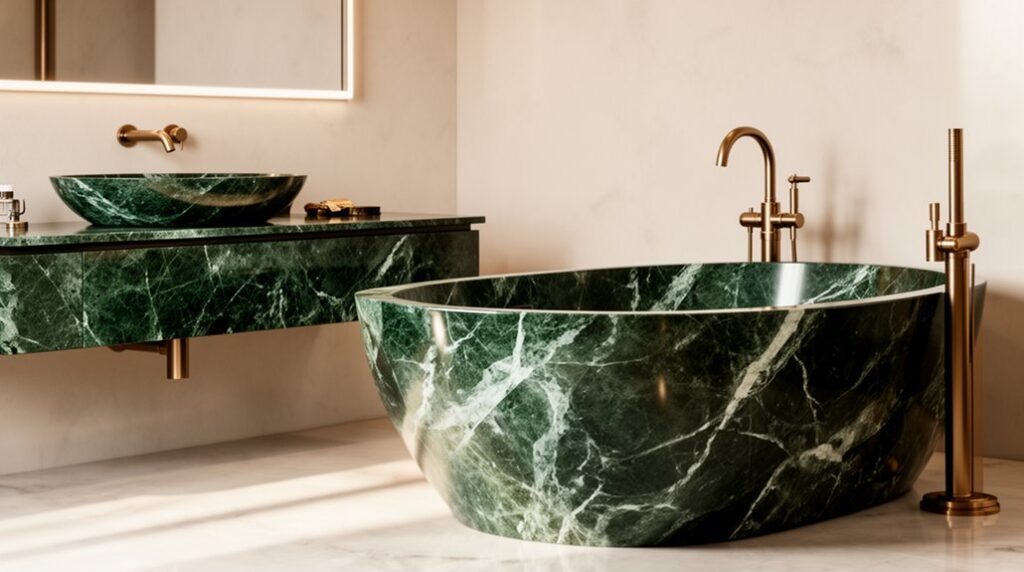

Premium bathroom suites using rare marble finishes deliver unmatched luxury through controlled veining, color depth, and translucency. You’ll maximize durability with low-porosity slabs, calibrated edge detailing, and precision seam tolerances, while strategic layout and vein continuity drive visual flow. Evaluate pigment grades, lighting, and porosity to maintain gloss and slip resistance. Ethical sourcing and transparent provenance guarantee value retention, with maintenance plans and sealing schedules sustaining long‑term performance. Continue to explore how these factors translate into tangible ROI and project predictability.
Benefits of Rare Marble Finishes in Premium Bathrooms
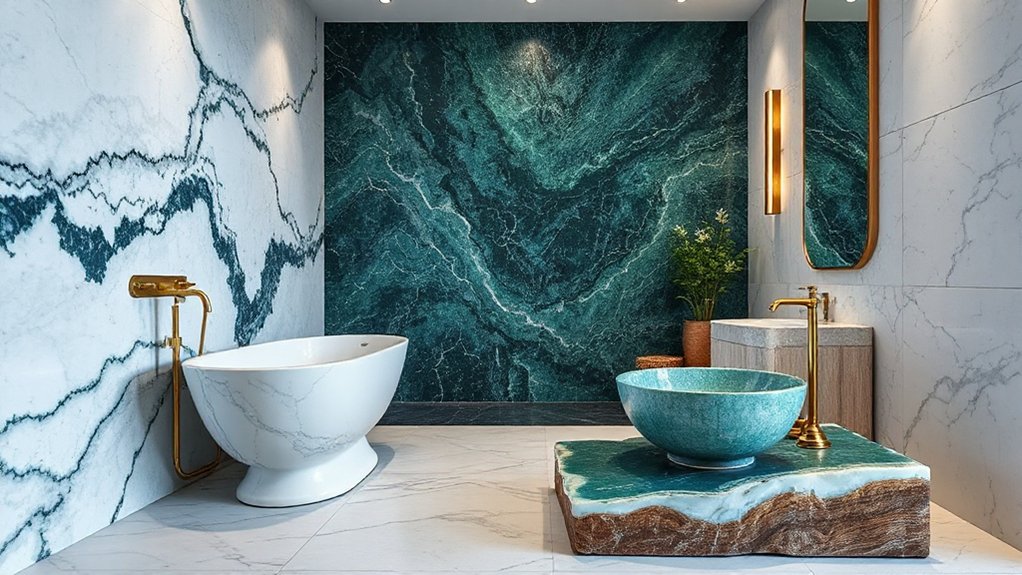
Rare marble finishes elevate bathroom suites by delivering distinctive veining, color depth, and reflective qualities that set premium projects apart. You’ll leverage precision selection to optimize material performance, installation tolerances, and long-term dimensional stability, aligning with project specs and warranty requirements.
Benefits span aesthetic distinctiveness, improved asset value, and differentiated resale appeal. Meanwhile, maintenance considerations—such as stain resilience, sealing schedules, and micro-scratches—are mitigated through engineered finishes and reputable fabrication.
You gain predictable appearance with controlled veining density, minimized color variability, and enhanced glare management via surface polish grades. Marble myths persist; you’ll debunk them through data-driven performance, lifecycle cost analysis, and code-compliant detailing.
Historical significance informs design intent, enabling narrative-rich interiors that resonate with heritage contexts, collector-grade bones, and precise material provenance documentation.
Evaluate Marble Veining and Color
Evaluating marble veining and color is about matching natural variability to project requirements while preserving visual coherence across the suite. You assess veining scale, pattern alignment, and color temperature to guarantee consistency from vanity to shower enclosure.
Begin with baseline comparisons against design boards, quantifying veining density, movement, and focal points using calibrated lighting. Prioritize substrate harmony and ambient light behavior to prevent color drift under sequential fixtures.
For material performance, evaluate surface stability under humidity cycles and cleaning regimes, noting potential efflorescence or microcracking indicators. Document color migration risks with epoxy fills and resin coatings, and specify finish fidelity requirements for Marble etching and protective sealants.
Plan maintenance pathways that preserve luster; assign marble polishing protocols tailored to each slab’s porosity and hardness, ensuring durable, cohesive aesthetics.
Match Marble Types to Bath Fixtures
In practice, you align a low-porosity, high-gleam slab with moisture-intensive components—shower benches, troughs, and vanity tops—to minimize staining risk while maintaining reflectivity.
For high-traffic zones, select marble with stable veining and medium translucency to preserve luminance under bathroom lighting.
Reserve fully honed surfaces for less exposed pockets to dampen glare and prolong ease of maintenance.
Calibrate edge detailing, undermount sinks, and seam tolerances to reduce microcracking pathways, especially where heat and humidity fluctuate.
Integrate marble polishing schedules with bathroom lighting cues to sustain uniform sheen, and coordinate material behavior with fixtures to optimize both aesthetics and performance.
Durability and Care: Keeping Luxury Marble Looking Sharp
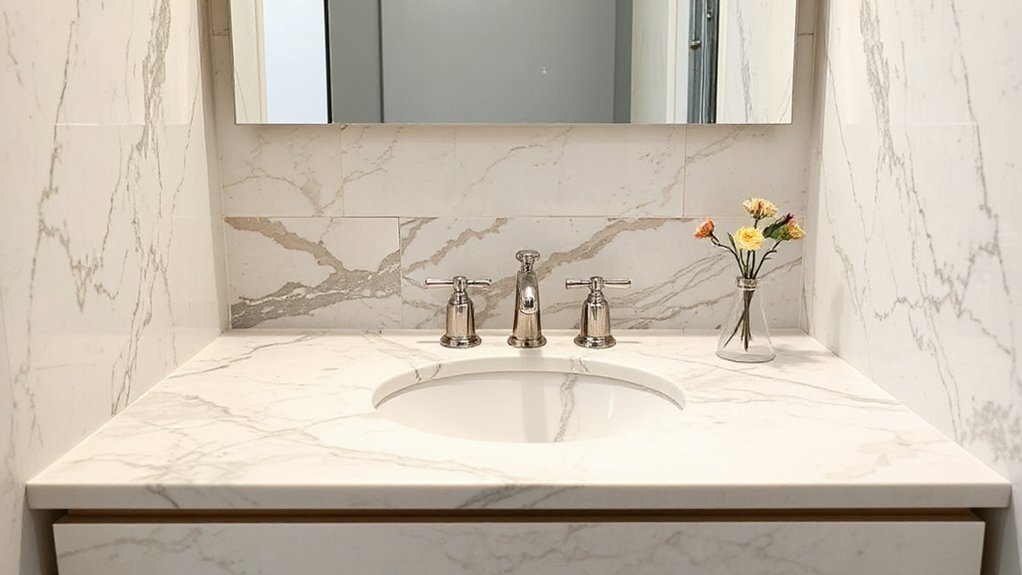
Durability and care are about controlling porosity exposure, polishing cycles, and environmental microclimates to preserve marble’s integrity over time. You interrogate porosity with sealed substrates, selecting low-absorption finishes and proper sealer sequencing to minimize wicking of stains from spills.
You monitor polishing cycles, balancing gloss retention against surface hardness; over-polishing degrades microtexture that informs slip resistance and even color depth. You manage environmental microclimates by controlling humidity and cleaning frequency to deter calcium soap formation and biofilm adhesion.
Marble color and vein pattern guide maintenance intervals: uniform slabs demand consistent sealing, while dramatic veining can reveal micro-scratches earlier, prompting targeted abrading. You document corrective actions, ensuring restoration records reflect color stability, stain resistance, and preserved vein pattern integrity for long-term luxury performance.
Popular Rare Marble Finishes for Bathrooms
Rare marble finishes elevate bathroom aesthetics by combining bold veining with unusual mineral matrices and refined surface textures. In this segment, you’ll evaluate popular finishes that align with high-end spa environments and luxury residences.
You’ll prioritize materials with consistent grain patterns, low porosity, and controlled translucency to optimize light diffusion. Common options include calcite-rich varieties and contrast-stitched patterns that read as statement walls or countertops.
You’ll assess quarry yield, finish uniformity, and edge-detail compatibility with open-radiant flooring systems. Consider Marble quarrying provenance and stability, ensuring sourcing aligns with sustainability and traceability.
Historical marble uses inform etching resistance and patina evolution, guiding your selections for long-term lifecycle performance. Your decisions should balance aesthetic intent with installation tolerances, maintenance windows, and system integration.
Surface Treatments to Protect Marble
You’ll apply Protective Marble Sealants as a primary barrier, selecting a formulation compatible with our rare finishes and expected wear.
Implement Regular Maintenance Protocols to monitor porosity, reapplication intervals, and surface tests, ensuring long-term resistance to etching and staining.
In practice, this combination establishes a proactive defense strategy that preserves sheen, color integrity, and maintenance efficiency.
Protective Marble Sealants
Do marble surfaces in bathrooms demand proactive defense against staining and etching? Yes, and protective marble sealants form the first line of defense. You apply a breathable, impregnating sealer that penetrates grout lines and stone pores, creating a hydrophobic barrier without altering color or gloss.
Choose a polymer- or silane-based formulation rated for dense calcite marbles to minimize efflorescence risk and guarantee vapor permeability. Before application, clean surfaces thoroughly to remove residues that would block penetration; follow with precise curing times and ventilation.
Reapplication schedules hinge on porosity, use patterns, and abrasion exposure. As you integrate sealants, align with maintenance plan: document cure windows, product lot numbers, and renewal dates. Include notes on marble polishing and cleaning techniques to preserve long-term clarity and surface integrity.
Regular Maintenance Protocols
Use a quantified schedule: wipe-downs after use, periodic microfiber dusting, and resealing intervals aligned to porosity tests and traffic loads. Select breathable sealants with appropriate penetration depth to minimize efflorescence and watermark risk, avoiding over-application that clouds translucence.
Document historical significance and cultural influences guiding finish choices, ensuring compatibility with historic-laminated fixtures and contemporary hardware. Verify compatibility with rare marble veining, testing for haloing under artificial lighting.
Maintain a log of product batches, exposure conditions, and maintenance outcomes to predict lifecycle costs and preserve architectural intent across durable, aesthetically calibrated surfaces.
Layout Ideas for Marble-Driven Baths
Coordinate marble color schemes with the overall palette to establish cohesive contrast and legibility.
Optimize layout flow by aligning vein-dominant slabs with high-traffic axes and focal points, ensuring seamless shifts between wet zones and storage cores.
Use vein patterns as intentional focal elements to guide sightlines, balance, and perceived space without overloading the room.
Marble Color Coordination
When pairing marble finishes, start with a dominant color story and build around it: select one base hue—whether warm cream, cool gray, or dramatic black—and map secondary veining and translucency to create visual order.
You’ll align material calibration with lighting strategy, ensuring color consistency across slabs and tiles. Marble pattern emerges through controlled veining density, orientation, and contrast pairing, with edge details tuned for readability at scale.
In practice, coordinate board angles, s-curve progressions, and polish depth to minimize chromatic diffusion. Marble polishing should emphasize uniform luster without holographic bands, while sealing protocols preserve translucency.
Document pigment grading, surface texture tolerances, and measurement tolerances for thickness variance. Your result: a cohesive palette that delivers legibility, restraint, and premium material storytelling.
Layout Flow Efficiency
Layout flow in marble-driven baths hinges on deliberate zoning and seamless shifts that respect slab geometry and edge detailing. You optimize circulation by mapping primary zones—wet, dry, and prep—around the focal marble piece, ensuring passages align with natural sightlines.
Corridor widths, grade changes, and threshold tolerances are calibrated to minimize trip points while supporting wipe-clean maintenance regimes. In practice, you coordinate space planning with material continuity, selecting plinths and fascia that preserve vein orientation integrity across passages.
Lighting layers are synchronized to highlight surface gloss and translucence without glare, so bathroom lighting becomes a governance tool for flow.
You specify plumbing fixtures with shallow rough-ins and concealed fasteners, enabling flat escarpments and clean joint lines that reinforce a disciplined, marble-centric narrative.
Vein Pattern Focal Points
Vein patterns serve as the primo design cue, guiding focal points and informing layout decisions across marble-driven baths. You analyze vein pattern alignment to establish sightlines, margin allocations, and sink/vanity relationships that maximize marble mineralogy readability.
Begin by identifying dominant veining directions and scale, then set secondary corridors for secondary surfaces to prevent visual clutter. Implement deliberate focal anchors—vanities, baths, or shower walls—where vein intersections yield natural symmetry or rhythm.
Use Vein pattern analysis to dictate panel orientation, edge detail, and corner progression, ensuring cut to size preserves pattern continuity. For lighting, place fixtures to illuminate high-contrast junctions, enhancing depth and mineral grain.
Document tolerances and seam strategies early, then iterate with mockups to confirm coherence across finishes and substrate performance.
Color Stories With Vein Cohesion
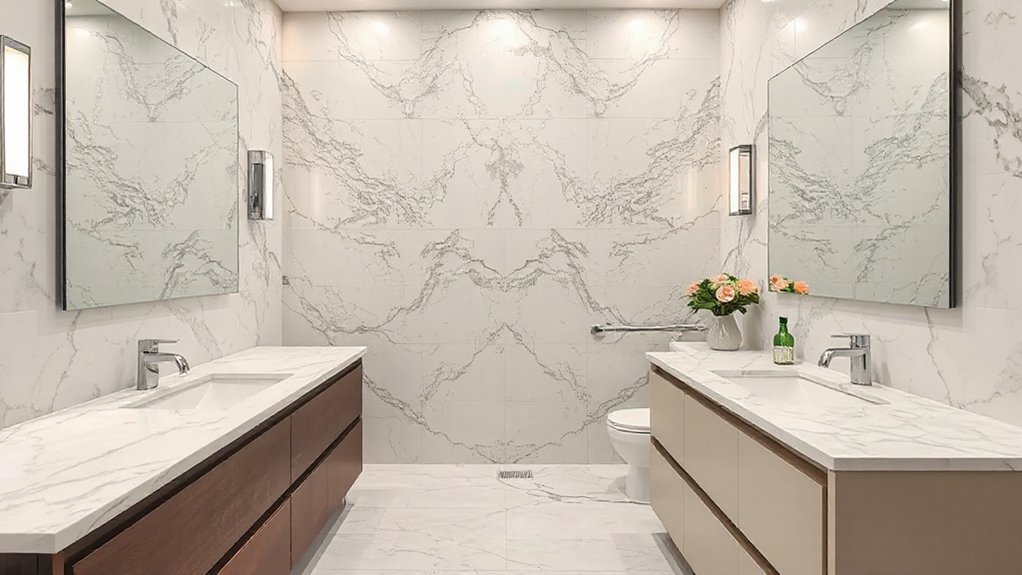
Color stories in rare marble finishes hinge on cohesive vein patterns that guide perceptual flow across fixtures and surfaces. You select panels and countertops where linear or feathered veining establishes a narrative cadence, aligning with fixture geometry to reinforce spatial hierarchy.
Vein cohesion reduces visual noise, enabling color harmonies to emerge from substrate tones, luminance, and finish texture. When evaluating Marble origin, you assess mineral sources and quarry batch variability to predict veining continuity and color homogeneity, ensuring consistent palettes across adjacent surfaces.
Cultural symbolism informs your palette decisions, leveraging traditional motifs and regional affinities to communicate intent without overstatement.
You document vein alignment tolerances, cross-cut matching, and finish luster, embedding this data into installation guides for reproducible, premium outcomes.
Budgeting for Rare Marble Without Compromise
Rare marble imposes unmistakable budgeting constraints, so you must anchor cost planning in objective material metrics and project scope. You optimize by itemizing slabs, backing, and edgework, then mapping thickness, finish, and tolerance to total installed cost.
Monitor Marble pricing trends and seasonality, and lock in firm quotes via structured supplier negotiations to mitigate volatility. Align procurement with fixture schedule and long-lead storage, minimizing risk of obsolescence or waste.
Your plan should balance premium aesthetics with practical cost controls, using modular design to accommodate future updates without demolition.
- Define unit costs by grade, finish, and source, then apply a contingency bound to scope changes
- Phase procurement to leverage bulk buy and early-access discounts
- Document acceptance criteria and inspection thresholds for QA
- Establish clear supplier negotiation levers and fallback options
Ethical Sourcing for Rare Marble
How can you guarantee ethical sourcing when selecting rare marble for bathroom suites without compromising on quality or timeline? You’ll evaluate supply chain integrity from quarry to showroom, prioritizing Marble ethical practices and verifiable provenance.
Implement supplier conformance audits, track-and-trace metadata, and third-party certifications to confirm origin, harvesting methods, and labor standards. Demand transparent manifest records, risk assessments, and periodic KYC checks to mitigate conflict minerals and environmental externalities.
Require documented due diligence, including chain-of-custody and age-appropriate extraction controls, aligned with industry standards. Mandate sourcing transparency across shipments, with clear batch IDs and QA pass/fail signals.
Establish a contractual framework that ties milestones to ethical benchmarks, ensuring stylistic fidelity without compromising certification. This approach preserves value, performance, and reputational integrity.
Marble Installation: From Slab to Splash
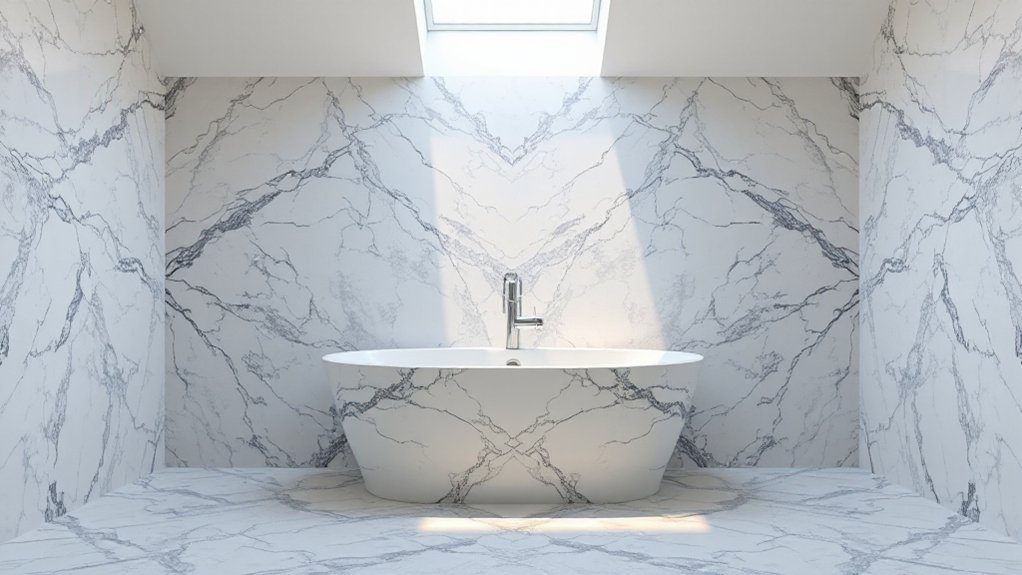
You’ll approach marble installation with a tight workflow: select slabs with color and grain consistency, evaluate thickness and backing for structural compatibility, and plan for waste and yield.
We’ll cover sealing and maintenance upfront to guarantee longevity, sizing decisions for edge finishes, and how to align slab layout with mechanicals and substrate prep.
Finally, we’ll map a seamless installation process from substrate prep through grout and caulk tolerances, focusing on joint discipline and wipe-down protocols to prevent staining.
Slab Selection Tips
Selecting the right marble slab starts with evaluating grade, veining, and movement at comparable thicknesses, then confirming finish compatibility with your backsplash and countertop profile. You’ll assess slab consistency, edge yield, and fabrication tolerances, aligning with the project’s tolerance stack and heat-load expectations.
Prioritize color stability under lighting, plan for cross-banding, and map seam locations to minimize visual disruption, while honoring Marble artistry and Historical significance in quarry provenance.
- Assess grade and consistency across production lots with a documented stripe map
- Engineer veining alignment to preserve linearity through joints
- Confirm edge and edge polish radius tolerances for splash interfacing
- Pre-plan backing substrate support and grain orientation for long-term stability
Sealing And Maintenance
Schedule, cadence, and environmental conditioning drive performance, so you’ll verify cure times with ASTM standards and calibrate humidity during application. For marble lithography pieces, you’ll prioritize uniform saturation to prevent mottling and ensure chemical compatibility with polishing compounds and sealers.
Historic restoration workflows demand meticulous documentation, color matching, and controlled patination to maintain patina without over-sealing. Regular maintenance cycles include dusting, damp-then-dry wiping, and re-sealing every 1–3 years based on porosity testing and surface wear.
Seamless Installation Process
From slab to splash, the seamless installation process hinges on precise substrate preparation, meticulous templating, and controlled fabrication tolerance. You’ll align substrate flatness, verify plumb, and pre-slope for drainage to prevent deflection that disrupts joint continuity.
Templates are cut with laser accuracy, then transferred to quarry slabs, ensuring seam alignment mirrors marble art intent.
Fabrication tolerances demand edge-profile consistency, stone thickness uniformity, and adhesive bleed control for unified plane transitions.
Dry-fit verification precedes sealing strategy, while setting compounds accommodate seasonal expansion without telegraphing.
Mitigate chipping risk with full-bed epoxy mortars in high-stress zones, and implement radiant-ready interfaces for luxury textures that read as monolithic surfaces.
Precision detailing at corners and radius shifts guarantees an imperceptible grout line and pristine finish.
- Subfloor flatness and plumb verification
- Laser templating to scenic seam alignment
- Full-bed epoxy mortar for high-stress zones
- Radiant-ready interface and edge-profile consistency
Real-Home Case Studies: Marble Suites
Marble craftsmanship informs stone selection, with veining continuity and porosity assessment guiding grout line optimization and sealing intervals. You’ll evaluate edge transitions—pencil, micro-bullnose, and mitred miters—for fracture resistance and cleanability, ensuring stain mitigation without compromising light reflection.
Artistic design emerges through coordinated color temperature, translucency, and backdrop cabinetry, delivering cohesive visual rhetoric. Field results validate wear resistance, thermal stability, and cleaning protocol efficacy, reinforcing maintenance predictability.
These case studies translate lab benchmarks into actionable workmanship, guiding specification, fabrication tolerances, and on-site QA without sacrificing performance or aesthetics.
ROI of Timeless Marble in Modern Bathrooms
Timeless marble delivers measurable ROI in modern baths by balancing upfront costs with durable, long-term performance. You quantify life-cycle value through maintenance intervals, resell appeal, and utility savings from durable finishes.
In practice, marble artistry elevates perceived luxury while resisting surface wear when properly sealed, reducing repaint cycles and material downtime. Color contrast, thoughtfully applied, enhances perceived space and light, driving higher room-by-room value without expanding footprint.
The ROI hinges on material selection, finish durability, and substrate compatibility, ensuring low depreciation and steady market interest. You’ll track depreciation against incremental project costs, calibrating for zoning, warranty coverage, and serviceability.
Strategic integration yields higher asset liquidity and client confidence, converting premium materials into measurable equity in modern bath iterations.
- Life-cycle cost advantage through longevity and lower maintenance
- Enhanced resale value via luxury positioning and durability
- Color contrast optimization for spatial perception and light play
- Risk management: proper sealing, substrate prep, and warranties
Frequently Asked Questions
How Does Rare Marble Affect Bathroom Resale Value?
Rare marble boosts resale value by signaling premium finishes; your marble installation elevates perceived quality, supporting higher resale pricing. You’ll attract discerning buyers and justify price premiums through durability, maintenance requirements, and consistent material characterization.
What Maintenance Schedule Suits Luxurious Marble Best?
Marble cleaning weekly while you monitor sheen signals; seal every 6–12 months based on traffic. You’ll notice microabrasion wear and solvent sensitivity, so use pH-neutral cleaners and microfiber pads for crisp, durable, showroom-worthy finishes.
Can We Mix Rare Marble With Non-Marble Surfaces?
Yes, you can mix rare marble with non-marble surfaces if you manage surface compatibility and marble color options; guarantee joint detailing, sealants, and substrate compatibility, and plan for differential movement to preserve long-term performance.
Are There Ethical, Fast-Track Sourcing Options?
Yes, you can pursue fast-track options, but evaluate sustainable sourcing and ethical suppliers for speed. You’ll prioritize traceability, certifications, and vetted networks to guarantee compliance, while maintaining quality—leveraging industry standards and transparent supply-chain audits for credibility.
Which Sealers Preserve Color Without Changing Sheen?
You should choose color-preserving sealers like enhancer-deep, when you want Marble sealing that maintains color without altering sheen; opt for polymer-modified or fluoropolymer formulas, ensuring color preservation and UV stability for consistent, long-lasting finishes.
Conclusion
You’ll discover that luxury marble isn’t luck, it’s alignment: veining cadence mirrors faucet geometry, color harmonizes with tile palettes, and slab consistency dictates drainage precision. When you factor ethical sourcing and precise installation, the coincidence of durability, timeless ROI, and radiant finish becomes inevitable. You’ll witness how rare finishes elevate fixtures, and every curated seam echoes expert planning. In the end, you’ll realize the splash is no accident—it’s deliberate craftsmanship meeting your design intent.