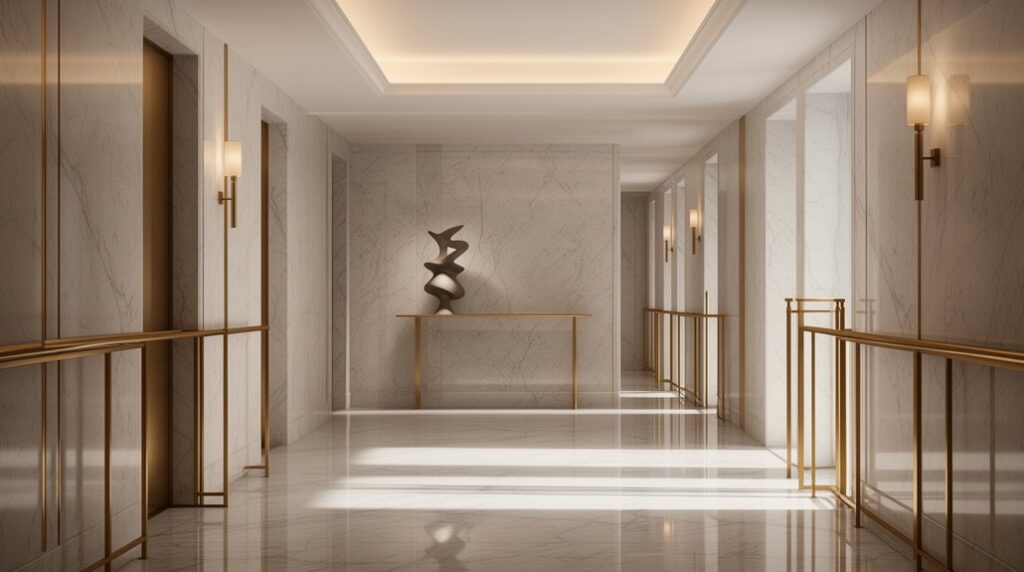

To achieve a high-end hallway with marble and brass, you establish a clear material hierarchy: marble grounds the space with controlled veining, while brass accents provide measured shimmer. Choose marble patterns and tones that align with traffic flow, and select brass finishes—polished or brushed—based on durability and maintenance. Employ layered lighting to reveal veining and depth, balance texture with restrained ornament, and curate furniture to sustain negative space. Continue for deeper guidance on implementation and upkeep.
Set the Foundation: Why Marble and Brass Elevate Hallways
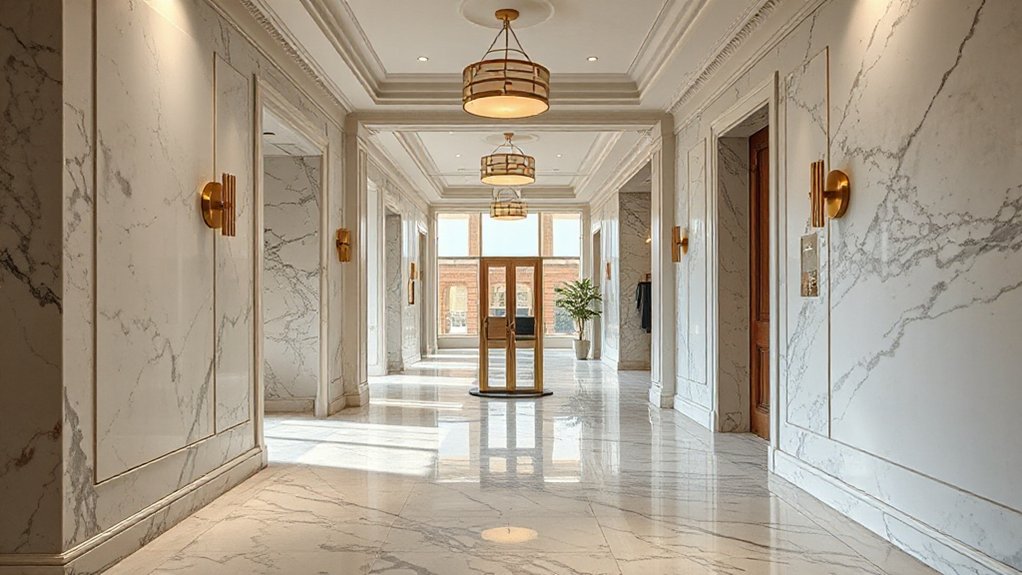
Marble and brass combine to set a refined baseline for hallway design, delivering immediate impact through material honesty and tactile luxury. You appreciate how marble grounds spatial perception, while brass accents yield a controlled shimmer that reads as curated restraint.
This duo establishes hierarchy from entry, guiding sightlines toward focal points without overpowering architecture. In practice, you integrate artistic murals as a calibrated counterpoint, ensuring texture and color remain legible against the mineral palette.
The ceiling details become a complementary stage, with brass trim, recessed lighting, and precise cornice work enhancing acoustic and visual cadence. You prioritize joinery precision, flange alignment, and substrate stability to preserve long-term wear.
The result communicates sophistication, durability, and craft fidelity, elevating the hallway to a curated passage rather than a passive corridor.
How to Assess Your Hallway for Marble and Brass Feasibility
To determine feasibility, assess your hallway’s structure, traffic patterns, and moisture exposure, then map every surface and joinery detail that marble and brass would interact with. You should conduct a condition audit of substrate rigidity, substrate joints, and environmental controls to anticipate differential movement and sealing requirements.
Evaluate load paths, vibration susceptibility, and service routings to guarantee hardware anchorage remains durable under high-use conditions. Consider historical influences and cultural symbolism as guiding constraints for material choice and finish provenance, aligning the design vocabulary with architectural context.
Document tolerance thresholds for humidity, temperature fluctuation, and cleaning regimes to preserve luster. Finally, benchmark maintenance intervals against expected life-cycle costs, confirming feasibility before committing to fabrication tolerances, procurement lead times, and detailed shop drawings.
Choose Marble Patterns for Corridors: Veining, Scale, and Tone
You’ll balance veining intensity with scale to guarantee corridor legibility. Selecting patterns that maintain a cohesive rhythm with brass accents is also important.
Consider tone harmony across the run to prevent visual discord between adjacent panels and edges.
Align veining direction and scale with traffic flow to optimize wayfinding and light reflection.
Veining Intensity Variations
Veining intensity dramatically influences corridor perception, guiding movement and light reflectivity as you choose marble patterns. In this scenario, you evaluate veining patterns for functional messaging and spatial legibility, balancing dynamic emphasis with subtlety.
High-contrast veining creates focal anchors that punctuate wayfinding, while restrained patterns sustain uninterrupted flows along long corridors. Consider scale compatibility: finer veining reads as refined texture at distance, whereas bold, broader strokes assert material presence up close.
Veining intensity interacts with ambient light, modulating brightness distribution and perceived depth; stronger contrasts elevate tactile richness but can overwhelm narrow tracts. Material contrast remains a critical parameter, informing junctions with brass accents and adjoining finishes.
You should document performance metrics across luminance, slip resistance, and maintenance windows to guarantee durable, legible corridors.
Tone and Scale Harmony
Select marble patterns whose scale echoes corridor width, balancing large-format slabs with smaller accents to avoid visual fatigue. Maintain tonal coherence with the architectural palette, leveraging seasonal color palettes to refresh rooms seasonally without altering core materiality.
In practice, coordinate with mechanical runs and reflectivity to optimize glare control, while brass accents anchor focal points and progression. Plan furniture placement to complement veining corridors, preserving clear circulation zones and allowing honest material honesty to inform sophisticated spatial hierarchy.
Selecting Brass Finishes for High-Traffic Zones: Brushed or Polished?
In high-traffic corridors, you’ll compare brushed versus polished brass by durability and wear patterns.
Prioritizing finish stability under frequent contact and cleaning cycles is essential. We assess maintenance implications, noting brushed finishes mask micro-scratches while polishing yields higher reflectivity but requires greater upkeep.
This discussion sets the framework for selecting finishes that balance longevity with visual acuity in busy hallways.
Brushed vs Polished Durability
Brushed and polished brass finishes offer distinct durability profiles for high-traffic zones, where wear patterns and cleaning regimes drive performance. In practice, you assess surface interaction: brushed textures tolerate scuffing and reveal texture with controlled patination, while polished surfaces emphasize reflectivity and require rigorous wipe regimes to maintain sheen.
You’ll encounter abrasion resistance variations tied to alloy composition and coating systems, influencing maintenance cadence and appearance retention under constant footfall. For marble-adjacent corridors, expect brushed finishes to conceal micro-scratches more effectively, whereas polished finishes deliver higher luminance against dark veining, necessitating consistent prophylactic cleaning.
In sourcing, align finishes with brass manufacturing tolerances and coating adhesion specs, ensuring uniformity during long-span installations. Consider marble quarrying implications for color consistency and alloy selection, minimizing chromatic disparity across slotted fixtures.
Maintenance in High-Traffic Areas
Could brushed or polished brass finishes hold up better in high-traffic corridors, and how should maintenance regimes differ accordingly? You assess finish selection in relation to realized abrasion, patination speed, and cleaning frequency, aligning with marble installation requirements and brass polishing protocols.
Brushed finishes typically conceal micro-scratches, while polished surfaces reveal wear sooner; therefore, cleaning cadence and protective measures vary. You implement a calibrated maintenance plan that minimizes surface disruption and preserves uniform luster, integrating industry-standard dispensations for acid-free cleaners and microfiber tools.
- Establish a preventive schedule prioritizing routine brass polishing intervals and marble installation touch-ups to maintain consistency.
- Apply nonabrasive, pH-balanced solutions; avoid abrasive compounds that risk micro-scratching.
- Inspect high-traffic zones weekly, addressing etching risk, corrosion, and equalized patina development to sustain finish integrity.
Lighting to Flatter Marble Veining: Placement, Color, and Brightness
To flatter marble veining, position lighting to emphasize the mineral patterns rather than flatten them, using directional fixtures that cast subtle shadows along the grain. You implement a layered lighting approach, balancing ambient, task, and accent derives to reveal translucency and depth without glare.
Place wall-mounted luminaires at aesthetic midpoints, ensuring even wash while preserving vein articulation; consider cove or floor grazing for edge definition. Select correlated color temperatures that preserve stone warmth—prefer 2700–3000K for brass accents and 3000K for cooler gray marbles, aligning with color schemes to maintain visual harmony.
Use lighting fixtures with high CRI and dimming capability to modulate brightness during display phases. Maintain fixture spacing that respects terrazzo-like grain without introducing hot spots or veiling reflections, optimizing legibility of natural patterns.
Flooring Layouts That Showcase Luxury Materials
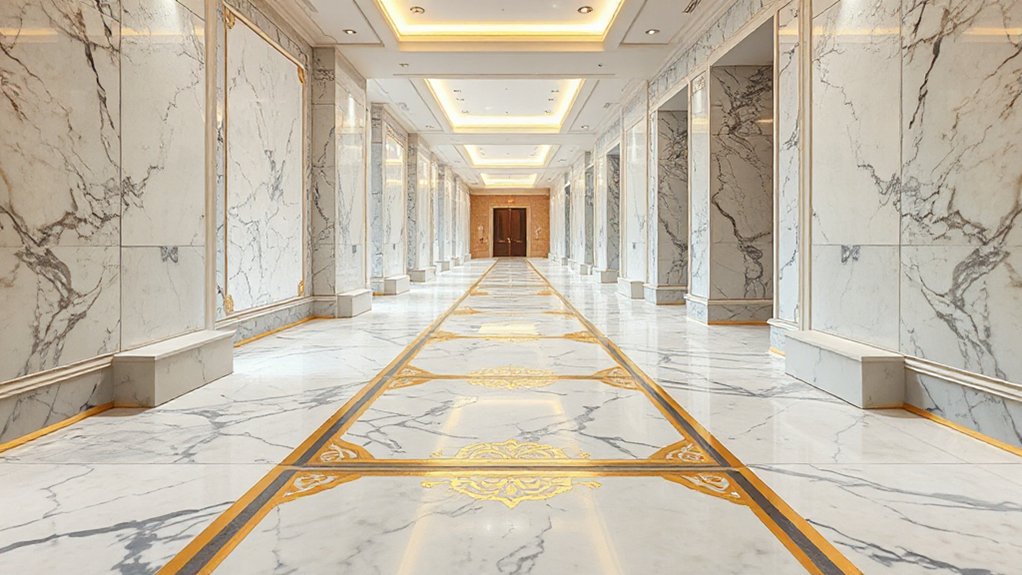
You’ll align flooring layouts to emphasize coordinated marble patterns while ensuring seamless shifts with brass accent placements.
By prioritizing ledger tiles and run-length continuity, you’ll achieve a cohesive material narrative that reads as a single, luxury ensemble.
This approach balances precision geometry with deliberate focal points, guiding movement and visual hierarchy throughout the hallway.
Coordinated Marble Patterns
The Coordinated Marble Patterns approach integrates floor layouts that maximize material integrity and visual impact, balancing vein alignment, tile size, and field-to-mleur shifts to emphasize luxury. You implement strategic seam placement and directional flow to preserve natural veining, while selecting consistent grain for rhythm and depth.
Precision is essential in progressions between slabs, with meticulous subfloor preparation and accurate leveling to prevent telegraphing and pinholes. Look for standardized joint widths that accommodate movement without compromising the marble’s integrity, and document grout color to harmonize with brass accents while avoiding contrast that distracts from the pattern.
marble installation, brass cleaning.
- Align vein orientation across openings to sustain continuity
- Coordinate tile sizes for proportional scale and perceived luxury
- Schedule substrate preparation and inspection prior to laying
Brass Accent Placement
Brass accents should be positioned to complement marble patterns without overpowering them, using precise alignment with vein direction and floor seams established in the prior layout work.
In this phase, you evaluate transition points where brass detailing meets marble field tile, ensuring consistent grout lines and junction tolerances.
Place trims at key corridor nodes where traffic concentrates, leveraging linear runs that mirror the floor’s intrinsic geometry.
Coordinate brass inlays with vein orientation to maintain visual flow, and apply masking during installation to prevent unwanted scribe drift.
For maintenance, plan brass cleaning protocols that minimize chemical exposure to marble surfaces, preserving luster without etching.
Document each placement metric, including spacing, alignment, and joint treatments, to support repeatability across adjacent zones.
Console Designs That Complement Marble and Brass
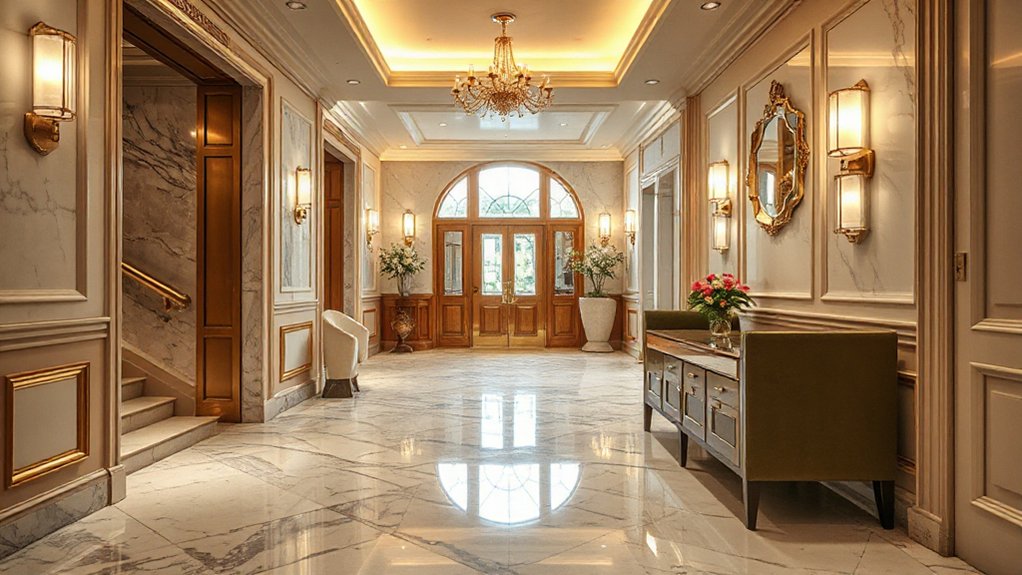
What console designs best complement marble and brass by balancing texture, scale, and finish? You’ll select silhouettes that read refined yet restrained, ensuring the marble’s veining remains the focal point while brass accents provide contrast.
Prioritize low-to-medium profiles and bass‑heavy bases to preserve proportion with wall panels and artwork. Then align hardware with metallic undertones for cohesive glow.
Incorporate tactile surfaces—lacquered wood, parchment‑like veneers, or stone—in restrained palettes to avoid visual clutter. Include features such as Artistic mosaics or inlaid brass details to echo the room’s ornamentation, and consider Vintage fixtures that reinforce period coherence without overpowering the composition.
Aim for symmetry with lighting and accessories to sustain a disciplined, gallery‑like hallway cadence.
- Symmetrical silhouettes with restrained ornamentation
- Inlaid brass detailing paired with marble tops
- Mounted lighting and curated accessories for tonal harmony
Hardware Choices That Tie the Look Together
When selecting hardware, you balance brass finish pairings with marble grip finishes to create a cohesive tactile and visual rhythm. Consider subtle brass tones that echo cabinet hardware and door pulls while preserving the marble’s integrity and light reflection.
This discussion focuses on achieving durable finishes, precise tolerances, and consistent patina across high-use hallway applications.
Brass Finish Pairings
Pairing brass hardware with marble interiors requires deliberate selection to guarantee cohesion and longevity. You’ll balance surface patina with material density, ensuring a consistent narrative across textures and finishes. Focus on brass color options that preserve contrast without overpowering veining, and prioritize hardware profiles that complement marble durability under high-traffic conditions. Precision in finish tolerances minimizes perceptual mismatches between grout lines and escutcheons, promoting a seamless corridor rhythm.
- Define brass tones (polished, satin, matte) to align with marble veining intensity and lighting strategy.
- Calibrate hardware scale to marble slab dimensions, maintaining proportional contrast.
- Pair complementary metal accents (nailheads, hinges) with unified patination to sustain long-term visual cohesion.
This approach yields a timeless, high-precision hallway aesthetic without sacrificing durability or accessibility.
Marble Grip Finishes
In practice, you select profiles that resist smudging while delivering consistent abrasion resistance, ensuring continuity with adjacent brass hardware. Marble grip finishes must harmonize with brass patina, balancing cool undertone shifts against warm metallic highlights.
Consider depth of carve, radii on pull surfaces, and finish uniformity across runs to prevent perceptual modulations that disrupt cadence. You couple polished or satin marble with sealed interiors to preserve tactile fidelity under high-traffic conditions.
Finally, you document maintenance matrices, clarifying cleaning protocols, patina stabilization, and replacement cycles to sustain finishes that read as cohesive, enduring design language.
Wall Treatments That Enhance Reflective Surfaces
Strategic wall treatments that amplify reflective surfaces leverage material sheen, light diffusing qualities, and edge detailing to maximize luminosity and perceived depth. You select finishes that mirror, refract, or scatter light, coordinating with marble and brass accents to maintain a cohesive tonal range.
The approach integrates seamless junctions, subtle chamfers, and restrained ornament to preserve clarity and avoid glare. Incorporate architectural details that cue depth, such as linear grooves or tactile textures, while ensuring durability in high-traffic hallways.
Artistic murals and ceiling textures should be considered as accent vocabularies that still respect reflectivity and proportion within the corridor’s geometry.
- Strategic mural integration that aligns with brass highlights and marble veining
- Subtle ceiling textures that diffuse glow without compromising reflectivity
- Edge detailing and panel rhythm that sustain luminous continuity
Color Stories That Pair With Marble and Brass
Subtle tonal variations—warm greiges, cool alabasters, and charcoal accents—create depth while preserving clarity in circulation paths. You’ll pair matte plaster or limestone with brushed brass fixtures to modulate glare and cast gentle shadows along architectural rhythms.
Consider artistic motifs drawn from mid‑century abstraction or classical ornament, implemented as repeats in rugs, canvases, or textiles to reinforce the palette. The result delivers refined contrast, legibility, and a timeless, gallery‑like cadence throughout the hallway.
Storage Ideas That Keep the Statement From Crowding the Space
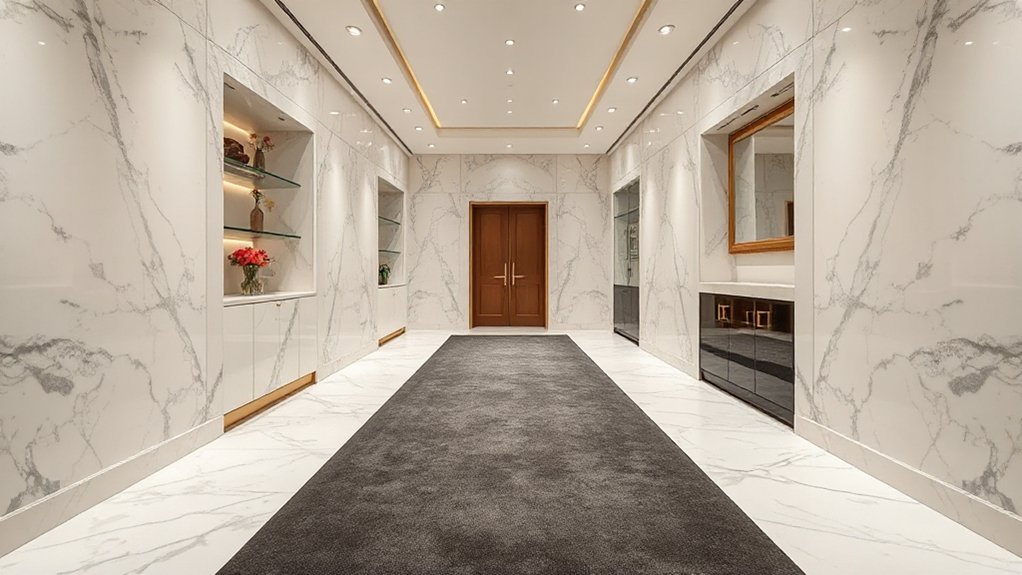
To prevent the statement from crowding the hallway, implement intelligent storage that preserves the marble-and-brass drama while maintaining clear sightlines. You optimize proportion, concealment, and access, aligning with color psychology to keep visual weight balanced and calm. Acoustic treatment is integrated where practical to minimize resonance from footfall and doors, preserving perceived space.
- Custom alcove niches with shallow depth and reflective interiors to enhance light bounce without intruding on flow.
- Slim, pull-out consoles or flankers in neutral finishes with concealed hardware, preserving clean lines and allowing selective display.
- Hidden organizers within cabinetry, pairing magnetic or push-to-open mechanisms with micro-foam seals for sound dampening and elegance.
Balancing Pattern and Texture for a Calm Hallway
Balancing pattern and texture in a calm hallway hinges on deliberate restraint: use a restrained palette and repeat motifs with subtle irregularity to prevent visual fatigue. You should calibrate contrast through measured surface finishes and scale variation, ensuring each element reinforces a cohesive narrative rather than competing signals.
In practice, limit the number of patterns to two or three domestic-right-angles terms, and deploy texture through material depth—marble veining, brass detailing, and textile wall accents—without saturating sightlines. Consider interior lighting as a unifying vector, selecting indirect luminance to reveal texture without glare.
Plan furniture placement to preserve negative space, aligning consoles and seating with sightlines for unobstructed traversal. Maintain restrained repetition across borders, caps, and hardware to sustain serenity while signaling refinement.
Budgeting Smartly to Maximize Perceived Luxury
By leveraging smart budgeting, you can amplify perceived luxury in a hallway that features marble and brass accents without inflating costs. Strategic allocation prioritizes impact zones—artistic lighting, furniture placement, and finish selection—to yield high perceived value with controlled spend.
You optimize materials by choosing cost-efficient composites, enduring brass finishes, and precise fabrication tolerances, ensuring longevity without overcapitalization.
- Prioritize artistic lighting fixtures with sculptural impact and dimming control to modulate ambiance without frequent replacement.
- Optimize furniture placement to create focal axes, leveraging negative space and scale while minimizing accessory density.
- Channel finish fidelity through calibrated contrasts—matte backgrounds with high-gloss reflects—to heighten perception of refinement without premium surcharge.
Maintenance Routines for Marble and Brass
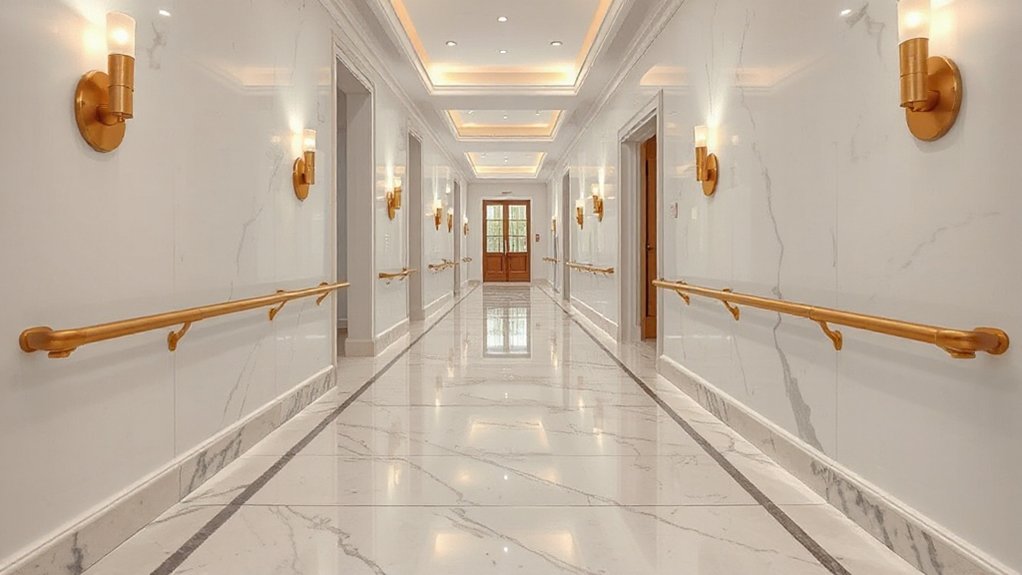
Marble and brass demand disciplined care to preserve their aesthetic and structural integrity in high-end hallways. You implement a maintenance cadence that targets surface protection, microabrasion, and patina control without compromising finish.
For marble, seal annually with a penetrating, impregnating product suited to calcium carbonate substrates, and employ pH-balanced cleaners to avoid etching.
Brass requires gentle brass-plate care, periodic polishing with a non-abrasive, residue-free compound, and avoidance of harsh acids that induce tarnish.
Establish moisture management protocols for joints and thresholds, and document observed wear patterns to guide timely restorations.
Align routine maintenance with high-traffic dynamics, incorporating garden decor considerations adjacent to passages and ensuring outdoor lighting components are shielded from moisture exposure while maintaining visual consistency.
Regular inspections underpin aesthetic longevity and structural reliability.
Quick-Start Checklist to Begin Your Marble-Brass Hallway Design
To start your marble-brass hallway design, gather your baseline specifications and establish a clear scope for materials, geometry, and environmental controls. You’ll translate abstract goals into actionable parameters, aligning artisan capabilities with project constraints. Focus on performance metrics, finish tolerances, and fabrication sequences to mitigate rework.
Consider acoustics, luminance, and thermal stability as they relate to marble veining and brass patina. This approach supports an integrated art installation mindset and informs ceiling design decisions as well as wall and floor systems.
- Define material grades, machining tolerances, and joint detailing to guarantee seamless alignment between marble slabs and brass profiles.
- Establish lighting, HVAC, and humidity controls to preserve finish integrity and color accuracy.
- Sequence procurement and installation milestones with contingency buffers for bespoke elements.
Frequently Asked Questions
How Do I Protect Marble From Everyday Hallway Wear and Tear?
You protect marble from everyday wear by instituting a strict cleaning regimen and protective measures: implement Marble cleaning protocols nightly, seal quarterly, and employ runners; perform Brass polishing as needed to prevent tarnish, preserving sheen and durability.
Can Brass Items Cause Allergic Reactions or Tarnish Quickly?
Brass items can trigger brass allergies for some individuals and tarnish quickly without proper care. You should implement tarnish prevention via protective finishes, regular polishing schedules, and nickel-free alloys to minimize reaction risk and maintain finish integrity.
What Is the Ideal Thickness for Marble Panels in Hallways?
You’re best off with marble panels around 3/4 inch thick for hallways. Guarantee precise substrate, controlled expansion joints, and professional marble installation; regularly inspect joints. Brass cleaning protocols recommended to prevent corrosion and maintain polished luster.
Are There Cost-Effective Alternatives to Full Marble and Brass?
Like a tempered glass beacon, yes—you can use porcelain-look tiles with brass accents as cost-saving stand-ins. You should schedule Marble cleaning and Brass polishing, ensuring depth and luster while maintaining professional, precise finish in your hallway project.
How Often Should I Schedule Professional Maintenance for These Materials?
You should schedule professional maintenance every 12 to 18 months. For Marble cleaning and Brass polishing, rely on certified technicians to safeguard finishes, address etching, corrosion, and tarnish, and minimize long‑term darkening or etched halos in high‑traffic hallways.
Conclusion
In contrast to sterile corridors, marble’s restraint and brass’s warmth craft a hallway of poised drama. You weigh restraint against opulence, texture against gloss, light against shadow, and find harmony where materials clash—yet complement. The luxury isn’t in excess but in precision: veining that guides flow, finishes that endure, and lighting that reveals depth. When you balance durability with discipline, your passage becomes a curated gallery: enduring elegance that welcomes yet resists obsolescence.