


Did you know that up to 60% of narrow terraced kitchens feel cramped because layouts don’t optimize flow? In tight spaces, you’ll want a practical plan that prioritizes a clear work triangle, efficient storage, and smart lighting. Galley, L-shaped, or hybrid configurations can transform a slim footprint into a functional kitchen with room to move, cook, and clean. But the best choice hinges on your terrace’s exact width and depth, and a few design tweaks can make all the difference.
Key Takeaways
- Favor galley layouts with two parallel work zones for efficient flow from fridge to sink to cook.
- Use L-shaped or hybrid configurations to maximize corner storage and add a slim island or peninsula for extra prep space.
- Implement tall cabinets, pull-out drawers, and clever corner solutions to maximize storage in narrow widths.
- Layer lighting (ambient, task, under-cabinet) and reflective, light-colored finishes to visually expand the space.
- Prioritize durable, weatherproof materials and robust ventilation for terrace environments.
Key Design Criteria for Narrow Terraced Kitchens
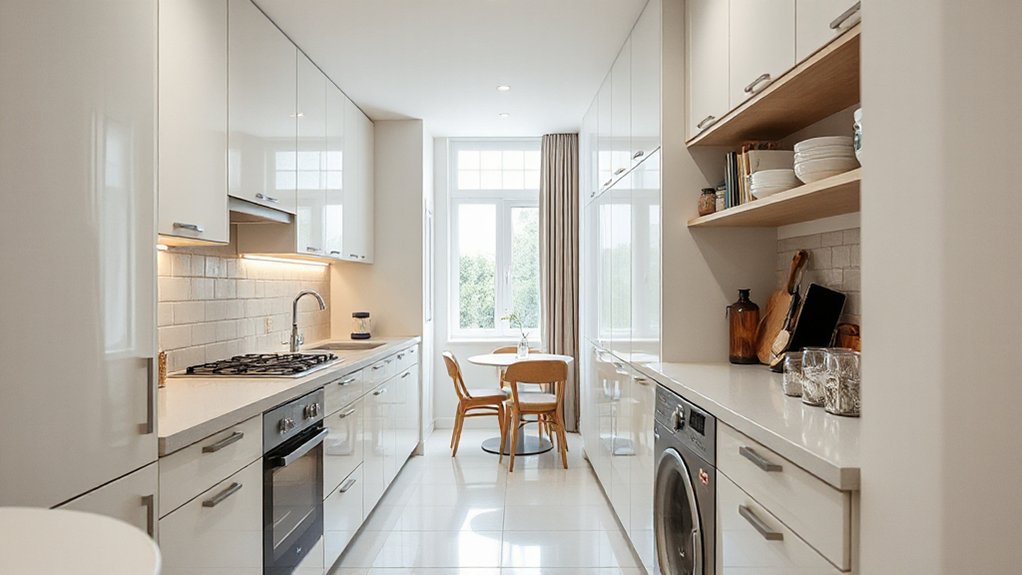
In narrow terraced kitchens, every inch matters, so start by defining a clear work triangle: cooktop, sink, and prep area should form a logical loop with minimal reach. You’ll optimize cabinet depth, appliance size, and corridor width to keep movement fluid and safe.
Prioritize counter surfaces that resist stains and are easy to wipe, and choose storage that reduces clutter without sacrificing function. Open shelving can reveal essentials while keeping digestion of space balanced; it rewards frequent-use items and pairs well with low-profile lighting.
A statement backsplash anchors the room, guiding color and texture without visually crowding.
Finally, plan for flexibility: consider future upgrades, integrated tech, and accessible storage that remains comfortable for daily routines.
Galley Layouts: When Short Widths Demand Streamlined Flow
In a galley with narrow width, you’ll optimize a clear path from fridge to sink to stove, keeping traffic steady and unobstructed.
This layout emphasizes galley ergonomics essentials—short spans, purposeful work zones, and efficient flow that makes a compact kitchen feel larger.
Your focus on narrow kitchen design means prioritizing streamlined sightlines, accessible storage, and precise placements for every tool.
Narrow Width, Clear Path
When space is tight, a galley layout channels movement and efficiency with two parallel work zones and a clear, linear path from entrance to the far end. You’ll optimize every inch by placing primary prep near the sink and cooktop on the opposite side, preserving a steady workflow.
Narrow widths reward a minimalist footprint: shallow upper cabinets, open shelves, and drawer dividers that reduce clutter. A pedestrian-friendly corridor keeps traffic predictable, so you won’t disrupt serious cooking.
If you crave sociability, add a small, compact breakfast bar or outdoor dining connection at the far end to extend the kitchen’s reach.
Consider architecture-friendly finishes that reflect light and mood, and use Kitchen islands sparingly to maintain flow while anchoring task zones. This approach supports practical, aspirational living.
Narrow Kitchen, Efficient Flow
Even in tight spaces, a galley layout excels by keeping two parallel work zones aligned and a clear corridor from entrance to far end. You optimize narrow width by prioritizing efficient traffic flow, placing the primary workstation along one wall and the prep area opposite it.
Open shelving within arm’s reach reduces clutter and speeds retrieval, while keeping counters clear for task surfaces. Use a linear run for appliances to minimize steps and maintain a clean, uninterrupted workflow.
Choose a statement backsplashes to anchor the design, adding personality without visual congestion. Lighting should be layered: bright task lighting above work zones, plus understated ambient tones to widen the perception of space.
Finish materials lean durable and easy to wipe, reinforcing practical, goal-driven efficiency.
Galley Ergonomics Essentials
Galley layouts in tight widths demand a precise rhythm: two parallel work zones aligned, with every inch optimized for flow. You organize tasks along a clean corridor: prep near the sink, cooking toward the range, cleanup trailing you toward the exit.
Precision matters because narrow spaces punish clutter. Keep lines short, sightlines clear, and appliance footprints intentional to avoid bottlenecks. Prioritize a logical sequence that reduces cross-traffic and fatigue, especially during peak cooking.
Regular Kitchen maintenance keeps gleaming surfaces and reliable functions, preventing slowdowns during busy mornings. Place major appliances with careful thought to reachability; appliance placement should minimize reaches and awkward twists.
Integrate pull-out drawers, angled corner storage, and zone markers to reinforce discipline. In short, streamlining workflow elevates efficiency and enjoyment in compact galley kitchens.
L-Shaped and Hybrid Layouts for Flexibility in Tight Spaces
An L-shaped layout helps you partition work zones while keeping sightlines clear, so you can move from prep to cooking without crossing paths.
Combine an L with a compact island or peninsula for added counter space, storage, and a flexible dining edge that adapts to your needs.
Hybrid configurations amplify this flexibility, letting you swap island roles, open up flow for entertaining, or tuck away appliances where you least expect them.
L-Shaped Flow Benefits
Could an L-shaped or hybrid kitchen finally give you the flexible footprint your tight terrace needs? In practice, an L-shaped flow concentrates work zones along two walls, reducing cross-traffic and improving ergonomic circulation. This layout keeps prep, cooking, and cleanup in clear, connected bands, so you move naturally without backtracking.
- Maximize corner use with tall cabinets and integrated appliances to preserve floor space.
- Create a clear work triangle by aligning sink, stove, and fridge along adjacent walls for smooth progression.
- Use a peninsula or island to add prep space without interrupting circulation.
This approach feels deliberate, efficient, and aspirational, delivering steadier daily rhythm, better sightlines, and a sense of openness within a compact footprint.
Hybrid Layout Flexibility
Hybrid layouts blend the efficiency of an L-shaped flow with the flexibility of modules that can be reconfigured as your space changes, making them ideal for tight terraces.
You gain incremental adaptability: movable islands, collapsible counters, and zones that shift from prep to casual dining without reworking walls. This approach preserves circulation, minimizes wasted steps, and helps you tailor kitchen aesthetics to changing needs.
You can extend the dining surface for outdoor meals, then tuck it away for compact days.
Storage can be modular, hiding blades, lids, and small appliances behind doors that stay aligned with your lines.
Maintenance remains straightforward, since components are planned for access and durability.
U-Shaped and Parallel Layouts for Multiple Work Zones
A U-shaped or parallel kitchen layout creates clear, efficient work zones that let you move between cooking, prep, and cleaning without crossing paths. You’ll optimize traffic flow by separating zones, keeping utensils handy, and reducing steps. This setup supports multiple cooks and deliberate organization, so you can stay focused while you multitask.
1) Island integration enhances communication and acts as a central pull for occasional tasks.
2) Corner storage uses dead space with tall cabs and lazy Susans to maximize access.
3) Counter triangles stay tight, so you reach the sink, prep area, and hob in a natural arc.
This approach is pragmatic, detail‑driven, and aspirational—delivering practical efficiency without sacrificing style.
Slimline Appliances and Smart Storage for Maximum Square Footage
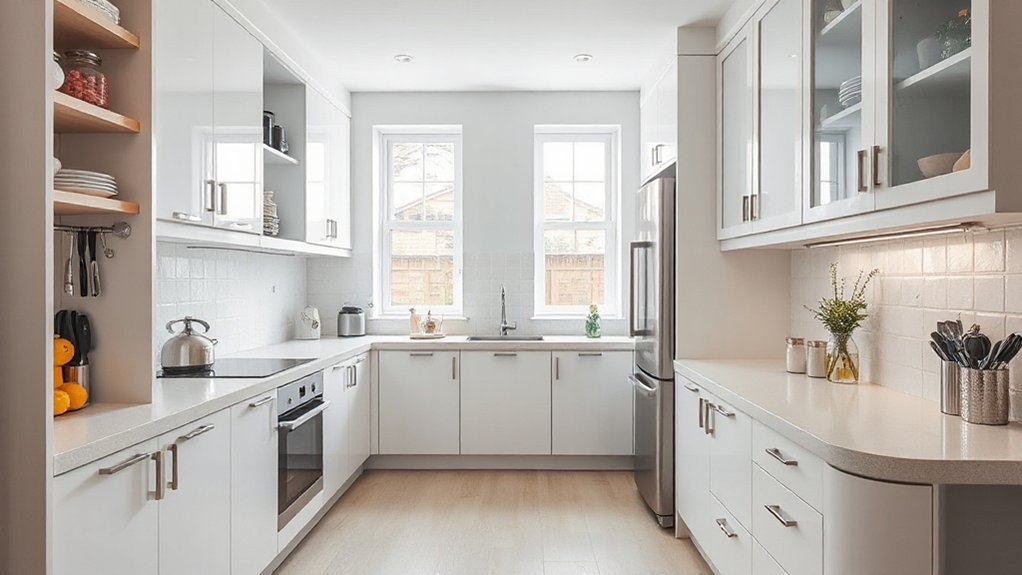
Slimline appliances are the backbone of a high‑efficiency kitchen in narrow terraced layouts, letting you maximize every inch without sacrificing performance. You pair compact devices with full‑size capability, prioritizing integrated controls and hidden ventilation to maintain clean sightlines.
Appliance integration keeps workflows seamless; a single interface can manage cooking, refrigeration, and prep zones without clutter. Choose multi‑function units that reduce gaps, and install top‑mounted controls for quick access while you work.
Storage optimization follows, with tall pantry modules, pull‑out organizers, and corner carousels designed for reach and visibility. Use adjustable shelves and labeled bins to minimize rummaging, so you reclaim counter space for prep.
In this approach, precision planning yields practical, aspirational results: efficient corners, proactive storage, and a kitchen that feels expansive yet intimate.
Lighting, Color, and Materials to Visually Expand a Narrow Kitchen
To visually expand a narrow kitchen, you’ll leverage lighting, color, and materials that reflect and deliberate space rather than crowd it. You’ll combine ambient lighting with bright surfaces to reduce shadows and read as open.
Choose cohesive color schemes that extend beyond cabinets into walls or backsplashes, creating a unified, airy feel.
Materials should reflect light—glossy tiles, polished countertops, and glass accents—while remaining practical for a narrow workflow.
- Ambient lighting layers: ceiling fixtures, under-cabinet LEDs, and task lights to erase tight corners.
- Color schemes: light neutrals with subtle cool undertones to widen perceived depth.
- Material choices: reflective surfaces paired with durable textures to balance brightness and usability.
Choosing the Right Layout Based on Your Terrace Footprint
Choosing a layout that fits your terrace footprint starts with a clear map of available width, depth, and access points. You evaluate fixed elements—doors, windows, service lines—and note where traffic slows or bottlenecks form.
From there, prioritize efficient work zones: prep, cook, clean, and storage should align with natural footpaths to minimize crowding. If your terrace is narrow but long, consider a galley or L-shaped plan that preserves open sightlines while buffering movement with defined zones.
For small setbacks, prioritize outdoor integration, pairing compact appliances with fold-away surfaces to extend prep space without crowding. Budget planning guides decisions on durable materials and weatherproof finishes that last.
Finally, guarantee ventilation and moisture controls suit your climate, reinforcing a practical, aspirational kitchen you’ll actually use daily.
Frequently Asked Questions
How Can You Measure Practical Walking Clearance in a Narrow Kitchen?
You measure practical walking clearance by mapping your traffic flow from door to work zones, ensuring at least 36 inches (90 cm) of unobstructed space in high-use corridors.
Mark clearances at counters, appliance fronts, and island edges, then test with a full grocery haul to confirm ergonomic design.
Adjust cabinet overhangs or add a slim pull-out, if needed.
Recalculate after changes, prioritizing smooth movement, safety, and a confident, aspirational layout.
What Budget Ranges Suit Compact Terrace Kitchen Remodels?
You’ll find compact terrace kitchen remodels typically fit budgets from £5,000–£15,000 for basics, up to £20,000–£40,000 for full upgrades, appliances, and finishes.
Start with appliance placement to maximize flow, then invest in smart storage solutions that reclaim counter space.
If you’re aiming higher, allocate extra for durable materials and professional help.
You’ll gain longer-lasting value by prioritizing efficient layouts, precise measurements, and tidy, well-lit work zones.
Are There Door or Window Placements That Hinder Layouts?
Door placement and window positioning can quite heavily constrain layouts, yes. You’ll want doors not to swing into work zones, and windows aligned with prep spaces to maximize light without glare.
Avoid obstructing paths with awkward door swings or pocket doors that eat counter space. Consider traffic flow from living areas, and place openings where you can, maintaining symmetry and ease of access.
Pro tip: minimize walls near corners to keep aisles clear and comfortable.
Can You Upgrade Plumbing Without Removing Walls?
Yes, you can upgrade plumbing without removing walls. You’ll plan carefully, map routes, and work with access points to minimize disruption.
Plumbing rerouting becomes feasible with small, strategic trenching or access panels, preserving structure. You’ll also think about wall concealment to hide new lines neatly behind cabinets or drywall.
This approach keeps your project practical, ambitious, and tidy, letting you upgrade efficiency while maintaining a clean, cohesive, and functional space.
Which Retrofit Lighting Improves Perceived Space Without Wiring Chaos?
Ambient lighting and LED solutions can visually expand a space by washing walls with soft, even light and avoiding harsh shadows.
You’ll want layered lighting: ambient base, task accents, and subtle coci—calibrated to keep wiring neat.
Retrofit options like recessed LED strips, dimmable fixtures, and slim pendant lights minimize chaos.
You’ll perceive more openness, color accuracy improves, and you stay flexible for future changes.
Trust heat-dissipation ratings and plug-in options to simplify installation.
Conclusion
You’ve seen how galley, L-shaped, and hybrid layouts transform narrow terraced spaces into efficient work zones. With slimline appliances, smart storage, and lighting that enlarges the room, you can create a kitchen that feels both practical and aspirational. Picture seamless prep along parallel counters, a clever corner for spices, and glow from above that makes every task effortless. Ready to pick the layout that fits your terrace footprint and elevate everyday cooking?


