


Start by setting rules: lock a restrained palette (three neutrals, one muted accent, one wood/metal) and repeat consistent matte/satin finishes. Plan flow and sightlines with 36–42-inch walkways, a clear focal line, and seating grouped within 8 feet. Anchor rooms with timeless materials—oak, honed stone, wool rugs—and clean silhouettes, then add one crafted hero piece per zone. Hide clutter with flush storage, and layer dimmable ambient, task, and accent lighting. Keep going to see the easy swaps that keep it current.
Key Takeaways
- Use a restrained palette: three neutrals, one muted accent, and one wood or metal tone, tested in changing natural light.
- Choose clean-lined, enduring silhouettes with gentle curves, and limit patterns to one quiet hero motif for visual longevity.
- Layer timeless textures—linen, bouclé, wool, honed stone, brushed metals—to add depth without relying on trendy colors.
- Plan calm, functional layouts: clear 36–42 inch walkways, balanced sightlines, and properly sized rugs anchoring seating and conversation zones.
- Build in disciplined storage and rotate art and accessories to refresh the space while keeping core finishes, furniture, and symmetry consistent.
Set Your Timeless Contemporary Rules
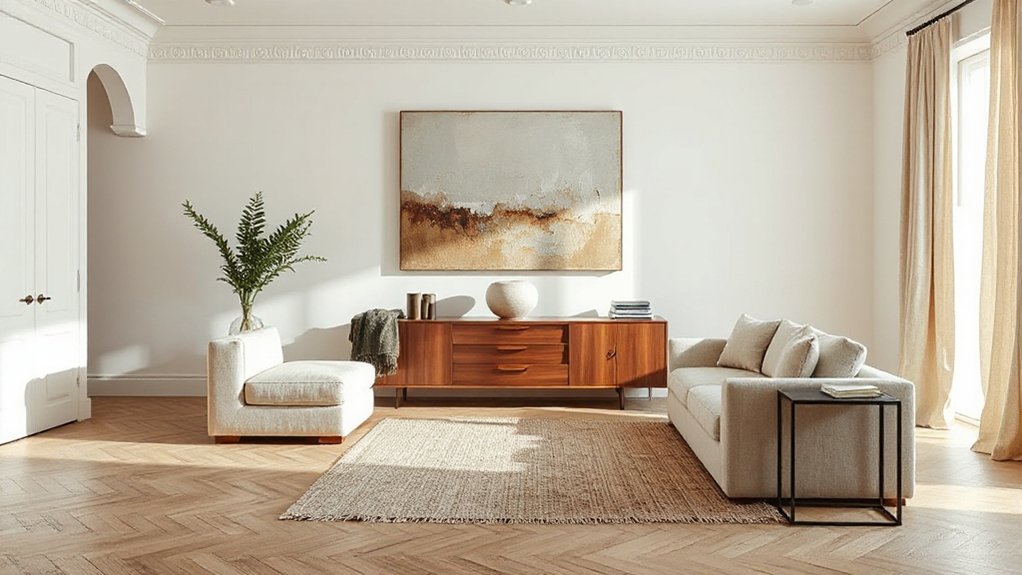
Where do you start when “timeless” and “contemporary” seem like opposites? You set rules that filter every choice.
First, lock in a restrained palette: three core neutrals, one muted accent, and one metal or wood tone. That’s Color harmony without chasing micro-trends.
Next, choose enduring shapes: clean-lined silhouettes, gentle curves, and low-contrast patterns that won’t date fast.
Then standardize finishes—matte, satin, or brushed—so new pieces won’t fight existing ones.
Commit to spatial symmetry at key moments, like paired lighting or balanced art groupings, to create calm structure.
Finally, cap your “statement” count: one hero element per zone, and everything else supports it. These rules keep the room current, not chaotic.
Plan the Layout, Sightlines, and Flow
Those rules only work if the room moves the way it should, so map your layout before you shop. Start with circulation: keep main walkways 36–42 inches clear, and avoid forcing detours around sofas or dining chairs. Anchor the room with one strong focal line, then place larger pieces first to confirm scale and proportion.
Next, control sightlines. From the entry, you should see a calm, intentional view—art, a window, or a sculptural chair—not the side of a TV or cluttered surfaces.
Use Furniture arrangement to frame conversation: seat people within 8 feet, align fronts of chairs to rugs, and keep coffee tables 14–18 inches from seating.
Maximize natural light by keeping tall pieces off window walls and angling seating toward it.
Build In Storage That Looks Intentional
If you want a contemporary room to feel timeless, you can’t treat storage as an afterthought—it has to read like part of the architecture. Start by mapping what must disappear daily, then allocate built-ins to the room’s natural planes: alcoves, soffits, and full-height walls.
Specify flush fronts, tight reveals, and consistent panel rhythms so cabinetry feels intentional, not “added on.” Use push-latch doors or integrated pulls to keep lines clean, and add hidden compartments for charging drawers, media hubs, and valet trays.
Balance closed volumes with minimalist shelving, but control clutter with defined shelf heights and a limited display zone. Finish with durable materials and edge details that match your trim and door profiles for cohesion.
Choose a Timeless Contemporary Base Palette
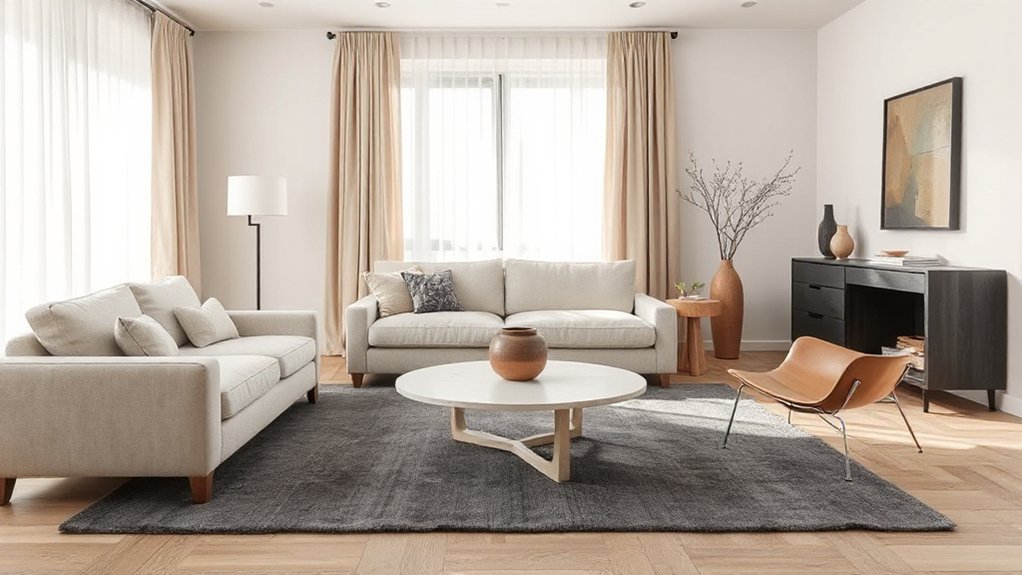
A timeless contemporary room starts with a restrained base palette that does most of the work before you add any “decor.” Anchor the space in warm whites, soft greiges, muted taupes, or mineral-driven grays with stable undertones (avoid anything too icy, too yellow, or overly saturated). Then repeat that core color family across walls, ceilings, and foundational upholstery for visual continuity.
Use Color psychology to guide undertones: warmer neutrals read welcoming and calm, while cooler minerals feel crisp and focused. Evaluate samples in Natural lighting at morning, noon, and night, because shifting daylight can reveal pink, green, or violet casts that won’t age well.
Choose one finish level per surface category—matte walls, low-sheen trim, textured upholstery—so the palette feels intentional, not piecemeal.
Pick 1–2 Accent Colors (Not Ten)
With your neutral base palette locked in, accent colors should do one job: add controlled contrast without hijacking the room. Limit yourself to one hero hue and, at most, one supporting shade to keep the look crisp and contemporary.
Choose Accent color pairing with a clear temperature logic: warm neutrals love rust, tobacco, and olive; cool grays sharpen with navy, ink, or forest.
Apply Color contrast techniques deliberately—use saturation for small, high-impact pieces (pillows, art, a single chair), and keep large surfaces quiet.
Repeat the accent at least three times across the room at varied heights to feel intentional. If you crave more variety, shift texture and pattern, not the palette.
Use Materials That Patina Beautifully
Why fight time when you can design for it? Choose surfaces that look better with use, not worse. Prioritize natural stone with movement, unlacquered brass, oiled hardwood, and saddle leather—materials that register touch, light, and air as character, not damage.
Specify finishes that can be refreshed without stripping, and select textures that hide micro-scratches while still reading crisp and contemporary. Plan for Patina development by placing these materials where hands, sunlight, and daily rituals will interact with them: pulls, countertops, stair rails, desk tops.
Respect Material aging by understanding maintenance realities—wax, oil, gentle cleaners—so wear stays intentional. You’ll get a room that evolves, then stabilizes into quiet permanence.
Repeat Finishes: Metals, Wood Tones, Sheens
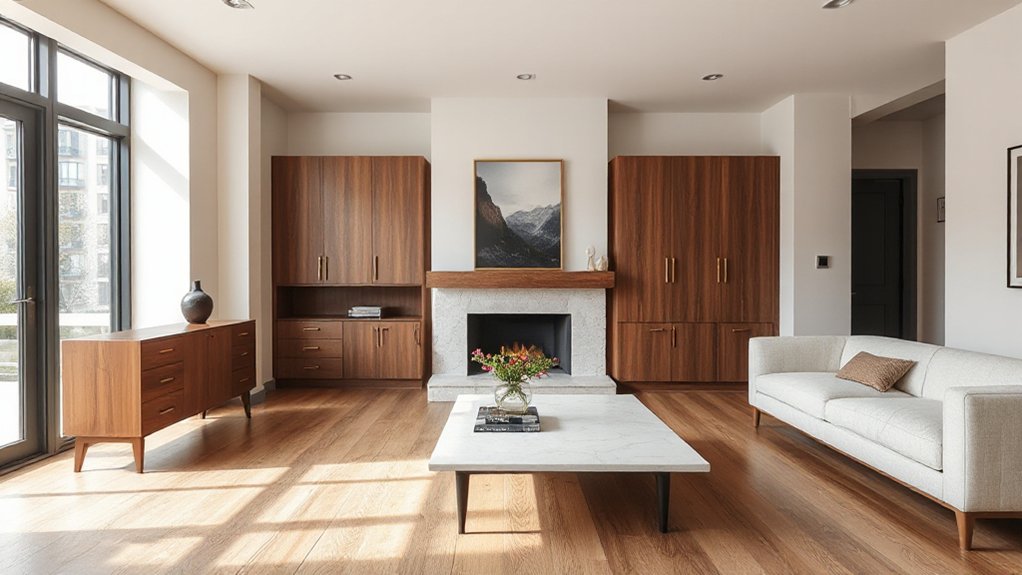
You’ll get a more intentional, contemporary look when you echo metal finishes—repeat the same brass, blackened steel, or chrome note across lighting, hardware, and plumbing.
You’ll also want to repeat wood tones so casework, flooring, and key furniture read as a cohesive palette rather than a patchwork.
Finally, balance surface sheens by mixing matte and satin with a few controlled gloss accents, so the room feels layered, not busy.
Echo Metal Finishes
Even if you love mixing eras and materials, a contemporary space reads more intentional when you echo metal finishes across the room. Pick one dominant finish—warm brass, cool chrome, or soft blackened steel—then repeat it at least three times: lighting, cabinet hardware, and a mirror frame or table base. This controlled repetition keeps your mix feeling curated, not chaotic.
Stay trend-aware by balancing sheen levels. Pair polished pieces with brushed or satin versions in the same family to avoid glare while still catching light. Use metal finishes to punctuate key sightlines: entry, seating area, and kitchen perimeter.
Finally, reinforce the look with echoing textures—ribbed glass, stone veining, or woven upholstery—so the metals feel integrated, not pasted on.
Repeat Wood Tones
Although contemporary rooms welcome contrast, repeating wood tones is what makes the mix feel deliberate instead of accidental. Choose a dominant family—warm walnut, neutral oak, or deep espresso—and let it show up at least three times across the room: casework, furniture legs, and a frame or shelf. That repetition creates Tone consistency without forcing everything to match.
For smart Wood pairing, keep species varied but undertones aligned. If your floor reads golden, avoid a pink-toned cherry table; instead, pick ash, rift-sawn oak, or walnut with a similar base. Use contrast through grain scale and silhouette, not random color shifts.
When you introduce a second wood tone, cap it at 20–30% and repeat it twice so it feels intentional.
Balance Surface Sheens
When every finish competes for attention, a contemporary room starts to feel busy instead of refined. Balance surface sheens by choosing a clear hierarchy: one dominant sheen, one supporting, one accent.
Anchor with matte or eggshell on large planes like walls, millwork, and casework to keep glare down and let form read cleanly. Add mid-sheen satin on cabinetry or textiles for durability without shine overload.
Then use high-gloss sparingly—lacquered art frames, a glazed tile strip, or a polished stone top—to create deliberate highlights.
Repeat metals consistently: stick to one family (brushed nickel, blackened steel, warm brass) and echo it in three places.
Mix material textures, but keep surface finishes coordinated.
Mix Clean Lines With Classic References
You’ll keep a contemporary space timeless when you pair modern profiles with traditional details—think crisp cabinetry edged with a subtle bead, or a clean sofa framed by tailored welt.
Anchor streamlined forms in heritage materials like marble, oak, or aged brass so the room reads current without feeling disposable.
Keep the references edited and intentional, and you’ll get that on-trend “new classic” balance that lasts.
Modern Profiles, Traditional Details
To make a contemporary room feel timeless, pair modern profiles—slim silhouettes, crisp edges, and low visual clutter—with traditional details that signal craftsmanship.
Choose a sofa with tight track arms, then echo it with welting, a tailored skirt, or a subtle flange.
Use Traditional motifs with restraint: a Greek-key border on a rug, a quiet toile on pillows, or a reeded edge on a mirror.
Add Ornamental details where the hand should land—turned pulls, small rosettes, beaded trim, or a finely routed cabinet stile—so they read as intentional, not fussy.
Keep scale disciplined: one hero piece with classic referencing, then let supporting pieces stay clean.
You’ll get crisp modernity, plus the familiarity that ages well.
Streamlined Forms, Heritage Materials
Even if the silhouettes stay razor-clean, heritage materials add the visual gravity that keeps a contemporary room from feeling disposable. Anchor streamlined silhouettes with oak, walnut, limestone, or patinated brass, then let the joinery do the talking—reveals, chamfers, and shadow gaps read modern while respecting craft.
Choose Heritage textures that age well: honed stone over polished, saddle leather over faux, wool bouclé over slick synthetics. Keep profiles simple—slab fronts, thin frames, monolithic plinths—so the material carries the story without competing ornament.
Repeat one classic reference per zone, like reeded glass, woven cane, or hand-troweled plaster, and pair it with crisp hardware and tight tolerances. You’ll get warmth, restraint, and longevity in equal measure.
Add Depth With Texture (Not Clutter)
While a contemporary room relies on clean lines and restraint, texture is what keeps it from feeling flat or sterile. Build depth through layered textiles: pair a tight bouclé or tweed upholstery with a matte linen cushion, then add a low-pile mohair throw for controlled contrast.
Aim for visual texture that reads subtle up close and cohesive from across the room—think ribbed ceramics, honed stone accessories, reeded glass, and lightly brushed metal.
Edit aggressively so every surface earns its place. Limit patterns to one hero motif, then echo it in quieter weaves or stitching. Keep your palette tight, but vary sheen: matte, satin, and soft gloss create dimension without adding objects.
Finally, anchor vignettes with negative space so they feel intentional, not busy.
Choose Timeless Floors and Grounding Rugs
Because floors set the visual temperature of a contemporary room, choose finishes that age quietly and support your palette instead of competing with it: wide-plank oak in a natural or lightly fumed tone, honed limestone or terrazzo with restrained aggregate, or a matte microcement that reads architectural rather than trendy.
Prioritize consistent undertones so your Neutral palettes feel intentional; sample in daylight and at night to confirm warmth and reflectance. Keep sheen low to hide wear and avoid “new-build glare.”
Then ground the layout with rugs that add Vintage textures without shouting: hand-knotted wool, flatweave kilims, or bouclé-topped dhurries in muted solids or soft geometrics. Size them correctly—front legs on at minimum—and leave clean borders to frame the floor. Use quality pads to prevent curling and extend pile life.
Layer Lighting: Ambient, Task, Accent
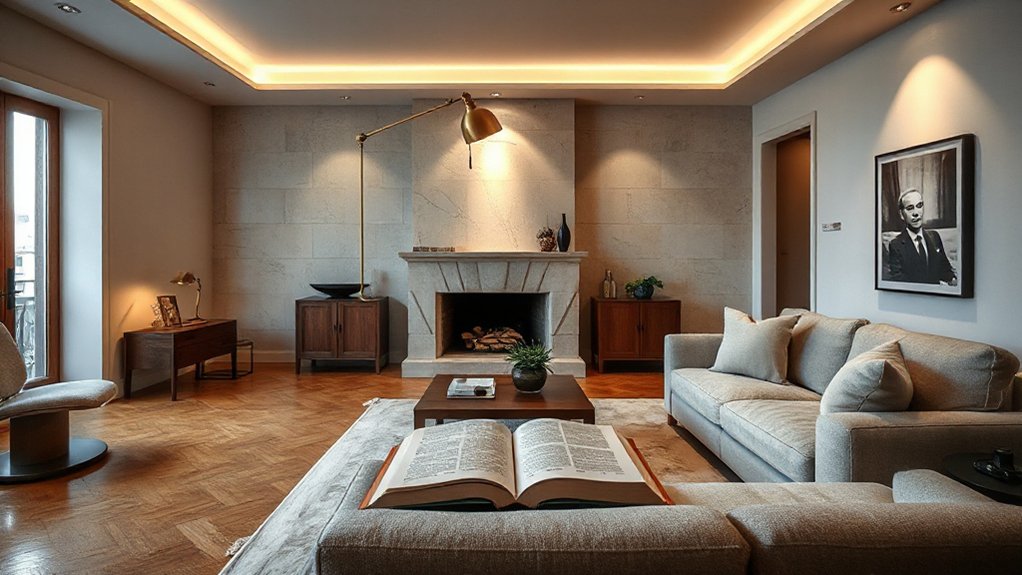
If you want a contemporary room to feel composed from morning through late night, you’ve got to layer lighting the same way you layer materials: ambient for an even baseline, task for precision where you work, and accent to sculpt depth.
Start with dimmable ambient light—recessed, a clean flush-mount, or cove—at 2700–3000K so whites stay crisp, not cold.
Then add task lighting exactly where you need it: pendants over counters, an adjustable reading light, or under-cabinet LEDs that eliminate shadows.
Finish with accent lighting to add architecture: wall washers, picture lights, or low uplights that graze texture.
Create lighting zones on separate switches or scenes, so you can shift from bright, functional to calm, gallery-like instantly.
Buy Timeless Contemporary Furniture Shapes
You’ll get the most longevity by investing in iconic silhouettes—think clean-lined sofas, sculptural lounge chairs, and disciplined profiles that won’t date.
Choose streamlined modular forms so you can reconfigure seating and storage as your needs shift without replacing key pieces.
When you anchor the room with these enduring shapes, accessories and textiles can carry the seasonal trends while your core stays contemporary.
Invest In Iconic Silhouettes
While colors and accessories cycle in and out of fashion, iconic furniture silhouettes hold their ground and instantly signal a timeless contemporary space. Anchor the room with one or two pieces whose proportions have proven staying power: a low, tailored sofa with clean arms, a sculptural lounge chair, or a pedestal dining table with a crisp edge.
These Iconic silhouettes read current without chasing micro-trends because the lines feel resolved and intentional. Prioritize signature shapes you can recognize from across the room; they’ll keep your layout cohesive even as you refresh textiles or art.
Check scale first, then material integrity—solid joinery, tight upholstery, and refined detailing. Choose neutral, high-quality fabrics so form stays the hero and always looks edited.
Choose Streamlined Modular Forms
Iconic silhouettes set the tone; streamlined modular forms keep the room flexible without sacrificing that clean, contemporary read. You’ll get longevity by choosing pieces with tight proportions, low visual noise, and intentional seams that disappear at a distance. Prioritize Streamlined forms that don’t chase micro-trends—think squared arms, slim plinth bases, and consistent reveals.
- Pick a sectional with reconfigurable modules, a defined grid, and restrained stitching for day-to-day adaptability.
- Choose storage in modular designs: stackable cabinets, floating credenzas, and closed fronts that hide clutter.
- Anchor with modular tables—nesting or expandable—finished in matte wood, stone, or powder-coated metal.
Keep legs and hardware minimal, scale to your architecture, and you’ll refresh layouts, not furniture.
Skip Trend Traps and “Statement” Overload
Because trends move faster than most renovation cycles, a timeless contemporary room can’t rely on “of-the-moment” finishes or a single headline-grabbing piece to carry the design. Track trend cycles, but treat them as references, not requirements, and avoid statement overload that dates the space the moment the feed moves on.
Instead, anchor the room with calm, low-contrast foundations: consistent flooring, simple millwork, and restrained wall colors that hold up under changing light. Choose materials with proven longevity—solid wood, natural stone, quality metal finishes—and keep patterns disciplined in scale and placement.
If you want impact, build it through proportion, negative space, and repetition rather than novelty. Edit hard: one focal point per sightline, cohesive hardware throughout, and art that complements the palette instead of competing with it.
Refresh the Room With Small, Reversible Swaps
You don’t need a full redo to keep a contemporary room feeling current—swap pillows and throws to shift texture, tone, and season in minutes.
Update hardware and switches with clean-lined finishes (think matte black, brushed nickel, or warm brass) to sharpen the room’s details without permanent commitment.
Rotate art and accessories on a tight edit—one new focal piece and a few sculptural accents will refresh the look while preserving a timeless baseline.
Swap Pillows And Throws
When the room starts to feel stale, swapping pillows and throws delivers a high-impact refresh without committing to new furniture. You can swap pillows to shift the mood from crisp to cozy, while you replace throws to introduce new texture and seasonality. Keep the palette grounded—stone, ink, camel, and soft white—so the update reads contemporary, not trendy.
- Rotate covers in tactile solids (bouclé, linen, washed velvet) and keep inserts consistent for a tailored silhouette.
- Mix scales: one large lumbar, two medium squares, and one accent pillow with subtle pattern or stitching.
- Drape throws with intention: fold on the arm for structure, or cascade once for relaxed elegance.
Aim for contrast in texture, not color noise.
Update Hardware And Switches
If the room reads finished but not quite elevated, updating hardware and switches sharpens the details with minimal disruption. Replace dated knobs and pulls with streamlined brass, matte black, or brushed nickel, keeping finishes consistent across the space. Choose solid-weight pieces with crisp edges; they feel custom and won’t date quickly.
Swap mismatched plates for screwless, low-profile wall plates, and align them perfectly for a cleaner grid. Upgrade toggles to modern rockers or dimmers, and consider Smart home switches that blend in while adding scene control. Specify LED-compatible dimmers to prevent flicker and boost energy efficiency.
In kitchens and baths, match faucet, cabinet hardware, and outlet finishes for a cohesive read. These changes are reversible, budget-friendly, and instantly more architectural.
Rotate Art And Accessories
How do you refresh a space without committing to a full redesign? You lean on Art rotation and accessory updates—quick, reversible moves that keep a contemporary room feeling curated, not stale.
Treat your walls and surfaces like a seasonal edit: swap in one bold piece, pull back another, and let negative space do the work. Stick to consistent frames and a tight palette so changes read intentional, not chaotic. Rotate objects by height, texture, and sheen to echo current trends like warm metals, matte ceramics, and natural stone.
- Rehang art: change scale or grouping, keep spacing precise.
- Swap textiles: pillows, throws, and a new rug corner.
- Edit surfaces: replace books, trays, and vases; remove one item.
Frequently Asked Questions
How Do I Blend Contemporary Design With Existing Vintage Pieces?
Blend contemporary design with vintage by anchoring with a clean palette, then layer heirlooms as focal points. Use Mixing textures, balancing contrasts, and repeat one modern material across rooms. Update lighting, scale, and spacing.
What Ceiling Treatments Make a Modern Room Feel More Timeless?
Choose subtle ceiling textures—plaster skim coats, thin wood slats, or painted beams—and keep Modern motifs restrained. Like a gallery I toured, one limewash ceiling calmed sharp furniture. Use warm whites, simple trims, concealed lighting.
How Can I Make Open Shelving Look Curated, Not Messy?
You’ll make open shelving look curated by editing ruthlessly: group items in threes, vary heights, and leave breathing room. Use Decor organization bins, strict color coordination, and repeat materials. Hide cluttered packaging, spotlight statement pieces.
Are Window Treatments Necessary in a Timeless Contemporary Space?
You don’t always need window treatments, but you usually should. Prioritize Window function—glare control, insulation, acoustics—and address Privacy considerations. Choose tailored sheers or roller shades in neutral textures; skip fussy patterns.
How Do I Choose Art That Won’T Date the Room?
Nearly 70% of collectors prioritize originality over trend. Choose art with enduring themes and disciplined craft, tie it to your color palette, and match furniture scale—go larger, fewer pieces. You’ll avoid fad imagery and dated frames.
Conclusion
You’ve set the rules, mapped the flow, and chosen storage that reads like architecture, not clutter. With a calm base palette and one or two accents, you keep the room disciplined—more *Eames* than impulse buy. Layered lighting does the heavy lifting, while clean-lined furniture avoids “statement” fatigue. Now, protect that timeless edge: skip trend traps, and refresh only with reversible swaps—textiles, art, hardware—so your space evolves like Theseus’ ship, without losing itself.


