


Design your backyard as a cohesive pool-focused outdoor room. Define your goals, constraints, and desired outcomes, then map your lot to select a pool style, form, and durable finishes that weather your climate. Pair hardscape with drought-tolerant plantings for year-round appeal, using architectural evergreens and structural grasses to maintain structure. Plan for safety with clear paths, non-slip surfaces, and modular, adaptable seating. Want practical steps and real-world layouts that grow with you? Keep exploring.
Define Your Pool-Integrated Backyard Vision: Goals, Constraints, and Outcomes
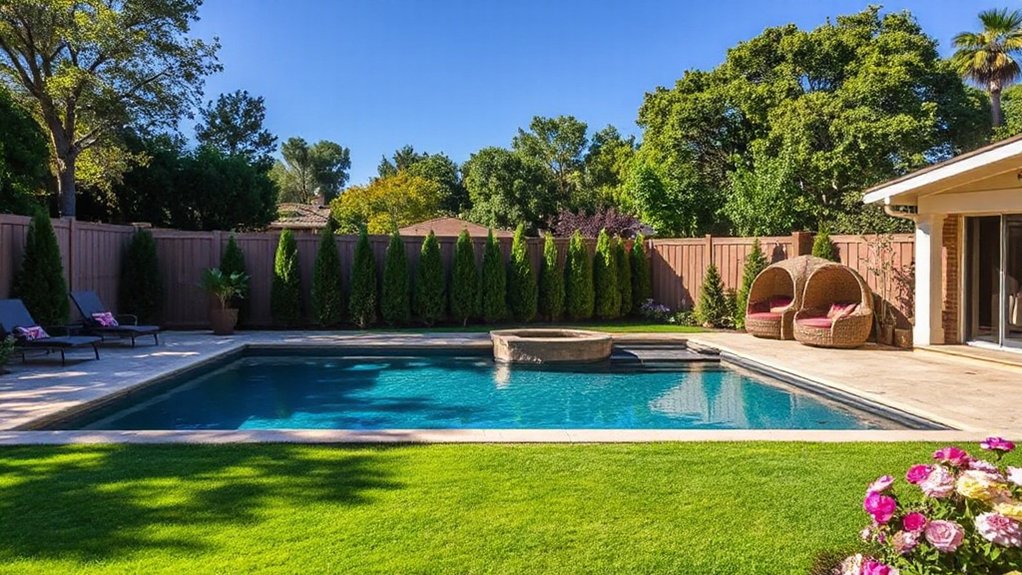
Establish a clear vision for your pool-integrated backyard by detailing specific goals, constraints, and desired outcomes. You define primary objectives, such as safety, maintenance efficiency, and visual balance with surrounding landscape.
Constraints include local codes, budget caps, sun exposure, and access points for equipment. Outcomes describe successful integration: seamless progressions between living spaces, optimized circulation, and durable materials that resist weathering.
You specify focal points like a water-feature centerpiece and complementary pool fencing that maintains sightlines while meeting safety requirements. Prioritize system integration—lighting, irrigation, and filtration—so they function cohesively without redundancy.
Your plan identifies critical decisions early, including sizing, pool shape, and surface textures. This foresight reduces mid-project changes, ensuring a precise, aesthetically cohesive, and technically sound design.
Water features enhance ambiance; pool fencing preserves safety with elegance.
Assess Your Space: Pool Styles That Fit Your Lot Size and Climate
Assess your space by matching pool styles to your lot dimensions and climate, so you pick forms that maximize usability and efficiency. Consider compact, modular designs for smaller lots and climate-responsive features like shade, heating, or drought-tolerant landscaping to extend use year-round.
This space-first approach keeps aesthetics balanced with performance, guiding your selection toward styles that scale with your site and conditions.
Space-Driven Pool Styles
To choose pool styles that fit your lot and climate, start by mapping available space, sun exposure, drainage, and access points. Then align design goals with local codes and mature landscaping expectations.
With those parameters defined, select a form factor that maximizes function without sacrificing aesthetics: compact geometric for tight lots, freeform for landscape integration, or spillovers that leverage existing slopes.
Consider material and finish variations that endure local weather cycles while minimizing maintenance. You’ll want proportions and circulation that support safe, efficient maintenance zones.
Prioritize elements that simplify upkeep and water management. Address pool water chemistry and filtration needs upfront to reduce downstream work.
Establish routine pool cleaning routines and spa-like features only where they enhance flow and access, avoiding overcomplex systems that complicate operations.
Climate-Conscious Designs
A climate-smart approach starts with a precise assessment of your lot size, sun patterns, microclimates, and drainage. Then pairs those factors with pool styles that perform well under local conditions. You’ll select forms that maximize shade, heat retention, and airflow, reducing energy demands and water loss.
Consider compact, efficient shapes like rectangles or L-shaped layouts that fit narrow lots while supporting automation and filtration efficiency. Material choices matter: opt for eco-friendly materials that resist weathering and minimize maintenance. Align decking, coping, and plantings with local hydration cycles to cut irrigation needs.
Integrate passive cooling via wind corridors and shade trees, then pair with water-saving features such as covered spas and recirculation controls. The result is a durable, aesthetically cohesive, climate-responsive outdoor living space.
Pool Landscaping: Hardscape and Plant Pairings for Year-Round Appeal
You’ll balance hardscape textures with strategic plant choices to create a cohesive, year-round backdrop for your pool area. Consider how durable materials—concrete, pavers, or stone—pair with foliage and seasonal color to maintain appeal in sun, shade, and wet conditions.
This harmony sets the stage for practical maintenance, tactile contrast, and a refined, enduring landscape rhythm.
Hardscape-Plant Harmony
Achieving year-round appeal in pool landscaping hinges on the deliberate pairing of hardscape materials with complementary plants. When pavers, decking, and surrounding walls echo the color, texture, and scale of selected greenery, the space feels cohesive and durable.
You evaluate landscape integration by aligning material grain, line, and rhythm with plant forms, ensuring every shift reads as a single composition. Choose architectural evergreens and structural grasses to anchor corners, then weave seasonal interest through deciduous perennials that don’t overwhelm sightlines.
Plant placement matters: place taller specimens at the rear, mid-height varieties midline, and groundcovers along edges to soften edges without obstructing views. Future maintenance angles are minimized by well-spaced irrigation, mulch depth, and thoughtful pruning schedules that preserve balance.
Seasonal Palette Pairings
Seasonal palette pairings elevate pool landscaping by aligning hardscape tones with plant colors across the year, ensuring contrast in winter and vibrancy in summer. You’ll implement a deliberate rotation of materials and species to maintain year‑round visual interest.
Start with a neutral base—cool grays or warm taupes—for decks and coping, then layer seasonal accents via foliage and bloom timing. Use color coordination to map plant palettes to those hardscape tones, selecting evergreen structure for winter silhouette and deciduous foliage for spring and fall drama.
Consider foliage contrast to maximize readability: light‑leaf accents against dark trunks, or deep greens paired with silvery textures. Plan irrigation and maintenance around bloom cycles to preserve contrast without saturating color intensity.
This approach yields cohesive, durable aesthetics throughout seasons.
Budget-Smart Starter Plan for Pool Landscaping: Step-by-Step
A budget-smart starter plan for pool landscaping guides you from empty yard to a cohesive, low-cost upgrade in clear, actionable steps. Begin with defining zones: water feature placement, seating, and circulation paths. Map utilities and assess sunlight to prioritize low-maintenance plantings and drought-tolerant textures.
Select modular, affordable hardscape elements—gravel accents, pavers, and stepping stones—to establish rhythm without overbuilding. For irrigation, implement drip lines near plant beds, minimizing waste.
Choose a compact water feature as a focal point to maximize impact with modest cost, and align it with a simple lighting design to extend usability after dark.
Pair native, textured plantings with evergreen backbone for year-round structure. Schedule phased upgrades, documenting each cost and outcome to stay on budget.
Essential Safety, Maintenance, and Privacy Tips for Pool Landscaping
As you finalize a budget-friendly pool landscape, prioritize safety, upkeep, and privacy as core design criteria. Begin with enclosure considerations that meet local codes and keep gatherings secure without hindering visibility.
Install non-slip surfaces around the pool deck and route drainage away from entry paths to reduce slip hazards and water damage. For pool safety, place clearly marked depth gauges, accessible life-saving gear, and a compliant barrier with self-latching gates.
For pool maintenance, choose low-porosity pavers, use easy-clean vegetation, and install a dedicated filtration shutoff to simplify routine cleaning.
Integrate privacy shrubs and lattice screens at setback points, ensuring year-round screening without obstructing sightlines for maintenance crews.
Document seasonal maintenance tasks and safety checks to sustain long-term aesthetic and functional health.
Create Space-Saving Layouts: Seating, Shade, and Easy Access
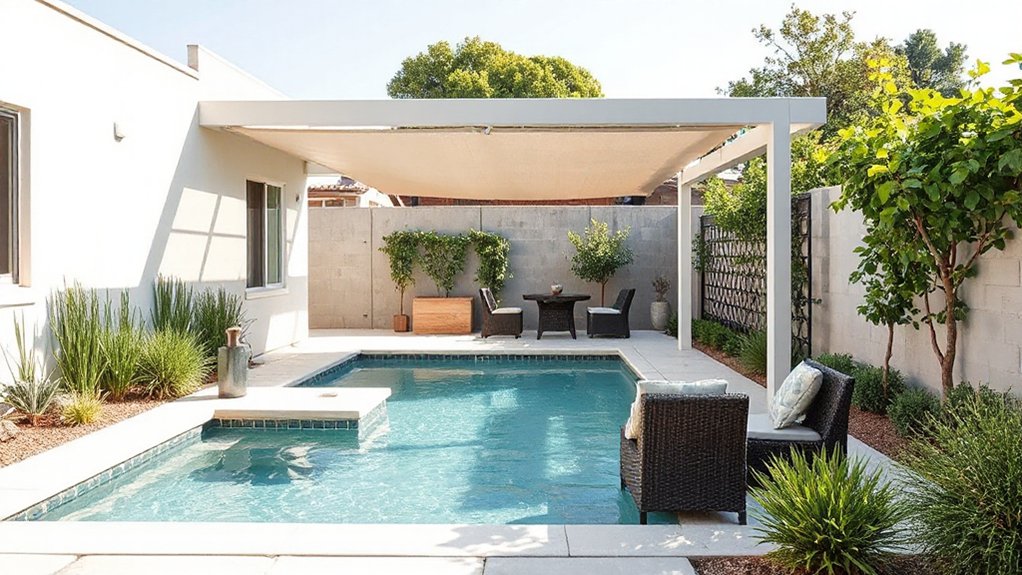
To maximize usability in compact pool zones, prioritize multi-functional seating, compact shade structures, and clear pathways that maintain access to all essential features.
You design seating that serves dual roles—storage benches, modular lounge clusters, and foldaway options—to reduce footprint without sacrificing comfort. Select outdoor furniture with slim profiles and weather-resistant finishes, and align planters as natural dividers to preserve sightlines.
Integrate garden lighting along edges and steps to extend usability after dusk while preserving safety, avoiding glare on water surfaces.
Shade elements should be low in height and removable, enabling flex layouts for gatherings or solo use.
Make sure access routes remain at least 36 inches wide, with mat-free transitions between zones.
This disciplined approach yields a cohesive, functional perimeter that supports activity and relaxation.
Seasonal Tweaks to Keep the Pool-Side Oasis Fresh Year-Round
Seasonal tweaks keep your pool-side oasis fresh year-round by optimizing materials, climate control, and lighting in response to changing conditions. You adjust materials for durability across seasons, selecting shade fabrics and decking that resist moisture, heat, and UV degradation.
Climate control focuses on efficient insulation and automated covers, plus low-energy heating or cooling as needed, minimizing evaporation and temperature swings.
Lighting evolves with daylight hours, implementing dimmable, weatherproof fixtures and color temperatures that preserve mood without glare.
You refine poolside durability by coordinating landscaping cadence with maintenance cycles, ensuring drainage and weed suppression align with seasonal rainfall.
Integrate water features strategically to avoid energy spikes while enhancing sound, scent, and visual depth.
Choose ergonomic Poolside furniture and modular pieces that adapt to guests and events throughout the year.
Real-Life Mapped Examples: From Tiny Yards to Large Lots
Real-Life Mapped Examples illustrate how scalable backyard designs translate from compact parcels to expansive lots, revealing practical layout logic, material choices, and drainage strategies. You’ll see how proportional zones—pool, lounging, dining, and circulation—translate across scales, preserving function without clutter.
For tiny yards, you optimize vertical spaces, pair compact plinths with permeable surfaces, and emphasize sightlines to a focal water feature. In mid-sized lots, you balance screening with openness, deploy modular fencing, and align paths with cardinal drainage gradients.
On large parcels, you cultivate terraces, repeating material palettes, and integrate multiple conversation centers. Choose garden furniture that nests with shade structures, and employ outdoor lighting to extend usability after dusk, ensuring safety and ambiance without overpowering the landscape.
Frequently Asked Questions
How Long Does It Take to Complete a Pool Landscaping Project?
A typical pool landscaping project takes 4–12 weeks, depending on scope and permitting. You’ll coordinate pool lighting installations and outdoor furniture placements, ensuring drainage, grading, and aesthetic balance while meeting safety standards and finish-quality expectations.
What Maintenance Tasks Are Essential After Installation?
After installation, you balance Pool chemical balance and maintain the pool filter maintenance; with precision, you troubleshoot chemistry versus clarity, keeping edges pristine. You monitor pH and chlorine, shock when needed, and clean filters routinely for lasting clarity.
Can I Install a Pool in a Small Yard?
Yes, you can install a pool in a small yard, but plan carefully. Prioritize Pool safety features, optimize space, and align with Budget planning; choose compact shapes, efficient pumps, and integrated safety barriers for a precise, aesthetic result.
Which Plants Are the Best for Poolside Safety?
You’ll want poolside plants that maximize safety: safety foliage, non-toxic, non-slip leaves, and clear sightlines. About 90% of slips occur near water; choose restrained textures, low aromas, and sturdy roots to minimize hazards while preserving aesthetics.
How Do I Maximize Privacy With Pool Landscaping?
You maximize privacy by layering sightlines with privacy screens and smart fencing options, choosing tall, dense species, and integrating permeable screens. Install retractable or modular fencing, align with wind patterns, and maintain sight-blocking foliage for year-round seclusion.
Conclusion
You’ve mapped a pool-centered landscape that blends form and function with purposeful restraint. By aligning goals to space, climate, and budget, you create a coherent oasis that rises in value and enjoyment. An interesting stat: well-planned pool landscapes can boost property value by up to 7–15% while improving energy efficiency through shade and airflow design. Keep maintenance simple, emphasize safety, and curate plant choices that reduce glare and root intrusion. Your yard becomes a durable, aesthetic, low-stress retreat.


