
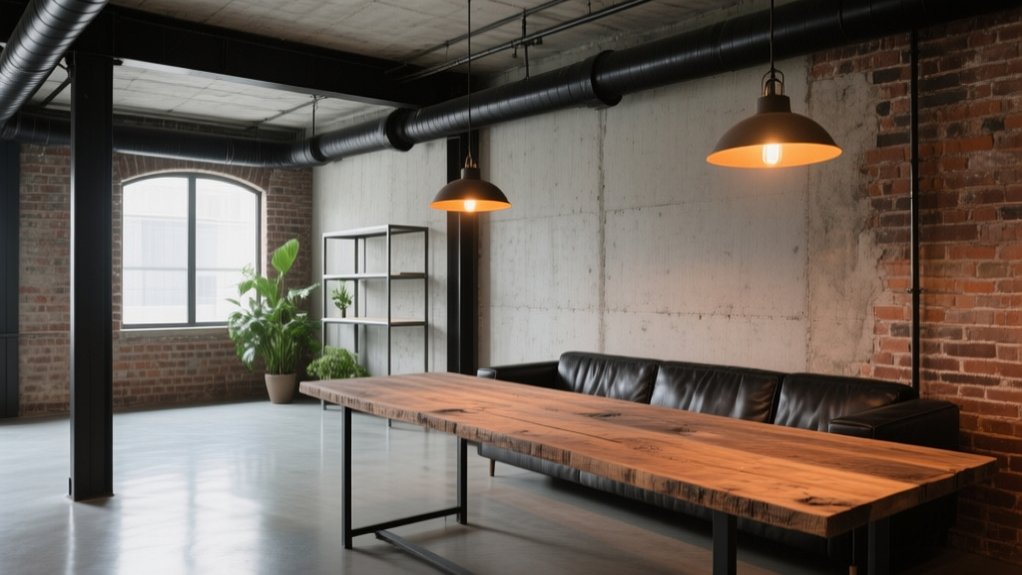

Do industrial style right by keeping structure honest—real brick, concrete, steel, and visible runs placed logically, not as random pipe décor. Tighten the palette to black, warm gray, and oxidized tones, then repeat two main materials plus one accent for cohesion. Pick finishes that patina well: sealed concrete with micro-pitting, hot-rolled steel with matte clear coat, and unlacquered brass in low-splash zones. Layer 2700–3500K CRI 90+ lighting, and soften with wool rugs and linen drapes. Keep going for the exact material map.
Key Takeaways
- Expose real structure—brick, steel, concrete, ducts—only where logical; avoid fake rivets and random pipe décor.
- Limit the palette to blacks, warm grays, and oxidized tones, plus one disciplined accent for controlled contrast.
- Choose finishes that patina well: sealed concrete with micro-pitting, hot-rolled steel with matte wax, and oiled leather.
- Use limewash on brick or block for breathable, softly scuffed walls that feel aged without looking dirty.
- Layer warm, high-CRI lighting with dimmers and diffusers to highlight texture while preventing glare on metal surfaces.
Industrial Style Rules: Raw, but Edited
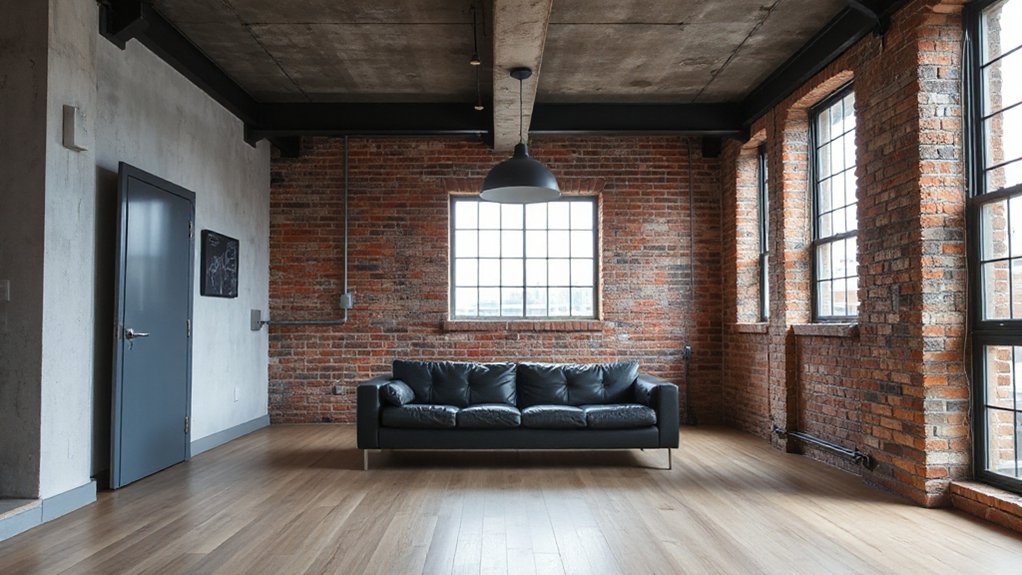
Although industrial style celebrates rough edges, it still runs on a tight rule set: keep the bones exposed, then control the edit. Start by prioritizing structure: show steel, brick, concrete, duct runs, or conduit only if they’re real and logically placed. That’s Industrial authenticity—no fake rivets, no random pipe décor.
Next, simplify the palette to blacks, warm grays, and oxidized tones, then lock contrast with one disciplined accent. For Modern industrial, refine proportions: choose slim-profile furniture, consistent leg finishes, and clean-lined storage that hides clutter.
Keep lighting purposeful—factory pendants, track heads, and wall-mounted arms—spaced to task zones, not symmetry. Finally, cap the look with restraint: fewer, larger objects; repeat materials; align edges and sightlines.
Industrial Finishes That Age Well (and Where to Use Them)
When you pick finishes that patina instead of peel, industrial style stays sharp long after the “new loft” look wears off. Prioritize materials that oxidize, burnish, and scratch gracefully, so wear reads intentional, not neglected.
Use hot-rolled steel for shelving and stair rails; it darkens to a stable Vintage patina if you seal it with matte wax or clear coat. Specify sealed concrete on floors and counters; micro-pitting and hairlines add character while densifier plus penetrating sealer controls staining.
Choose unlacquered brass for pulls and faucets in low-splash zones; it tones down fast, then evens out. For walls, try limewash over brick or block; it breathes and scuffs softly.
Keep Patina maintenance simple: neutral cleaners, periodic re-waxing, and spot sealing.
Warm Industrial Style With Lighting and Paint
If your industrial space feels cold, you can warm it fast by tuning light temperature and paint undertones instead of softening everything with décor. Start with bulbs: use 2700–3000K for living zones, 3000–3500K for kitchens, and keep CRI 90+ so brick and wood read rich, not gray.
Layer your lighting techniques—ambient for base, task over worktops, and controlled accent grazing on concrete or metal to add depth without glare.
Then shift paint: choose warm whites with yellow-beige undertones, greiges with red-violet bias, or muted clay tones for feature walls. Specify eggshell or matte to reduce specular bounce off steel.
Tie industrial décor together by repeating the paint undertone in trim, cabinetry, or built-ins for cohesion.
Soften Industrial Style With Rugs, Curtains, and Throws

Once you’ve warmed an industrial room with the right Kelvin range and paint undertones, use textiles to fix what light can’t: echo control, tactile comfort, and visual softness against hard planes.
Start with a rug large enough to anchor the zone; choose low-pile wool or flatweave for durability, or a felted pad to boost absorption without bulk.
Build textile layering with a throw that contrasts temperature—nubby cotton, bouclé, or brushed wool—so concrete and steel feel intentional, not cold.
For window treatments, skip stiff grommets and go tailored: ceiling-mounted tracks, ripplefold drapery, or linen-blend panels that stack cleanly.
Add sheers to diffuse glare on glossy surfaces, then pair heavier side panels to cut street noise.
Keep palettes tonal; let texture do the work.
Industrial Furniture: Scale, Silhouettes, and Finishes
Although industrial rooms can handle visual weight, your furniture still needs the right scale, silhouette, and finish to keep the space feeling curated instead of cluttered. Start by sizing anchor pieces to the room’s footprint: leave clear walk paths and choose a sofa depth that doesn’t choke circulation.
Favor clean, rectilinear silhouettes for large items, then add one sculptural form to create contrast without chaos.
Prioritize finishes that read authentic: matte black powder-coat, burnished steel, and oiled leather outperform glossy lacquers. Use reclaimed wood for tops and shelving when you want warmth, but keep grain tone consistent across pieces.
Add Vintage accents sparingly—like a factory stool or apothecary cabinet—to punctuate the layout. Repeat one metal finish twice to unify the set.
Mix Industrial Materials Without Visual Clutter
To mix industrial materials without visual clutter, you need to balance texture and tone so metal, wood, and concrete read as a coordinated system, not a scrap pile.
Keep finishes on a tight spectrum—match undertones (warm vs. cool) and repeat one or two textures across the room to create rhythm.
Then limit material variety to a few core surfaces and use consistent hardware and trim to keep the look clean and current.
Balance Texture And Tone
When you mix brick, concrete, steel, and raw wood in one room, texture can stack up fast and read as clutter. To keep Industrial aesthetics sharp, you’ve got to balance texture with tone: let one surface lead, then make the rest support it through controlled value shifts and sheen.
- Anchor with a dominant mid-tone plane (warm gray plaster or sealed concrete) so heavy textures don’t compete.
- Use modern contrasts via finish, not pattern: matte brick against satin black steel, then oiled oak to bridge temperatures.
- Calibrate lighting: 2700–3000K warms raw wood; narrow-beam spots rake brick; diffuse panels soften concrete.
Keep grout, stain, and metal color within a tight range, and you’ll get depth without visual noise.
Limit Material Variety
Where industrial rooms often go sideways is in the materials list: stack too many “authentic” finishes—brick, concrete, black steel, reclaimed wood, leather, mesh—and the space starts reading like a showroom. You’ll get more impact by editing hard: pick two dominant materials and one accent, then repeat them across key planes (floors, casework, lighting) to lock in aesthetic cohesion.
Limit Material diversity by assigning roles. Use concrete or wood as the field material, blackened steel for structure and hardware, and reserve one “character” layer—aged brass, saddle leather, or ribbed glass—for touchpoints only. Keep sheen consistent (matte to satin) and cap contrasts to one high-chroma element.
This approach feels curated, not themed.
Industrial Style Mistakes (and Quick Fixes)
You can derail an industrial room fast by overloading it with metal, which pushes the space from curated to clinical.
You also create a cold, unwelcoming feel when you rely on harsh 4000–6500K lighting or exposed bare bulbs without diffusion.
Next, you’ll calibrate the metal-to-wood ratio and tune lighting with warmer temps, layered sources, and dimming to keep the look sharp but livable.
Too Much Metal
How much metal is too much in an industrial room? When every surface shines or scratches, you’ve hit metal overload and the space reads like industrial clutter. You don’t need less edge—you need better balance and fewer competing finishes.
- Limit metals to two tones (blackened steel + brushed nickel), and repeat them with intent across hardware, legs, and frames.
- Break up reflectivity: pair a steel table with matte wood, leather, or concrete textiles to absorb visual noise.
- Edit accessories: swap extra wire baskets and riveted décor for one oversized statement piece, then keep surrounding planes clean.
Treat metal like a structural accent, not wallpaper. Your room stays raw, modern, and controlled.
Cold, Unwelcoming Lighting
Balanced metal finishes set the stage, but cold, unwelcoming lighting can still make an industrial room feel like a warehouse instead of a home. If you rely on bare 5000K LEDs or a single overhead fixture, you’ll flatten texture and exaggerate shadows on concrete, brick, and steel.
Swap to 2700–3000K bulbs for a warm glow, then layer light: a dimmable ceiling source, task lighting at work zones, and low-level accent light to graze walls.
Add shades or diffusers to cut glare on metal surfaces. Choose fixtures with blackened brass, smoked glass, or opal globes—still industrial, just softer. Use smart dimmers to shift scenes from day to night, so you get a cozy ambiance without losing that raw edge.
Frequently Asked Questions
How Do You Soundproof an Industrial-Style Room With Exposed Surfaces?
You soundproof exposed-surface rooms by sealing gaps, adding mass, and decoupling walls/ceilings. Install Soundproofing materials like MLV, acoustic sealant, and isolation clips, then apply Acoustic treatments—fabric panels, rugs, baffles—to control reflections.
Are Raw Industrial Materials Safe for Homes With Kids and Pets?
Yes—if you manage Industrial safety and choose Child friendly finishes. Over 30% of child poisonings involve household products, so you’ll seal concrete, deburr metal, cap edges, use low-VOC coatings, and anchor heavy pieces.
What’s the Best Way to Remove Rust Stains From Concrete or Metal?
You’ll get best results by doing Rust removal fast: scrub with a nylon brush and oxalic-acid cleaner, rinse, then neutralize with baking soda. For metal, use phosphoric-acid gel, surface cleaning, dry, and seal.
How Can You Add Industrial Style in a Rental Without Permanent Changes?
Treat your rental like a set: you swap props, not walls. Add Industrial lighting with plug-in sconces, choose vintage furniture, layer peel-and-stick metal-look film, and use tension-shelf piping—landlords can’t object.
What’s the Typical Cost Range to Achieve an Industrial Look per Room?
You’ll typically spend $300–$1,500 per room for an industrial look: $80–$400 on vintage lighting, $50–$250 on metal accents, plus $150–$850 for rugs, shelves, paint, hardware, and textiles.
Conclusion
Industrial style works when you treat raw finishes like a sharp blade: powerful, but controlled. You’ll let concrete, brick, and steel earn their patina in the right zones, then dial in warmth with layered lighting and smarter paint. You’ll soften the edges with rugs, curtains, and throws, and choose furniture with clean silhouettes and correct scale. Mix materials like a tuned playlist—contrast, repeat, edit. Fix missteps fast: add texture, adjust color temperature.


