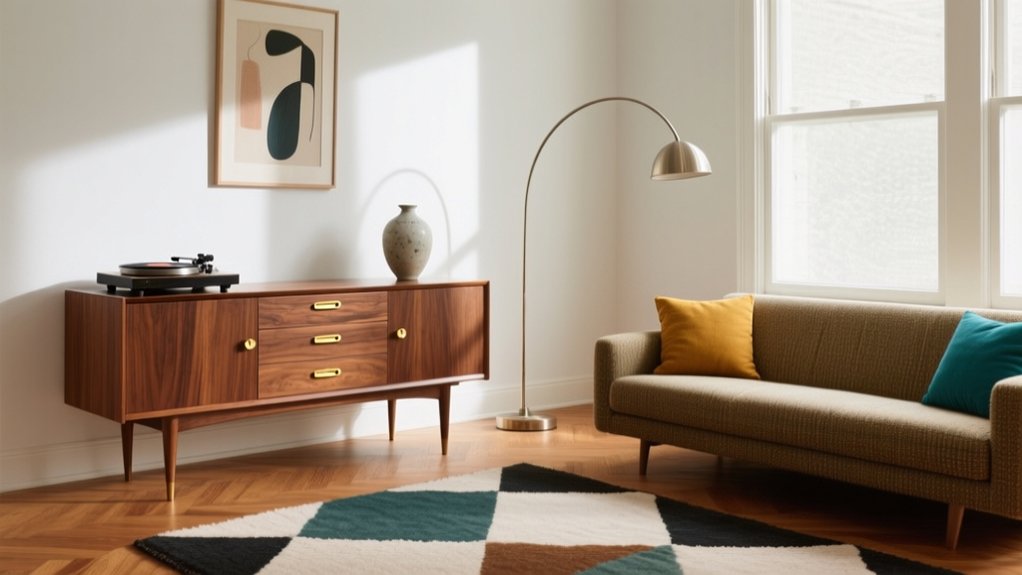

Mid-century modern still works because you’re using a proven design system built for real life: clean, low-slung silhouettes, tapered legs, and open-plan flow that keeps sightlines clear. You get warmth from honest materials—walnut, teak, leather, and brass—balanced by simple geometry and minimal hardware. A tight neutral palette takes bold accents like mustard, teal, or olive without feeling dated. Keep icons limited, layer soft lighting, and you’ll see how far it can go.
Key Takeaways
- Mid-Century Modern endures because its clean lines and functional forms feel timeless, not trend-driven.
- Open layouts, low-profile furniture, and integrated storage support modern living with clear sightlines and easy circulation.
- Honest materials like walnut, teak, leather, and brushed metal add warmth, durability, and visual depth.
- Iconic lighting and geometric silhouettes create strong focal points while keeping rooms uncluttered and calm.
- The style mixes well with contemporary pieces by repeating simple geometry, restrained palettes, and layered textures.
Mid-Century Modern Style: A Clear Definition
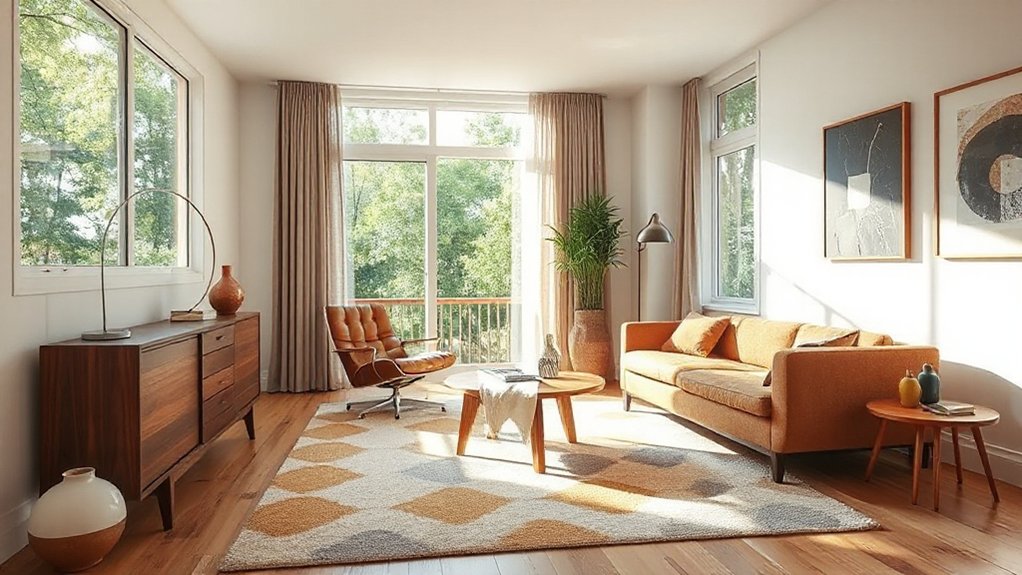
Although people often use “mid-century modern” as a catchall for anything retro, the style has a specific design identity rooted in the post–World War II era (roughly 1945–1969). You’ll recognize it by clean, low-slung silhouettes, tapered legs, and an emphasis on function over ornament.
Choose Vintage furniture with honest materials—walnut, teak, molded plywood, leather, and brushed metal—and keep forms geometric, not fussy. Plan your layout around openness: fewer, better pieces; clear sightlines; and integrated storage that looks built-in, even when it’s modular.
Then anchor the look with Retro color schemes: warm neutrals, olive, mustard, teal, and burnt orange, balanced by white or charcoal. Finish with graphic textiles and simple, globe or cone lighting.
It should feel streamlined, not nostalgic.
Mid-Century Modern Origins: Bauhaus to Postwar Design
That streamlined, functional look didn’t appear out of nowhere—it traces back to early 20th-century modernism, then crystallized in the optimistic rebuild of the postwar years. You can track the DNA to Bauhaus teaching: unify art and industry, design for real life, and embrace new materials without ornament.
When designers emigrated and ideas spread through the U.S. and Scandinavia, mass production made modern taste attainable, not elite. Postwar influences then accelerated it—GI housing demand, consumer optimism, and corporate commissions pushed practical, affordable design into everyday rooms.
When you shop Vintage furniture today, you’re buying into that origin story, not just a look.
- Bauhaus workshops and standardization
- Wartime material experiments
- Postwar housing booms
- Museum shows and catalogs
Mid-Century Modern Hallmarks: Lines, Legs, Silhouettes
You’ll spot mid-century modern the moment you see clean lines and clear form—nothing fussy, everything intentional.
Look for tapered legs that lift pieces off the floor, keeping the profile light, current, and architectural.
Then check the silhouettes: iconic shapes with confident curves or crisp angles that read timeless even in today’s interiors.
Clean Lines, Clear Form
When mid-century modern hits its stride, it does so through clean lines and unmistakable form—nothing feels accidental. You see a Minimalist Aesthetic that edits out clutter, letting structure speak.
Favor Geometric Forms—rectangles, circles, and disciplined arcs—so each piece reads clearly from across the room. You’ll notice how planes meet at crisp junctions, how profiles stay slim, and how negative space becomes part of the design.
To keep it current, you balance warmth and restraint with tactile finishes and precise proportions.
- Choose simple, rectilinear outlines for casegoods and shelving
- Repeat one strong curve to unify a room’s visual rhythm
- Use flush fronts and minimal hardware to maintain continuity
- Keep surfaces clear so the form remains the focal point
Tapered Legs, Iconic Silhouettes
Clean, disciplined forms gain lift and character the moment they rise on tapered legs and resolve into unmistakable silhouettes. You see it in credenzas that float above the floor, lounge chairs that cantilever with confidence, and sofas that read light even when they’re substantial.
That elevation isn’t decoration; it’s a functional move that improves sightlines, eases cleaning, and keeps rooms feeling open. Choose pieces where the leg taper feels intentional—thicker at the seat rail, finer at the floor—and where joinery looks precise, not chunky.
Pay attention to splay angles and negative space under arms and cases; those details sharpen the profile. Today’s best updates keep the proportions, then refresh finishes and upholstery while preserving iconic silhouettes.
Mid-Century Modern Layout: Open, Airy, Functional
You’ll get true mid-century modern impact when you prioritize open-plan flow that keeps sightlines long and circulation effortless.
Instead of walls, you’ll use furniture placement, area rugs, and lighting to create functional zoning for living, dining, and work without breaking the room’s airiness.
Keep pathways clear, anchor each zone with a few purposeful pieces, and let the layout do the heavy lifting.
Open-Plan Flow
Although mid-century modern interiors look effortless, their signature ease comes from an intentional open-plan flow that keeps sightlines long and circulation simple. You’ll feel the difference when furniture floats, not crowds, and pathways stay clear from entry to lounge to dining.
You don’t need more square footage—you need fewer visual stop signs and smarter continuity.
- Use low-profile seating to preserve long views and daylight.
- Keep wall treatments quiet: flat paint, warm wood paneling, or subtle texture.
- Choose floor coverings that read seamless, like broad-plank wood or a large, plain rug.
- Align lighting and casework to emphasize horizontal lines and easy movement.
Edit ruthlessly: limit tall pieces, hide clutter, and let one sculptural focal point anchor the room.
Functional Zoning
Where do you place the invisible “walls” when a mid-century modern room stays wide open? You zone with furniture, light, and material shifts, not drywall.
Anchor the lounge with a low-profile sofa and a wool rug; float a credenza behind it to define circulation. Mark dining with a tulip table under a pendant, then keep sightlines clean with tapered legs and open bases.
Use Color psychology to cue function: warm woods and ambers energize eating, cool greens calm reading, and crisp neutrals keep boundaries seamless.
Support sustainability trends by choosing vintage casegoods, FSC-certified woods, and modular pieces you can reconfigure as needs change.
Finish zones with layered lighting and consistent hardware for cohesion.
Mid-Century Modern Materials: Walnut, Teak, Leather, Brass
Because mid-century modern design leans on honest construction and warm restraint, the materials do most of the visual heavy lifting—walnut and teak bring tight, expressive grain and rich brown-to-honey tones. Leather adds tailored softness that ages with character, and brass delivers a crisp hit of reflective warmth without feeling flashy.
You’ll get the best results when you treat these finishes as a system: wood for structure, leather for touch, brass for punctuation. Keep joinery visible, prefer oiled or satin sheens, and let patina be the point.
Pair casegoods with Vintage textiles and frame them beside Contemporary art to keep the look current, not museumy.
- Choose walnut for grounded silhouettes and clean edges
- Use teak when you want lighter, linear grain
- Add leather on seats for durable comfort
- Accent with brass pulls, legs, or sconces
Mid-Century Modern Color Palette: Warm Neutrals + Bold Pops
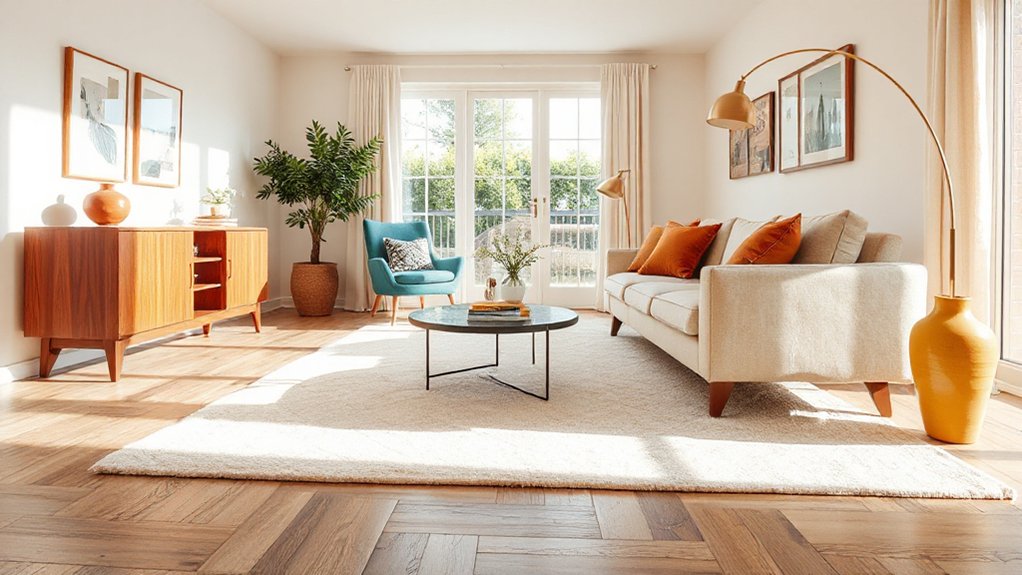
When you build a mid-century modern palette on warm neutrals, you give the room a calm, architectural baseline that can handle bolder hits of color without tipping into kitsch. Start with creamy off-white, camel, greige, or mushroom on large planes, then layer walnut and brass as naturally “warm” accents.
Use Color psychology to choose your pops: mustard reads optimistic, teal feels balanced, tomato adds energy, and olive grounds the scheme. Keep the saturation intentional—one hero color, one supporting tone, and plenty of negative space.
Apply paint techniques that feel era-appropriate: matte walls for softness, eggshell trim for crisp lines, and a single high-gloss door or built-in to echo lacquered casegoods. Repeat your pop color in textiles and art for cohesion.
Mid-Century Modern Lighting: Pendants, Arcs, Globe Lamps
Although furniture gets most of the mid-century credit, lighting sets the era’s signature mood by sculpting the room with clean geometry and a warm, deliberate glow. You’ll get the look fastest by mixing pendants, arcs, and globe lamps at different heights to build layers, not glare.
Choose opal or milk glass for soft diffusion, and pair it with brass, blackened steel, or walnut accents for a true Vintage revival vibe without feeling themed.
- Hang a dome or cone pendant over a table, centered and low enough to focus light.
- Use an arc lamp to throw light across seating without ceiling wiring.
- Add a globe lamp for even, shadow-minimizing ambient light.
- Switch to dimmable, warm LEDs for a Contemporary reinterpretation with better efficiency.
Mid-Century Modern Furniture Icons (And Smart Dupes)
Even if you don’t buy a single vintage original, you can still nail mid-century modern by anchoring your room with a few furniture icons—and choosing well-made dupes where it counts.
Start with an Eames Lounge silhouette: look for molded plywood, a deep seat angle, and leather grain that won’t peel.
Consider a Saarinen-style pedestal table; a quality dupe uses a heavy cast base and a seamless top edge.
Add a Wegner-inspired wishbone chair—prioritize tight cord weaving and tapered legs.
For storage, a low credenza with tambour doors delivers clean lines and practical function.
Balance these shapes with Vintage textiles—think nubby weaves and geometrics—so the room feels layered, not sterile.
Let Artistic influences show through sculptural joinery and warm walnut tones.
How to Get the Mid-Century Modern Look Today
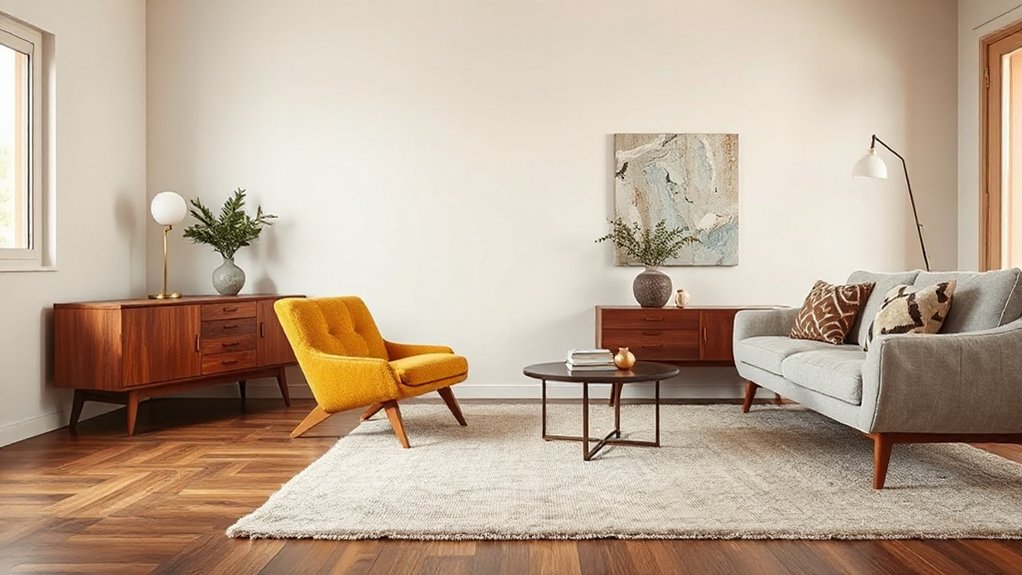
Three moves get you the mid-century modern look today: start with clean-lined anchors, warm up the palette, and edit the room hard. Choose low-slung pieces with tapered legs, then keep sightlines open so the architecture reads. Layer walnut, teak, and brass with tactile textiles—bouclé, wool, and tight weaves—to make the minimalism feel lived-in.
Add color strategically: olive, ochre, rust, and ink blue beat pastels and instantly feel current. Finish with a few high-impact accents, not clutter, and let negative space do the work.
- Swap bulky tables for slim profiles and airy bases
- Use Vintage pottery as your “small sculpture” moment
- Hang statement art large and centered, not gallery-style
- Keep lighting iconic: globe, sputnik, or arched floor lamp
How to Mix Mid-Century Modern With Other Styles
Once you’ve nailed the clean-lined anchors, warm woods, and edited negative space, you can start layering mid-century modern with other styles without losing its clarity. Keep one era dominant, then add accents that share its geometry: a streamlined sofa pairs effortlessly with a bouclé club chair or a Japanese-inspired paper lantern.
For Vintage charm, introduce patinated brass, a Persian-style rug, or a gallery wall of black-and-white photography—then echo one tone elsewhere so it feels intentional.
For an eclectic fusion, balance contrast by repeating materials: mix a marble-topped tulip table with industrial stools, but tie them together through matte-black hardware.
Limit your palette to three core hues, vary textures, and let sculptural lighting bridge periods with ease.
Mid-Century Modern Mistakes That Make It Look Dated
You can keep mid-century modern looking current by avoiding a few common missteps that instantly timestamp a room. Don’t overdo retro accessories, and watch scale and proportion so silhouettes, sightlines, and negative space stay clean and intentional.
Skip trendy imitations in favor of well-made, honest materials—otherwise the look reads like a shortcut, not a style.
Overdoing Retro Accessories
A few well-chosen retro accents can sharpen a mid-century modern room, but piling on vintage-look clocks, atomic starbursts, boomerang motifs, and kitschy collectibles quickly turns the space into a themed set instead of a livable interior. You’ll date the room faster than the pieces themselves, and you’ll bury the clean lines and warm woods that make the style timeless. Edit ruthlessly and let every accessory earn its spot.
- Limit statement icons to one per wall, then stop.
- Choose Vintage textiles with restrained geometry, not novelty prints.
- Hang one bold piece of retro artwork, and keep surrounding decor quiet.
- Mix in contemporary ceramics or greenery to prevent a time-capsule feel.
Aim for curated, not cosplay, and your space will read current, not kitsch.
Ignoring Scale And Proportion
Editing accessories keeps the room from feeling like a set, but proportion is what keeps mid-century modern from looking off. When you ignore scale, iconic silhouettes lose their crispness and the space reads dated.
A low-slung sofa needs breathing room; crowd it with bulky recliners and you create scale imbalance. Keep leggy pieces visually light, and balance them with one grounded anchor, not three.
Watch heights: pair a tall arc lamp with a substantial credenza, not a spindly side table that becomes a proportion misfit. Rugs matter, too—go large enough to catch front legs so the seating group feels intentional.
Finally, size art to furniture: aim for two-thirds of the console width, and hang it at eye level.
Using Trendy Imitations
While quick “MCM” dupes flood big-box aisles, relying on trendy imitations is one of the fastest ways to make a mid-century modern room look dated. You’ll spot it in plastic “wood” grain, thin legs, and finishes that photograph well but wear poorly.
Instead, anchor your space with fewer, better pieces that honor proportion, joinery, and honest materials—then layer in a Vintage revival accent or two for freshness.
If you must buy new, choose makers referencing original silhouettes, not copying Instagram props. Watch for these tells:
- Veneer that chips at edges
- Overly warm “teak” stains on MDF
- Faux brass that turns green
- Exaggerated sputniks and hairpins
Trendy imitations fade fast; considered choices age gracefully.
Frequently Asked Questions
What’s the Difference Between Mid-Century Modern and Scandinavian Modern?
You’ll find mid-century modern feels bolder and more varied, while Scandinavian modern stays lighter, minimalist, and craft-driven. For vintage authenticity, prioritize material identification: teak/walnut, molded plywood, and sleek metal versus pale woods and wool.
How Do I Authenticate a Vintage Mid-Century Piece Before Buying?
You authenticate it by reading it like a passport: check labels, stamps, joinery, patina, and period hardware as authenticity markers. Compare seller provenance and catalogs, then get a vintage appraisal; trust consistent wear, not shine.
What Are the Best Mid-Century Modern Plants and Planters for Interiors?
Choose indoor greenery like fiddle-leaf fig, rubber plant, monstera, snake plant, and bird of paradise. Pair them with modern planters: matte ceramic cylinders, walnut stands, brass cachepots, or terrazzo bowls, sized correctly.
How Can I Make Mid-Century Modern Work in a Small Rental Apartment?
You can make mid-century modern work in a small rental by prioritizing Space optimization: slim-leg furniture, multipurpose storage, and wall-mounted shelves. Use lighting techniques like plug-in sconces, warm bulbs, and mirrors to amplify depth.
What’s the Best Way to Care for and Refinish Teak or Walnut Furniture?
Clean with mild soap, dry fast, then oil sparingly for Teak maintenance. For Walnut refinishing, scuff-sand with 320 grit, wipe tack-free, apply thin Danish oil or wipe-on poly, buff between coats, cure fully.
Conclusion
Mid-century modern still works because you can pair clean profiles with practical planning and it stays fresh. You’ll spot the signature: sleek silhouettes, slim legs, and warm woods like walnut or teak, punched up with brass and leather. Keep your layout open, your palette controlled, and your pieces purposeful. Mix in contemporary textiles for contrast, but avoid clutter, kitsch, and cramped groupings. When you edit with intent, the look feels current, not dated.