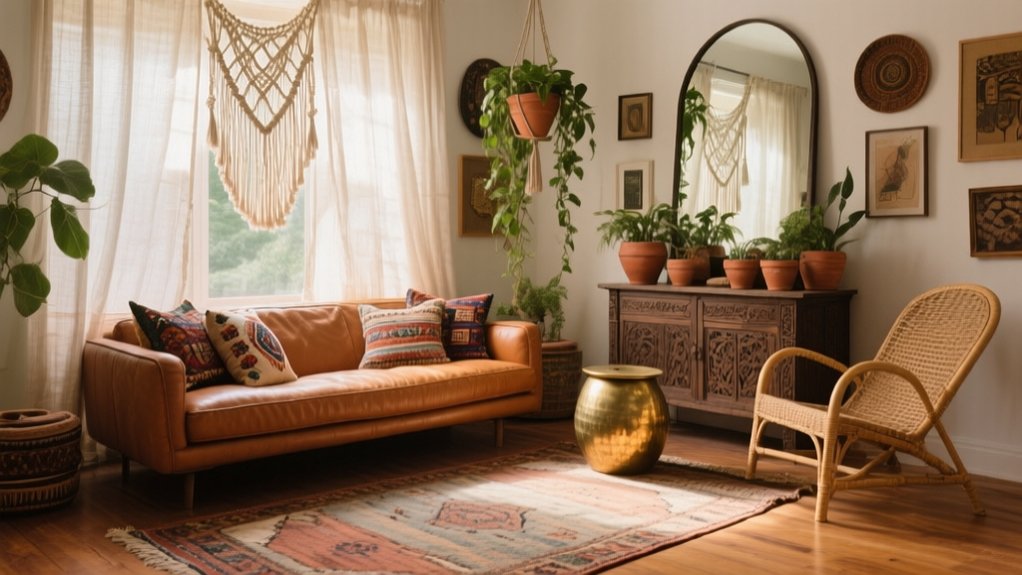

Make bohemian interiors work by treating every item as “collected,” not clutter—keep what has use, story, or craftsmanship, and leave breathing room. Start with warm neutrals, add 2–3 earthy tones, and ground it all with one deep stabilizer like charcoal or indigo. Choose one anchor piece per room (often a vintage rug), then layer patterns by scale and repeat key hues three times. Keep shelves in tight groups, add plants, and you’ll see what to refine next.
Key Takeaways
- Curate, don’t clutter: keep a few meaningful vintage and handmade pieces, and leave negative space so the room can breathe.
- Build a cohesive palette with warm neutrals, earthy tones, and one deep anchor color repeated three times across the space.
- Layer patterns by scale: one large dominant print, then medium geometrics and small stripes, all in the same color family.
- Mix textures for depth: combine wool, jute, linen, chunky knits, fringe, and flatweaves to define zones without visual chaos.
- Balance vintage patina with clean-lined modern basics, durable materials, and layered dimmable lighting for everyday functionality.
Bohemian Interiors: The “Collected” Rule
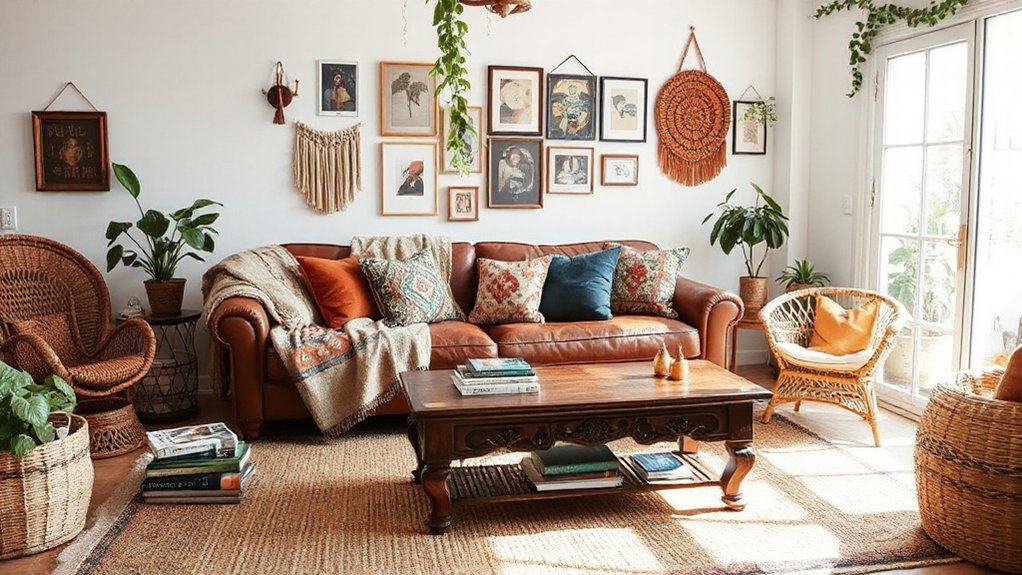
Why do the best bohemian rooms feel effortless instead of messy? You follow the “collected” rule: every piece earns its spot through use, story, or craftsmanship.
Start with a tight edit—keep one hero vintage rug, one statement chair, and a few layered textiles, then remove anything that competes.
Mix Cultural influences deliberately: a Moroccan tray, a Kilim pillow, and a carved wooden stool work when you repeat materials or scale, not just the vibe.
Spotlight Artistic expressions with intention—frame sketches, lean a canvas, or group pottery in odd numbers.
Shop like a curator, not a hoarder: set size limits, pick one patina, and leave negative space so the room can breathe.
Start With a Grounded Boho Color Palette
Even if you love saturated patterns and global textiles, you’ll get a more livable bohemian look when you anchor the room with a grounded palette first. Start with warm neutrals—sand, cream, camel, and soft white—to keep visual noise under control and make later layers feel intentional.
Build your Boho color schemes around earthy tones like terracotta, olive, ochre, and clay, then add one deep stabilizer (charcoal, indigo, or espresso) to prevent the space from reading “costume.” Keep saturation consistent: choose dusty or sunbaked versions instead of neon brights.
In today’s market, these palettes also photograph well and pair easily with natural materials. Use paint, rugs, and curtains to set the base, then repeat your key hues three times across the room.
Pick One Anchor Piece Per Room
Although bohemian interiors celebrate layers, you’ll get a cleaner, more expensive-looking result when you choose one clear anchor piece per room and design everything else around it. Pick something with scale and presence: a carved wood headboard, a vintage leather sofa, or a statement pendant that reads from the doorway.
Then edit your supporting cast to serve it—repeat one or two colors, echo a shape, and vary textures without competing focal points. Use Artistic textiles as controlled accents: one bold throw, a single set of patterned pillows, or a framed textile panel.
Add Vintage ceramics in a tight grouping on a shelf or console, not scattered everywhere. If a new find doesn’t reinforce the anchor, skip it and save money.
Choose Rugs First to Set Scale
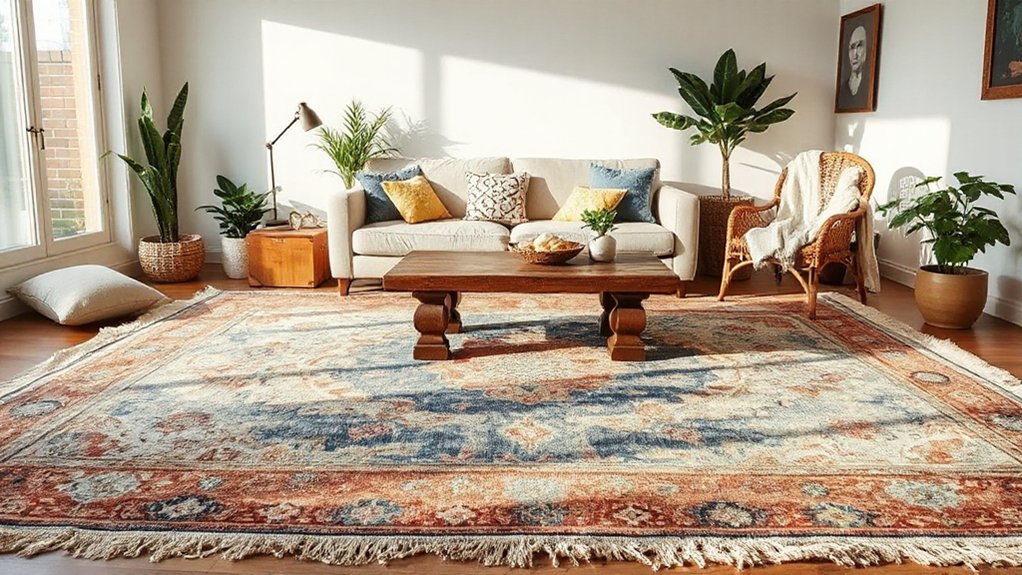
Start with the rug—it anchors the room’s palette and instantly sets the scale you’ll design around.
You can layer patterns (vintage over jute, kilim over sisal) and use separate rugs to define zones like seating, dining, or a reading nook.
Confirm your furniture scale against the rug first so front legs sit comfortably on it and the layout doesn’t feel undersized or ad hoc.
Anchor Room With Rugs
Before you buy a sofa or commit to paint colors, pick your rug—it sets the room’s scale and keeps a bohemian space from feeling random. Start with a size that fits your layout: in living rooms, aim for front legs of seating on the rug; in bedrooms, run it under the lower two-thirds of the bed. Use Vivid color to signal your vibe, then let Pattern mixing show up in smaller textiles later without overpowering the floor.
- Measure and tape the rug outline on the floor to confirm clear walk paths.
- Choose durable fibers for your market: wool for longevity, flatweaves for apartments, indoor/outdoor for pets.
- Balance budget by investing in the largest rug and going simpler on accents.
Layer Patterns, Define Zones
Once you’ve locked in the main rug size, you can layer patterns without visual chaos and use textiles to carve the room into clear zones. Start with a grounding weave in a medium value, then add a smaller vintage-look rug on top to spotlight a reading nook or music corner.
Keep Pattern layering intentional: mix one geometric, one organic, and one solid texture, and repeat a single color across them to prevent a patchwork mess.
For Zone definition, shift pile height and edge treatment: fringe marks a lounge area, a flatweave signals circulation, and a sheepskin softens a bedside landing. Offset top rugs by 6–12 inches so borders read on purpose.
Use rug pads so layers don’t creep, and choose durable fibers where foot traffic hits.
Confirm Furniture Scale First
If you choose your rugs first, you lock in the room’s visual footprint and can scale every furniture piece to match. In boho rooms, layered textiles can trick your eye, so you’ll need quick Scale verification before you buy a low sofa or oversized rattan chair.
Treat the rug as your measuring grid: it tells you how many seats fit, where legs can land, and how open the walk paths stay. Use these checkpoints:
- Keep front legs of seating on the main rug to unify Furniture placement.
- Leave 12–18 inches from rug edge to walls in most living rooms.
- Confirm coffee table clearance at 16–18 inches for comfort.
Shop with tape in hand, compare dimensions, and skip “looks about right” guesses.
Mix Boho Patterns Without Chaos
To mix boho patterns without chaos, you’ll anchor everything with a tight palette (2–4 core colors plus one accent) so the look reads intentional, not thrift-store random.
Then you’ll balance scale and motifs—pair a large-scale floral or ikat with medium geometrics and a small stripe, and keep at least one motif type consistent across the room.
Finally, you’ll repeat your winning patterns in two or three places (pillows, a throw, an ottoman) to lock in cohesion and make the mix feel styled for today’s market.
Anchor With A Palette
When you anchor your boho look with a tight, repeatable color palette, you can stack prints—ikat, kilim, florals, stripes—without the room tipping into visual noise. Start with Color psychology: pick one mood driver (calming sage, grounded terracotta, airy sand) and let it lead every purchase decision, from pillows to art.
Use palette coordination to keep the mix shoppable and cohesive: choose 3–5 core colors, then repeat them at least three times across the room. Keep neutrals as the “glue,” and limit high-chroma accents to small doses.
- Select 1 dominant, 2 supporting, 1 accent color.
- Match undertones (warm with warm, cool with cool).
- Test swaps under your room’s lighting before buying.
Balance Scale And Motifs
Although boho style celebrates “more,” you’ll keep it looking curated by balancing pattern scale and repeating a few motifs on purpose. Start with one dominant pattern in a large scale—like a bold kilim rug or oversized floral—then layer in medium-scale stripes or geometrics, and finish with small-scale ditsy prints on pillows. This creates scale harmony and keeps the eye moving without visual noise.
Choose two or three motif families (paisley, tribal diamonds, botanical vines) and use them across textiles and art so you can balance motifs even when colors vary. In stores, mix price points: invest in the anchor rug, then swap affordable covers seasonally.
If the room feels busy, reduce pattern on large upholstery and shift it to removable accents.
Repeat Patterns For Cohesion
Once you’ve balanced pattern scale and narrowed your motif families, repetition becomes the tool that makes a boho mix read intentional instead of chaotic. Pattern repetition creates visual harmony by giving the eye familiar checkpoints across the room, even when you’re layering global prints, stripes, and florals.
Use repetition like a merchandiser would—place it where it’ll be seen from multiple angles, and keep color values consistent (warm vs cool, light vs deep). Aim for three “echoes” of a motif or shape, not ten.
- Repeat one key pattern on two textiles and one small accent (pillow, lampshade, tray).
- Reuse the same colorway in different patterns (kilim + ikat) to unify.
- Mirror pattern density: busy print balanced by a quieter version nearby.
Add Texture With Textiles (Not Trinkets)
If your bohemian space feels flat, skip the shelves of tiny trinkets and build depth with textiles you can actually use. Start with Textile layering: a rug plus a smaller accent rug, then a throw, then 2–3 pillows in different weaves. Keep a tight palette so texture does the work, not clutter.
For smart Fabric selection, mix performance and natural fibers: a washable cotton slipcover, a wool or jute rug for grit, linen curtains for softness, and a chunky knit or boucle throw for relief. Vary scale—tight herringbone against wide stripes—so everything reads intentional.
Edit by function: every piece should add comfort, absorb sound, or soften hard surfaces. You’ll get richness without dusting dozens of objects every week.
Blend Vintage Finds With Modern Basics
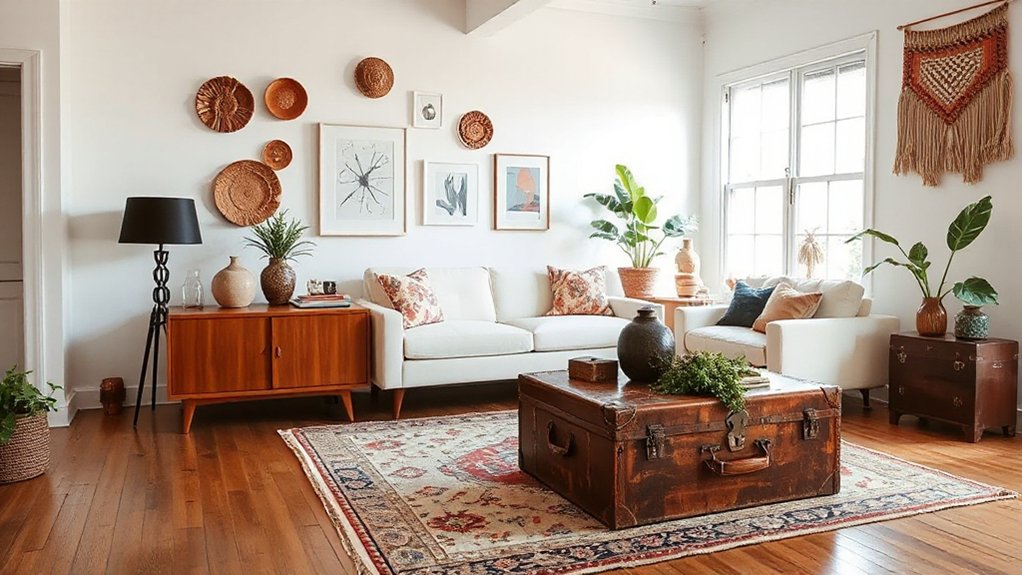
When you anchor your bohemian room with clean, modern basics, your vintage pieces look curated instead of chaotic. Start with Modern essentials in consistent tones—warm white, sand, charcoal—so your flea-market wins read as intentional highlights. Keep silhouettes simple, then let patina and quirks do the talking. Shop smart: today’s resale market rewards restraint, and editing saves you from impulse clutter.
Aim for contrast in era, not in chaos, and repeat one finish to tie it together.
- Choose one “hero” vintage piece, then give it breathing room.
- Add Vintage accents in pairs (brass, rattan, hand-thrown ceramic) for rhythm.
- Ground it with modern lighting and crisp, solid-color textiles to sharpen the mix.
Boho Furniture That Holds Up
Although boho style leans relaxed and collected, your core furniture has to perform like hardworking staples: prioritize solid wood or metal frames, tight joinery (dowels, mortise-and-tenon), and high-rub fabrics like cotton-linen blends or performance velvet so pieces age with character instead of collapsing into sag and wobble.
When you shop Boho furniture, flip sofas and chairs to check corner blocks, webbing, and eight-way hand-tied or sinuous springs; avoid stapled-only frames and thin MDF rails.
For tables, look for thick tops, reinforced aprons, and level feet; rattan should have tight cane and sealed edges.
Build longevity with durability tips: use felt pads, rotate cushions, keep away from direct sun, and spot-clean fast. Invest in replaceable slipcovers and repair-friendly hardware.
Set Calm Zones in a Boho Room
Because boho rooms can stack textures, patterns, and objects fast, you’ll get a more livable look by carving out a few calm zones that give your eyes—and your routine—some breathing room. Pick one corner that stays edited and repeat that logic elsewhere, so the room still reads collected, not chaotic.
- Define the Calm zone: anchor it with one solid-texture rug and two quiet textiles (linen, cotton), keeping patterns out.
- Limit the object count: cap surfaces at three pieces—tray, plant, book—so your styling looks intentional and resale-ready.
- Protect the Relaxation space: set one seat, one side table, and a basket for throws, then enforce a “no mail, no chargers” rule.
You’ll keep boho’s soul while gaining daily calm.
Layer Lighting: Ambient, Task, Glow
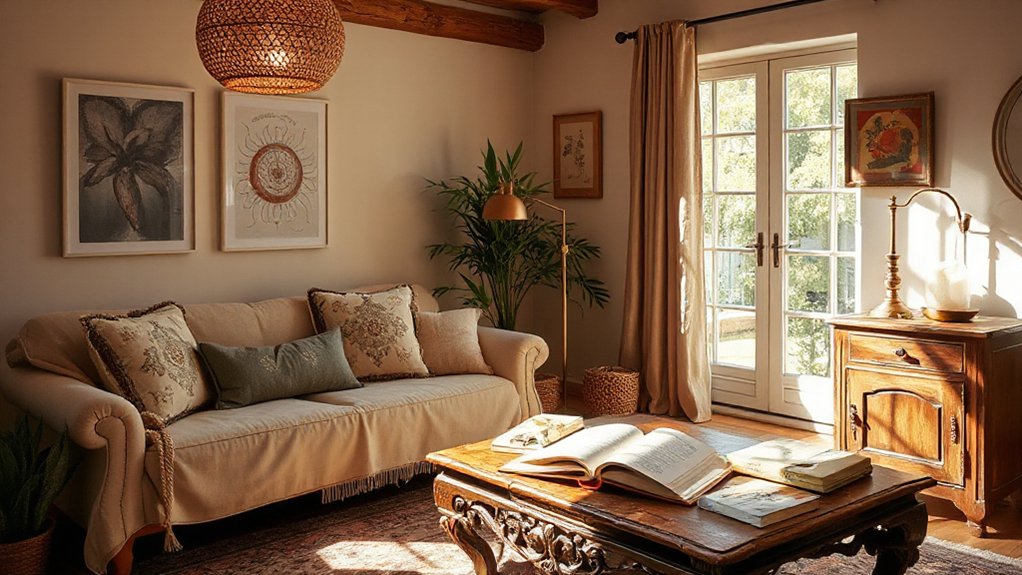
Even if your boho mix leans bold, layered lighting keeps the room functional and visually balanced by separating general ambient light, focused task light, and a softer glow.
Start with dimmable ceiling or pendant lighting to cover the whole space; choose warm LEDs (2700–3000K) so patterns and textiles don’t feel harsh.
Next, add task light where you actually work: a swing-arm sconce by the bed, a compact desk lamp, or an adjustable floor lamp beside a reading chair. Aim the beam down, not across the room, to cut glare.
Finish with glow: low-watt table lamps, lantern-style shades, or string lights on a timer for evening atmosphere. Put each layer on separate switches or smart plugs so you can price-shop fixtures and still get flexible control.
Style Boho Shelves Without Clutter
To keep boho shelves looking collected, not chaotic, you need a clear edit plan before you start styling. Aim for Minimal clutter by curating fewer, better pieces and giving each item breathing room. Start with what you’ll store, then choose display objects that reinforce your color story and textures, not random souvenirs.
- Set boundaries: limit each shelf to 60–70% filled, and group items in 3s for easy shelf styling.
- Mix heights, repeat materials: stack two books, add one sculptural object, then echo a finish (brass, rattan, matte ceramic) across shelves.
- Hide the mess: use lidded baskets or boxes for cords, remotes, and mail, keeping the front edge clean.
Step back, snap a photo, and edit again.
Use Plants to Soften Edges Naturally
You can soften hard lines in your bohemian space by letting cascading greens trail off shelves, adding movement without adding clutter. You’ll get instant curves by placing a tall floor plant in sharp corners to round out the layout and balance boxy furniture.
Build texture by mixing leafy layers—broad leaves, fine fronds, and trailing vines—so the room reads rich and relaxed on any budget.
Cascading Greens On Shelves
Where do your shelves feel a little too sharp or staged? Add cascading greenery to break straight lines and make shelf styling look collected, not curated. Start with dependable trailers like pothos, heartleaf philodendron, or string of turtles—widely available and forgiving in typical indoor light.
Place the pot on the highest shelf so vines drape naturally, then balance the visual weight with books or ceramics below. Keep it functional: don’t let leaves block speakers, vents, or outlets, and leave clearance for cabinet doors.
For a polished boho finish, do this:
- Use one trailing plant per shelf bay to avoid clutter.
- Choose a matte clay or woven cachepot to mute glare.
- Add a saucer insert to protect wood from runoff and stains.
Corner Plants For Curves
How can a room feel instantly less boxy without moving furniture? Place corner plants where hard angles stop your eye. A tall, upright plant in a floor pot pulls attention upward and rounds the visual path, especially beside a square bookcase or media console.
If you’ve invested in curved furniture, use plants to complete the arc: set a medium plant just behind a rounded chair, or flank a curved sofa end with one statement pot so the curve reads intentional, not accidental.
Choose containers with softened profiles—oval, ribbed, or tapered—to avoid repeating sharp corners. Keep clearance for walking paths, and match plant size to ceiling height for balanced scale. Rotate weekly for even growth.
Textures With Leafy Layers
Corner plants round out the room’s hard angles, and leafy layering takes that softness across every surface line. You’ll get richer contrast when you mix leaf sizes, finishes, and heights, creating leafy textures that read intentional, not cluttered. Keep sightlines clear and let plants act like living textiles against wood, rattan, and plaster.
- Stack heights: pair a tall floor plant, a mid shelf pot, and a low trailing vine to build layered foliage without blocking light.
- Mix leaf profiles: combine split leaves, fine fronds, and broad ovals so edges look blurred, not busy.
- Repeat containers: match two or three pot materials (terracotta, matte ceramic, basket) to keep the look market-friendly and cohesive.
Add Global Pieces Without a “Theme
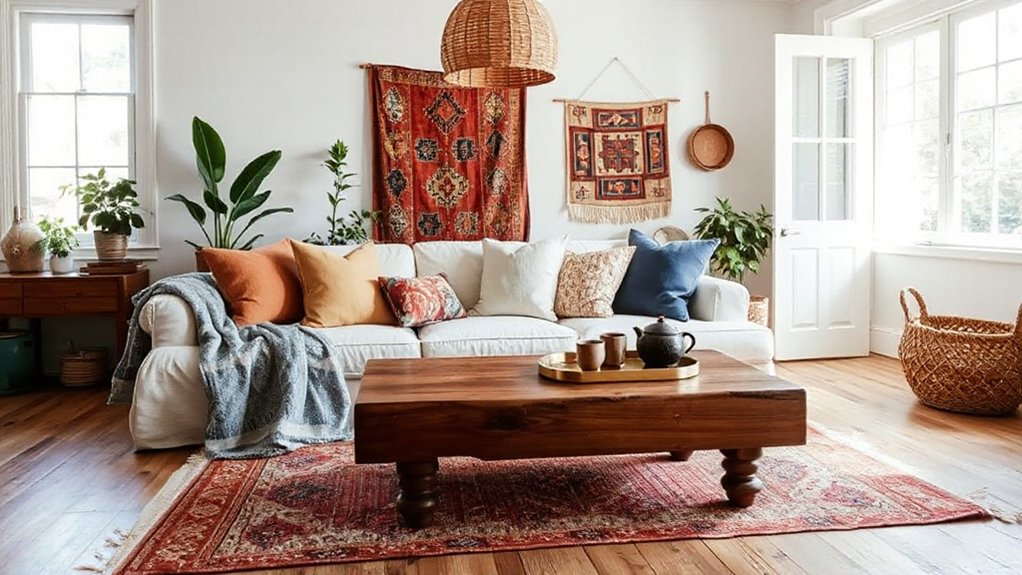
Even if you love pieces from different places, you don’t need to lock them into a matching “global” theme to make them work. Treat Global influences as accents, not a costume: one carved stool, one mud-cloth pillow, one brass tray. Let the rest of the room stay edited.
Create Eclectic fusion by repeating quiet connectors—one metal finish, a shared wood tone, or a tight color range pulled from your rug. Scale matters: balance a large statement textile with smaller objects so it feels collected, not cluttered.
Mix old and new deliberately; pair a vintage Moroccan mirror with a clean-lined sofa to keep it current for today’s buyers and rentals. Display pieces in small groupings, and leave breathing room on shelves and walls.
Quick Fixes for Common Boho Mistakes
If your boho room reads more “busy” than “lived-in,” a few targeted edits will fix it fast. Start by limiting competing focal points and giving each zone a purpose—lounging, reading, or dining—so your layers feel intentional, not random.
- Edit the palette: cap it at 3–4 core colors, then repeat them in textiles and Bohemian accessories to create continuity.
- Right-size your layering: keep one statement rug, one throw, and two pillows per seat; rotate the rest seasonally to avoid clutter.
- Curate boho art displays: group pieces into one gallery wall or two large anchors; align top edges, keep consistent frames, and leave breathing room.
You’ll keep the free-spirited vibe while making it shop-ready and easy to live with.
Frequently Asked Questions
How Do You Clean and Maintain Delicate Vintage Textiles in Daily Use?
You’ll protect delicate vintage textiles by rotating use, spot-testing, and vacuuming through a screen. For Textile preservation, choose Gentle cleaning techniques: pH-neutral soap, cold water, blot—don’t rub. Air-dry flat, store acid-free, avoid sun.
Is Bohemian Style Compatible With Small Apartments and Strict Building Rules?
Yes, you can make it work in a small apartment with strict rules: prioritize removable decor, lightweight textiles, and multifunction pieces. Control Bohemian clutter with closed storage, and plan Vintage preservation using UV liners, gentle rotation.
What’s a Realistic Budget Range to Achieve a Cohesive Boho Look?
You can land a cohesive boho look for $300–$1,500, like stitching a quilt from found treasures. Start Budget planning: allocate 40% rugs, 30% Vintage textiles, 30% lighting/art; buy secondhand, wait for sales.
How Can You Make Boho Interiors Kid- and Pet-Friendly?
You’ll make boho interiors kid- and pet-friendly by choosing washable rugs, performance fabrics, rounded edges, and closed storage. Stick to forgiving color palettes, plan clear furniture arrangements, anchor shelves, and use stain-resistant slipcovers.
Where Can You Source Ethical, Fair-Trade Decor Without Overpaying?
Start with vetted marketplaces and co-op storefronts; the payoff’s quiet: lower markups. Filter by Sustainable sourcing and Fair trade certifications, then compare landed costs, bundles, seconds. Buy direct from artisans during drops, not resellers.
Conclusion
Now you’ve got a boho plan that feels curated, not chaotic. Keep your palette grounded, choose one anchor piece, and let the rug set the room’s scale. Layer patterns with intent, then edit shelves so every object earns its spot. Add plants to soften hard edges, and mix global finds without turning your home into a costume. Think of it like jazz: improvisation, guided by rhythm. When it feels “too much,” subtract, don’t add.