
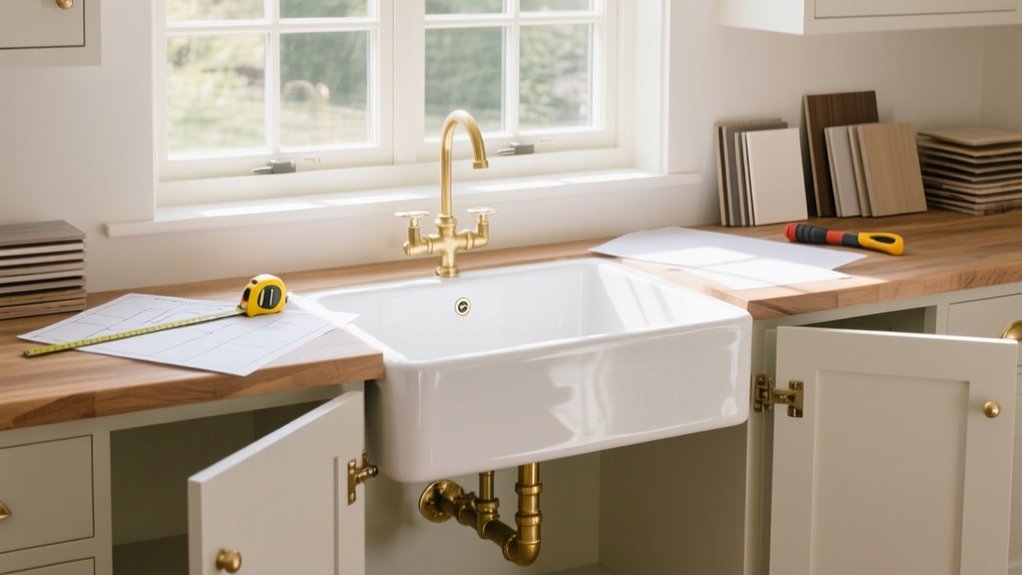

You’ll choose a Belfast sink by weighing depth, bowl layout and material (fireclay, ceramic, or cast iron) against your UK kitchen’s base-unit width, worktop type and tap position. Plan strong cabinet support, brackets and correct overhang, then set out tap holes, overflow and waste before cutting. Use compatible traps, maintain fall on waste pipes, and seal timber edges and joints thoroughly with quality silicone so you avoid leaks, swollen carcasses and future headaches—and that’s just the start.
Is a Belfast Sink Right for Your Kitchen?
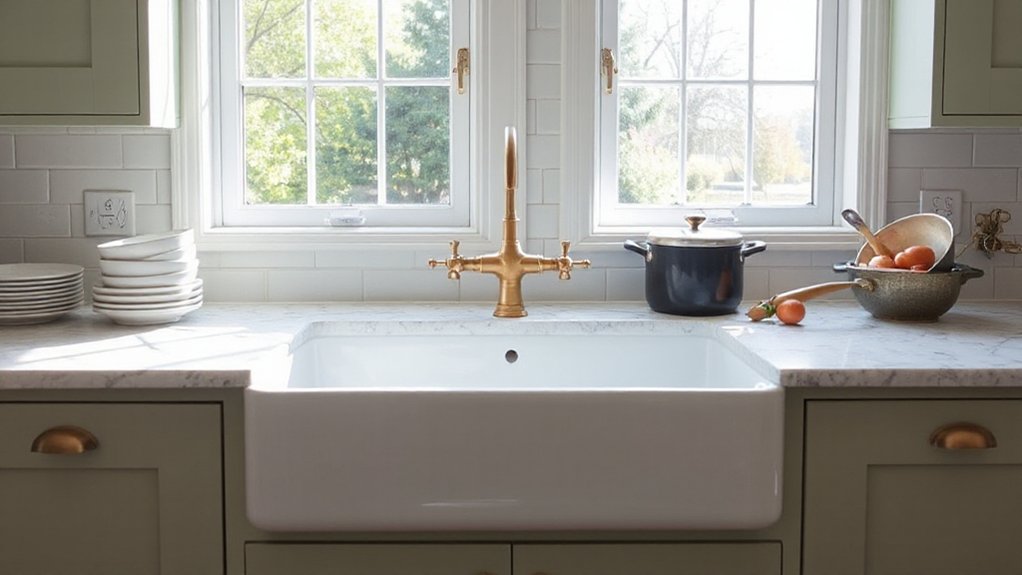
When you’re weighing up whether a Belfast sink suits your kitchen, start with how you actually use the space day to day. If you batch-cook, wash big pots, or rinse homegrown veg, you’ll appreciate the deep bowl and generous capacity.
If you mostly use a dishwasher, you may prefer something smaller.
You’ll also want the sink to anchor your kitchen decor. Belfast sinks pair well with Shaker doors, natural timber, and painted cabinetry, common across UK and Irish homes, but they can soften sharper, modern schemes too.
Check your base-unit width, worktop material, and existing plumbing fixtures, as the waste position, overflow, and tap layout must line up.
If you’re unsure, ask a local fitter to confirm compatibility before you commit.
Belfast vs Butler Sinks: What’s the Real Difference?
Although people often use the terms interchangeably, Belfast and Butler sinks aren’t actually the same thing, and the differences matter once you get into specifying one for a UK or Irish kitchen.
A Belfast sink is traditionally deeper, with an overflow weir to cope with plentiful water. The classic Butler (originally London) sink is slightly shallower, with no overflow, reflecting historic water restrictions.
In practice, you’ll notice Belfast models feel more robust and capacious, ideal if you routinely soak pans, prep veg, or batch‑cook.
Butler sinks read a little lighter and suit tighter worktop depths.
Both deliver vintage charm, but you can pair either with modern aesthetics—slab doors, quartz worktops, or brushed brass taps—to make the sink feel fully at home in your space.
Choose the Best Material for Your Belfast Sink
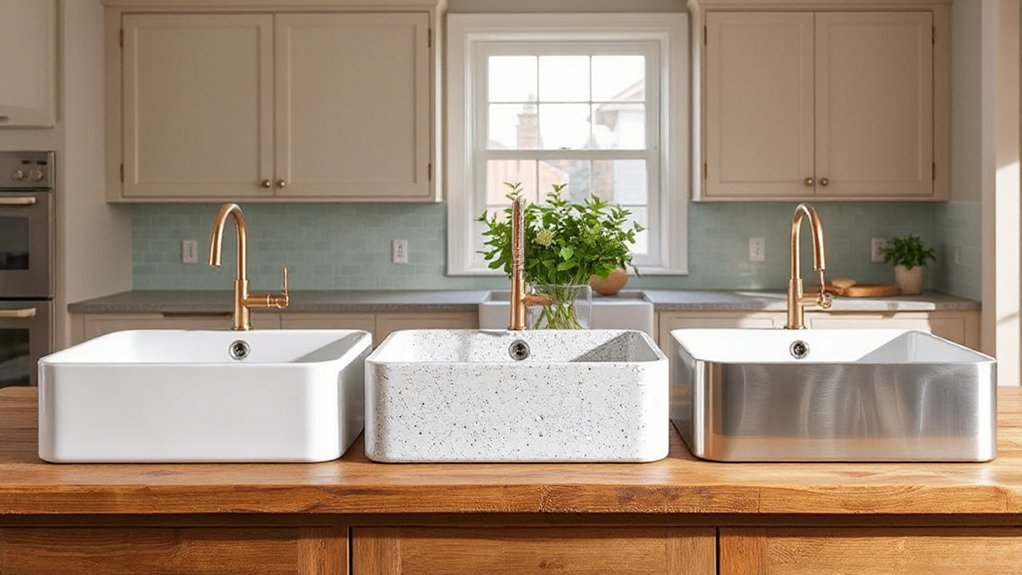
When you choose a Belfast sink, the material you pick—typically fireclay, ceramic, or stainless steel—will dictate how it performs in a busy UK kitchen. You’ll want to weigh up hardness, resistance to thermal shock, and how well the surface copes with pans, trays, and constant washing up.
Next, you should consider day‑to‑day care and long‑term maintenance, so you know exactly what’s involved in keeping your sink looking smart for years.
Comparing Sink Material Options
How do you decide which Belfast sink material will stand up best to daily life in a busy UK kitchen? Start by weighing how each option supports your kitchen decor, daily habits, and energy efficiency goals.
Fireclay is the classic Belfast choice: dense, precisely cast, and fired at high temperatures for crisp edges that suit both period terraces and modern refurbs. It works well with timber, stone, or composite worktops.
Ceramic is similar but usually a little lighter and more budget‑friendly, ideal for rental or family homes where you’re balancing cost with a timeless look.
Cast iron with enamel offers deep gloss and traditional character, pairing beautifully with shaker cabinetry.
Stainless or composite “Belfast‑style” options give a more contemporary, streamlined feel that fits compact, highly insulated homes.
Durability, Care, And Maintenance
Because a Belfast sink has to cope with heavy pots, hot trays, and constant rinsing, durability and day‑to‑day care should drive your choice of material just as much as appearance or cost. In real UK kitchens, that usually means balancing impact resistance, heat tolerance, and how realistic your cleaning routines are.
Ceramic and fireclay offer excellent material lifespan but need non‑abrasive cleaners and a bit of vigilance with metal marks. Cast iron remains tough, though enamel chips if you’re careless. Modern composites resist scratching yet dislike harsh chemicals.
- Match material lifespan to how long you expect to keep the kitchen
- Check manufacturer stain and heat ratings
- Use soft pads, not wire wool, on every finish
- Wipe spills quickly, especially tea, wine, and curry
- Follow the maker’s maintenance schedule and products
Pick the Right Size, Bowl Layout and Depth
Before you order a Belfast sink, you need to measure your cabinet carcass, worktop cut-out, and surrounding units so the sink sits correctly and meets UK regulations for clearances and overhangs.
You’ll then decide whether a single or double bowl layout suits how you actually use the kitchen, from pot washing to food prep and draining.
Finally, you must choose a practical bowl depth that balances capacity with comfort, plumbing falls, and any restrictions from your worktop thickness and waste position.
Measuring Cabinet And Worktop
Once you’ve settled on a Belfast sink style, you need to confirm that your cabinet and worktop can physically take it – in width, depth, height and weight. Measure the internal width of the base cabinet, allowing for side panels, plumbing and any pull-out kitchen accessories.
Check the sink’s depth against the plinth height so the base doesn’t foul the floor.
- Measure worktop front-to-back; allow overhang and tap ledge.
- Confirm carcass thickness and construction; Belfast sinks are heavy.
- Check clearance for waste kit, water traps and cleaning access.
- Verify worktop cut-out leaves at least 50 mm of solid material.
- Plan a slight fall towards the bowl to improve drainage and ease cleaning; this supports long-term hygiene and simple cleaning tips.
Single Vs Double Bowl
How you use your kitchen day to day should drive whether you choose a single or double-bowl Belfast sink, and how deep and wide it needs to be.
A generous single bowl suits smaller British kitchens and busy family homes, giving you uninterrupted space for roasting trays, stockpots and handwashing knitwear. It reinforces the classic farmhouse look and keeps your kitchen decor simple, with strong vintage appeal.
A double bowl works well if you often prep food and wash up at the same time, or prefer a defined area for soaking.
It’s popular in open-plan layouts where you share tasks. Just confirm your base cabinet can support the greater overall width and weight, and that tap position serves both bowls comfortably.
Choosing Optimal Sink Depth
Although Belfast sinks look broadly similar at a glance, depth varies a lot and has a direct impact on comfort, capacity and how well your drainage works. In most UK homes, 200–250mm internal depth suits daily use, giving you space for roasting trays without forcing you to stoop.
Go deeper only if your worktop is higher than standard, or you’re tall and do big batch cooking.
Key checks when you’re choosing depth:
- Measure from elbow to wrist; the bowl base should sit just below wrist height.
- Confirm your tap’s reach and splash pattern at different water temperature settings.
- Check clearance above the waste for efficient fall to the trap.
- Balance depth with under-sink storage and appliance plumbing.
- Consider sink aesthetics alongside neighbouring cabinets and window lines.
Plan the Base Cabinet and Support for a Heavy Belfast Sink
Before you order the sink, you need to design a base cabinet that can safely carry its weight, plus water and pans, without sagging.
Start by checking the manufacturer’s dry and filled weights, then confirm your existing carcass is 18 mm minimum with solid sides, not just thin backs or rails.
Plan cabinet reinforcement across the full width: add a continuous hardwood bearer front and back, fixed into the side panels, and a solid floor or stretcher rails beneath the bowl area.
In most UK homes, carcasses are chipboard, so don’t rely on cam fittings alone—use screws and glue.
Fit heavy-duty steel support brackets to the wall behind the sink, tying the cabinet into the masonry or studwork for long-term stability.
Get the Worktop Cut-Out, Overhang and Joint Right
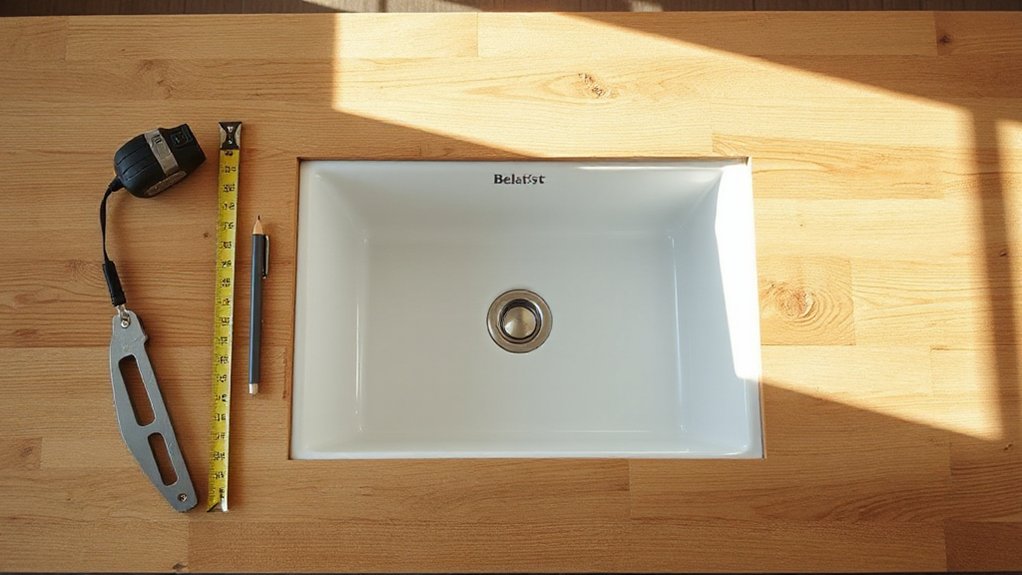
You now need to mark out the worktop precisely, so you get an accurate cut-out that matches the external dimensions of the Belfast sink and its expansion gaps.
You’ll also set the correct front and side overhang, which affects how water returns to the bowl and how comfortable the sink feels to use day to day in a UK kitchen.
Finally, you must position any worktop joints well clear of the cut-out and tap area, so you don’t create weak points that are prone to movement or water ingress.
Measuring Accurate Cut-Out
How do you turn a beautiful Belfast sink into a neat, watertight installation? You start by measuring the cut-out with joiner-level precision. Set the sink on trestles, measure its external width and depth, then deduct the manufacturer’s recommended clearance.
Mark those dimensions on masking tape laid over the worktop, squaring off from the front edge so the sink sits central to the base unit and tiles.
- Check the cabinet carcass is square before marking anything
- Confirm cut-out allowances suit your countertop finishes (laminate, solid wood, stone)
- Scribe around the actual sink rather than relying solely on drawings
- Dry-fit any sink accessories that affect the bowl position
- Measure twice from fixed points: wall, cabinet gables, and front edge
Setting Ideal Overhang
Precisely setting the overhang is what makes a Belfast sink look intentional rather than simply dropped into a hole. Aim for a 10–20 mm front overhang beyond the ceramic lip; it’s generous enough to control drips, but not so deep that it invites knocks or feels clumsy.
In most UK kitchens, 12–15 mm balances practicality with classic overhang aesthetics.
Check your worktop is square to the sink, then scribe the front edge to follow the sink’s line, not the other way round. This keeps gaps tight and consistent.
Prioritise edge finishing: a small pencil‑round or chamfer on timber or laminate softens the profile, protects vulnerable corners, and visually ties your sink into neighbouring cabinets and runs so it feels properly built‑in.
Positioning Joints Safely
Although the cut-out and overhang steal most of the attention, joint positioning is what determines whether a Belfast sink installation survives daily use in a UK kitchen. You never place a worktop joint directly over, or tight beside, the sink cut-out; you offset it by at least 100–150mm so water can’t sit and creep into vulnerable board edges.
Joint safety depends on both layout and sealing techniques, especially with laminate or timber.
- Keep all butt joints clear of tap holes, waste, and overflows.
- Use factory edges for joints wherever possible.
- Clamp joints hard, then fully seal with waterproof adhesive and colour-matched sealant.
- Run a continuous bead around the cut-out, not broken dabs.
- Wipe squeezed-out sealant immediately for a tight, invisible barrier.
Decide on Tap Holes, Tap Placement and Overflow
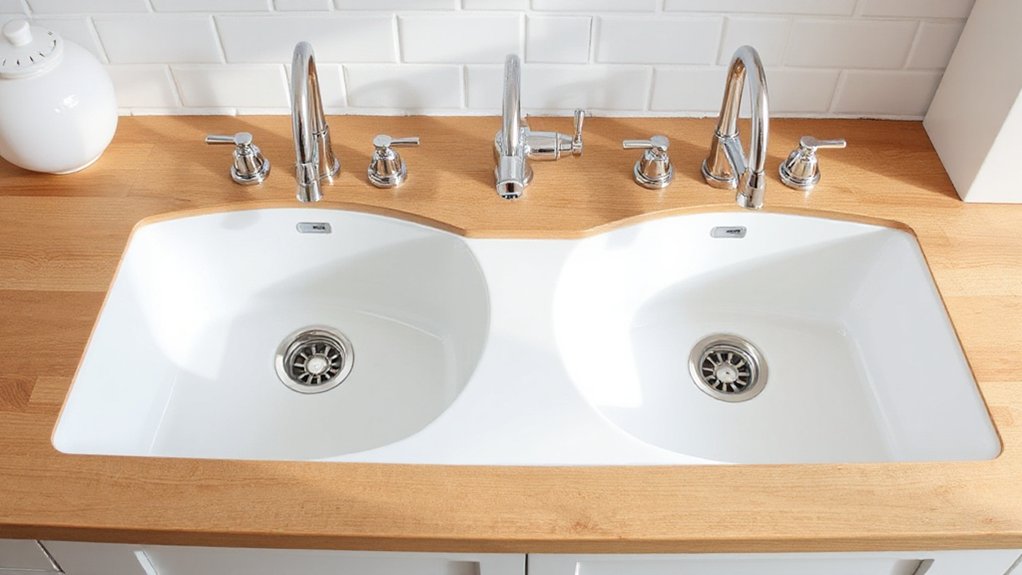
Once you’ve chosen your Belfast sink size and position, you need to decide exactly where the water will come from and where it will go if it overfills. Tap placement and Overflow positioning need agreeing before the worktop is cut or the plumbing first-fixed.
Decide whether you want deck-mounted taps on the worktop, wall-mounted taps above, or, on some modern Belfast models, taps mounted on a rear ledge. Check reach: the spout should discharge roughly over the centre of the bowl, clearing the front edge.
In older UK homes with solid walls, wall-mounted taps can simplify tiling and look period-correct.
For overflow, confirm whether the sink has an integrated overflow and position it facing the primary working side, visible and accessible.
Plumb Your Belfast Sink: Traps, Waste and Drainage
Before you tighten a single compression nut, you need a clear plan for how the Belfast sink will discharge waste water and trap smells.
Start by confirming the outlet size on your fireclay sink and matching it with a quality basket strainer and compatible waste trap.
In UK homes, you’ll typically run 40mm plastic to the main drain pipe, with enough fall to avoid standing water and gurgling.
Key checks as you set out the plumbing:
- Choose a deep seal P- or S-trap to meet Building Regulations.
- Keep the waste trap close under the sink to minimise odours.
- Maintain a continuous fall on every horizontal drain pipe run.
- Use solvent-weld joints where movement’s unlikely.
- Add a rodding point if the run’s long or awkward.
Seal and Waterproof Around Your Belfast Sink
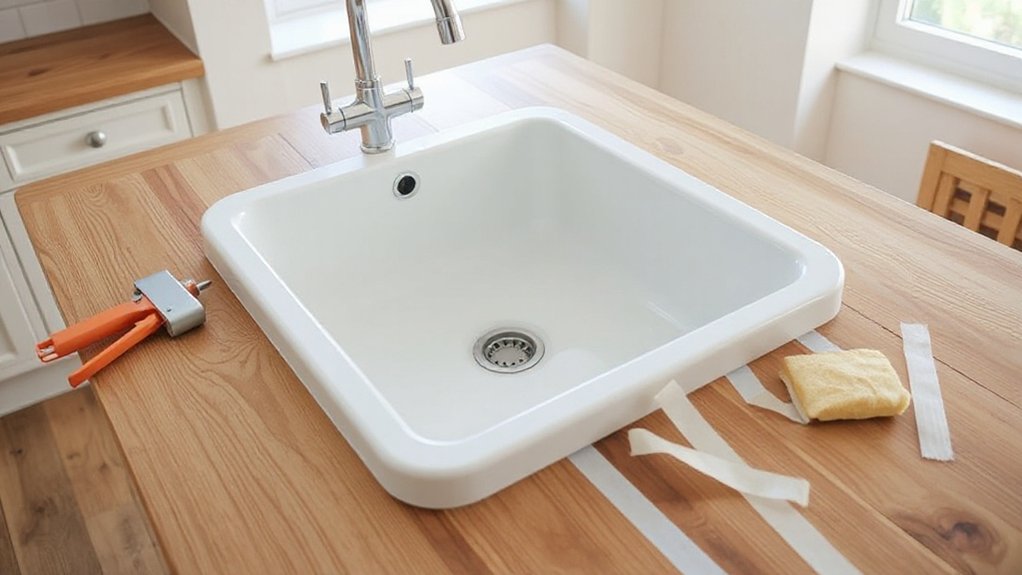
How do you stop a Belfast sink from slowly soaking the joinery around it? You start with meticulous preparation. Degrease the sink rim and worktop cut-out, then lightly abrade timber edges and prime them with a suitable waterproof sealer, especially on laminate or solid wood commonly used in UK kitchens.
Next, focus on precise sealant application. Use a high‑quality sanitary silicone rated for constant water exposure. Gun a continuous bead around the cut-out and along the sink rim, then bed the sink so sealant squeezes out evenly.
Finish with layered waterproofing techniques: seal the exposed underside of timber, run a secondary bead around the internal perimeter, and smooth it for full contact. Allow full cure time before connecting taps or loading the bowl.
Avoid These Common Belfast Sink Installation Mistakes
Sound sealing work only pays off if you avoid the classic mistakes that plague many Belfast sink installs in UK kitchens. You’re not just fitting a basin; you’re protecting cabinets, worktops, and those Belfast sink aesthetics that nod to historical design trends. Treat the sink, frame, and seal as one integrated system, not three separate jobs.
Common pitfalls to sidestep:
- Undersizing the support frame so the fireclay bears on worktops, not timber.
- Ignoring manufacturer’s clearances, leading to cracked rims or distorted silicone lines.
- Using basic sanitary silicone instead of high‑quality, mould‑resistant, flexible sealant.
- Forgetting to seal cut edges of chipboard or MDF, inviting hidden swelling and rot.
- Rushing waste and overflow alignment, stressing ceramic and creating future leaks.
Frequently Asked Questions
Can I Retrofit a Belfast Sink Into an Existing Kitchen Without Replacing Units?
You can, but you’ll usually cut down the existing cabinet, reinforce it, and plan for plumbing modifications. In a UK-style kitchen renovation, you’ll also adjust worktop height and waterproof surrounding joins so everything feels properly fitted.
How Do I Maintain and Clean the Glaze Without Causing Dullness or Scratches?
You treat the glaze like a well-loved village green: gentle Cleaning techniques, no scouring boots. Use soft cloths, mild detergent, bicarbonate paste; avoid abrasives, bleach, metal pads. For Glaze preservation, rinse, dry daily, and use rubber mats.
Are Belfast Sinks Suitable for Homes With Low Water Pressure or Older Plumbing?
Yes, Belfast sinks can suit low water pressure and older plumbing if you check plumbing compatibility first. You’ll likely need larger bore wastes, proper venting, and possibly pressure-boosting taps, which your local plumber can confirm.
Will a Belfast Sink Affect the Resale Value or Style Appeal of My Home?
Yes, a Belfast sink usually boosts style appeal and can nudge Market value up. Like a heritage pub’s tiled bar, its Aesthetic impact signals craftsmanship, reassuring local buyers they’re buying into character, not just square footage.
Can I Safely Use a Waste Disposal Unit With a Belfast Sink?
You can use a waste disposal with a Belfast sink if you confirm plumbing compatibility: check the fireclay outlet size, fit a compatible flange, guarantee robust support, and upgrade trapwork—particularly important in UK homes with older pipework.
Conclusion
You’re now ready to choose and fit a Belfast sink that actually suits your kitchen, not just your Pinterest board. Measure twice, cut once: confirm cabinet strength, allow for waste and taps, and plan waterproofing before you order. Check local plumbing regs, overflows and trap types, especially with UK/Irish-style deep bowls. Get the details right and your Belfast sink will work hard every day—and still look timeless in ten years’ time.


