
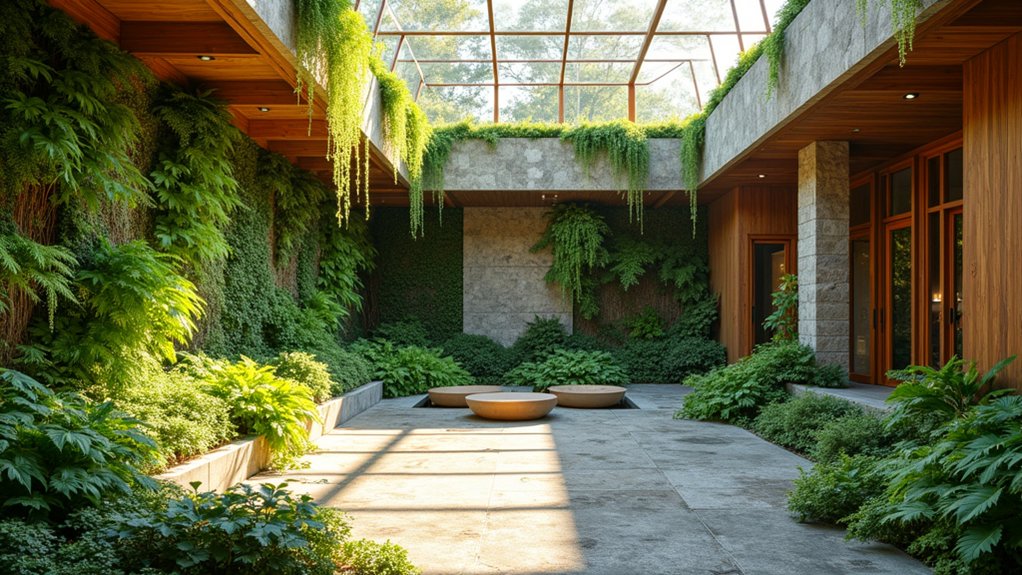

The Best Biophilic Design Trends to Try This Year blend nature-driven strategies with measurable outcomes to boost productivity, health, and resilience in interiors. Prioritize daylight-first layouts, large windows, skylights, and reflective surfaces to maximize natural light while reducing glare. Integrate greenery with low-maintenance species, living walls, and modular planters, plus natural textures and climate-aware materials. Use scent, sound, and microclimates to support daily rhythms and comfort. Expect scalable, budget-conscious trials that validate environmental claims as you proceed. More insights await.
Key Takeaways
- Integrate living walls and plant screens to improve air quality, acoustics, and visual depth in both offices and homes.
- Prioritize daylight optimization with strategic window placement, shading, and reflective surfaces for calm, glare-free work environments.
- Use natural materials with low lifecycle impact and authentic textures to enhance sustainability and sensory comfort.
- Layer biophilic scents and microclimate control synced with workflows to support focus, alertness, and relaxation.
- Employ modular greenery systems and vertical planting in small spaces to maximize ecological benefits with minimal retrofit costs.
What Is Biophilic Design: and Why It Matters Now
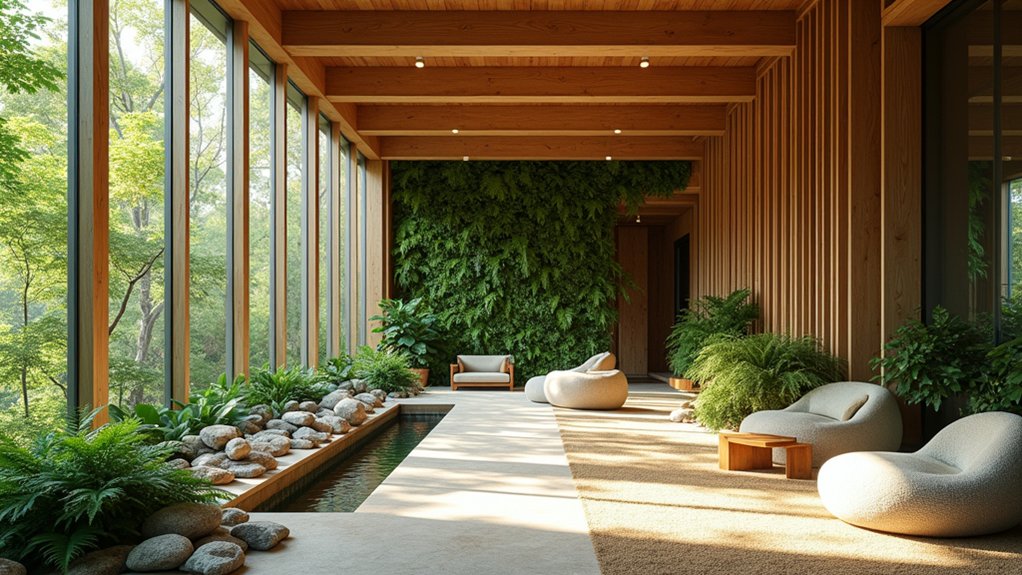
Biophilic design = the deliberate integration of nature and natural processes into built environments to strengthen human health, well-being, and performance. You engage this approach by recognizing how daily spaces influence physiology, cognition, and mood, and you implement intentional connections to the natural world.
In practice, it entails aligning architectural systems with ecological principles, optimizing light, air quality, and acoustics to mirror outdoor conditions. You assess how urban ecology informs site selection, materials, and landscape integration, ensuring biological diversity supports resilience and learning environments.
Natural aesthetics guide form, texture, and color palettes, creating legibility and calm. You quantify outcomes through performance metrics, user satisfaction, and health indicators, establishing a rigorous justification for investment.
The result is spaces that sustain productivity, creativity, and well-being while integrating seamlessly with their urban context.
Easy Greenery: Low-Maintenance Plants for Any Room
To implement easy greenery that supports biophilic goals without increasing upkeep, start with a curated selection of low-maintenance plants suited to typical indoor conditions. You’ll favor species tolerant of variable light, moderate watering, and stable temperatures, such as sansevieria, pothos, and zamioculcas.
These choices minimize routine care while maintaining visual biomass and air filtration benefits. Establish a simple plant care tips routine: irrigate on a fixed schedule, allow soil to dry partially, wipe leaves to sustain photosynthesis, and rotate containers for uniform growth.
Place plants in areas with representative ambient light, avoiding extreme drafts. Track performance via growth rate and leaf coloration to detect stress early. Regularly monitor indoor air quality indicators and adjust humidity or cleaning protocols.
This approach delivers reliable biophilic gains with predictable maintenance.
Daylight-First Layouts That Boost Mood and Focus
Daylight-first layouts prioritize natural illumination as a primary design driver, aligning task spaces with consistent, glare-balanced sun exposure to enhance mood and cognitive performance. You optimize window placement, orientation, and shading to maintain steady daylight levels while reducing glare, supporting sustained attention and reduced fatigue.
Work zones near apertures benefit from diffused light, while mid‑day sun angles are controlled with automated shading to prevent hotspots. Integrate daylight sensors with occupancy data to maintain consistent illuminance and energy efficiency.
To evoke urban jungles and sustainable materials, align desks with skylights or large transoms and pair with low‑emissivity glazing. This approach preserves daylight integrity and material longevity, delivering resilient productivity.
- Position primary tasks along generous windows to maximize exposure
- Use reflective finishes and light-colored surfaces to distribute glare-free light
- Select sustainable materials that withstand sunlight without yellowing or warping
Texture and Material Choices That Bring Outdoors In
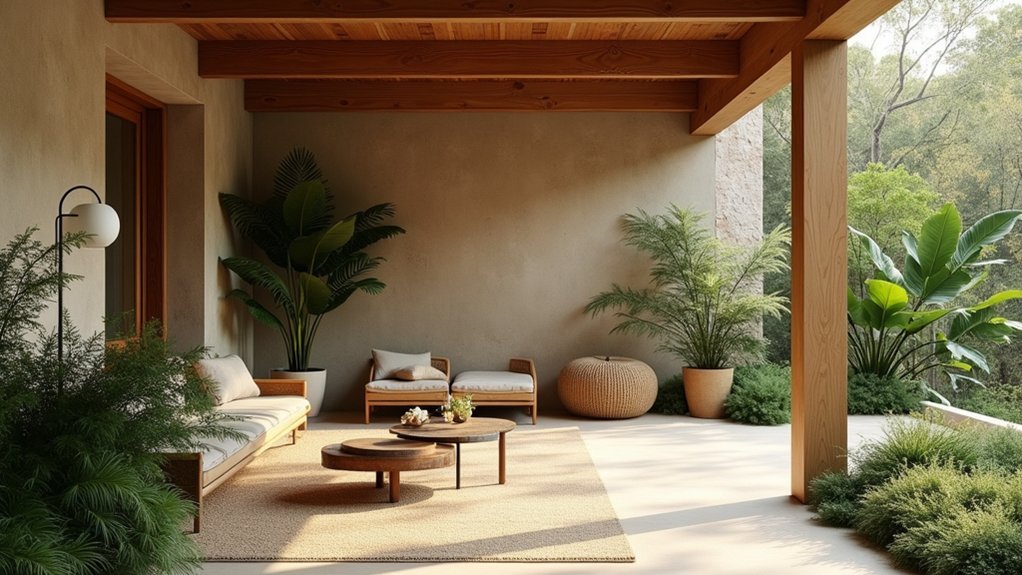
Texture and material choices play an essential role in translating outdoor environments indoors, shaping tactile experience, durability, and perceived connection to nature. You should prioritize materials that reliably resist wear while maintaining a natural aesthetic, ensuring long-term performance in high-traffic zones and humid spaces.
Favor textures that invite touch yet minimize maintenance, such as low-pillage textiles and seal-ready surfaces. When selecting surfaces, balance warmth and resilience by pairing soft, textured fabrics with durable substrates.
Incorporate natural stone for grounding texture, leveraging its thermal mass and moisture resistance to reduce energy needs. Use finishes that enhance grain and color variation without introducing glare.
Documentation should confirm pollutant-free composition and lifecycle impact, aligning with sustainability goals. This approach yields authentic biophilic texture without overstatement.
Nature-Inspired Color Palettes for Calm Spaces
Soft earth tones establish a grounded base for calm interiors, balancing warmth with subtle contrast to reduce visual stress.
Oceanic serene hues introduce cool, low-saturation palettes that promote perceived spaciousness and quiet focus, while maintaining legibility of architectural details.
Verdant botanical accents act as precise focal points that anchor nature-inspired schemes without overpowering others, enabling cohesive integration across materials and lighting.
Soft Earth Tones
- Use layered neutrals with subtle warmth to sustain depth and cohesion.
- Combine matte and low-sheen surfaces to modulate glare and reflection.
- Introduce organic textures and natural fibers to amplify tactility and grounding.
Oceanic Serene Hues
Implement a calibrated luminance hierarchy: wall tones around L* 45–55, accents at L* 25–35, and ceilings near L* 70–80 to maintain spatial clarity. Select pigments with micro-contrast control to prevent chatter under variable daylight.
Pair with Coastal interior accents such as driftwood browns, sand neutrals, and mineral whites to anchor the palette. Fix color temperature between 2700–3500K for harmony with natural textures.
Test sample zones under key lighting to verify real-world calm, avoiding abrupt shifts that disrupt serenity.
Verdant Botanical Accents
- Emphasize plant-inspired pigments with controlled saturation
- Integrate sources of indirect daylight and reflective finishes
- Prioritize air-aware materials and finishes for calm spaces
Biophilic Hardware You’ll Actually Use in Small Spaces
Compact biophilic add-ons and space-saving green hardware let you integrate nature without crowding your footprint. You’ll want devices designed for small spaces that are easy to install, durable, and energy-efficient, with clear UI and minimal maintenance.
This discussion starts by weighing practicality, performance, and aesthetic harmony to make certain you actually use these components daily.
Compact Biophilic Add-Ons
When space is at a premium, choose purpose-built biophilic hardware that delivers tangible benefits without crowding the area. Select items designed for mounting versatility, low-profile silhouettes, and modular integration.
In compact environments, the right add-ons extend greenery without clutter, delivering measurable air-quality and mood improvements through precise placement and robust attachment systems. Focus on discreet hardware that enables Indoor water features and Vertical garden installations without overpowering sightlines.
Prioritize options with cable management, moisture resistance, and tool-free adjustments to support rapid reconfigurations as needs evolve.
- Slim wall-mounted planters with integrated reservoirs
- Low-profile bracket systems for vertical grid installations
- Modular, stackable water feature components with reversible mounting
Space-Saving Green Hardware
Prioritize components that blend low-profile enclosures with high-load ratings, using lightweight yet durable substrates. Choose fasteners, hinges, and brackets manufactured from recycled or rapidly renewable materials to minimize lifecycle impact.
Guarantee product certifications align with indoor air quality goals, reducing volatile organic compounds and off-gassing through low-emission finishes and binders.
In practice, favor hardware that supports multi-functionality—think biofiltration vents, plant-friendly mounting rails, and concealed tubing channels.
Emphasize sustainable materials and traceability to validate environmental claims. This approach keeps spaces airy, resilient, and visually coherent while delivering reliable performance in constrained environments.
Designing a Productive Work Zone With Nature
To maximize focus and output, design a productive work zone with nature by integrating natural elements that support cognitive performance and well-being. You optimize lighting, acoustics, and airflow with plant-integrated screening, living walls, and access to daylight, aligning with urban forestry principles and ecological restoration goals to sustain benefits.
You also structure tasks around nature-associated cues that lower cognitive load and stress, while preserving work efficiency and accuracy.
- Integrate potted species and climbers for air quality, texture, and visual depth.
- Implement a living wall or green screen that doubles as a temperature and noise moderator.
- Align daylight zones with workstations and cultivate routine maintenance informed by urban forestry practices.
Biophilic Design Ideas for Tiny Apartments
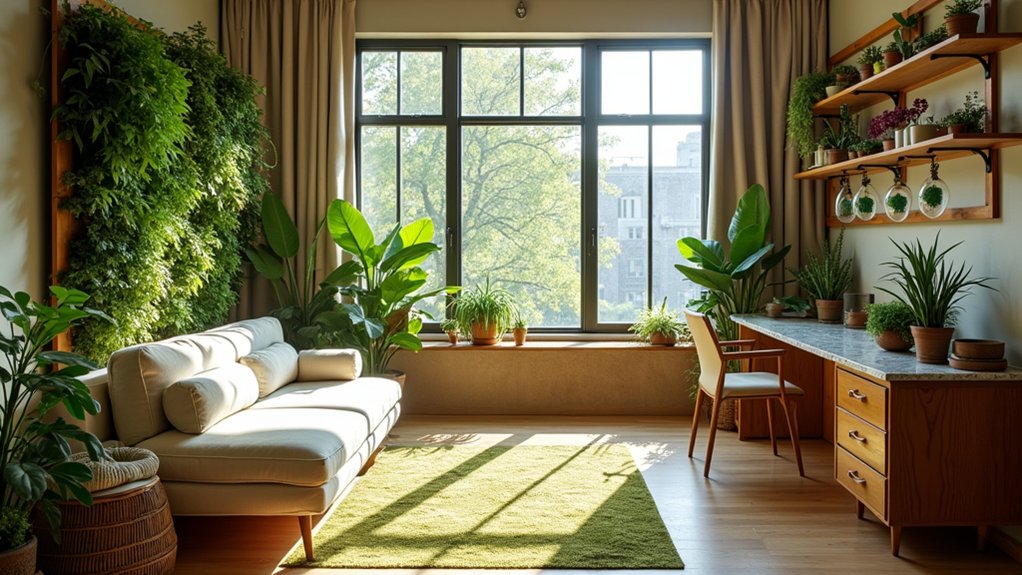
Biophilic design in tiny apartments hinges on maximizing ecological benefits within compact footprints. You optimize spatial layouts to support greenery without sacrificing function, prioritizing modular, expandable greenery systems and vertical planting where floor space is limited.
Integrate living walls, compact planters, and trellises that align with structural framing to minimize retrofit costs. Improve daylight autonomy by prioritizing natural lighting through large sash windows, light tubes, and strategically placed mirrors to amplify daylight penetration.
Choose breathable, moisture-tolerant species suitable for indoor ecosystems, and synchronize irrigation with intelligent controls to reduce waste. Design palettes use natural materials and textures that reflect plant form, while zoning preserves clear circulation.
This urban jungle approach creates microclimates, enhances air quality, and sustains occupant well-being within dense urban contexts.
Scent, Sound, and Microclimates for Everyday Wellbeing
You’ll examine how scent-driven daily rhythms, precise microclimate adjustments, and balanced soundscapes converge to support everyday wellbeing.
This section outlines how targeted scents, controlled acoustics, and local climate cues interact to reinforce routine health and comfort.
Expect a structured framework that links measurable outcomes to practical design interventions.
Scent-Driven Daily Rhythm
- Controlled diffusion zones synchronize with work, rest, and shift periods
- Layered scents combine citrus for alertness with lavender for calm, scaled by space
- Diffusion tempo matches ambient sound and microclimate tweaks for coherence
Microclimate Soundscapes Balance
Begin with quantitative targets: decibel ranges corresponding to spatial zones, humidity setpoints for occupant comfort, and scent intensity tied to activity cycles. Use targeted diffusion and air mixing to prevent odor stagnation while preserving acoustic clarity, avoiding masking effects that distort environmental cues.
Monitor real-time metrics from IAQ sensors, weather data, and occupancy patterns to adjust diffusion rates and ventilation. Calibrate microclimates to reduce thermal stress, support concentration, and mitigate noise irritation.
Ensure that scent, sound, and airflow stay synchronized for predictable wellbeing outcomes.
Budget-Smart Ways to Trial Biophilic Design This Year
Curious about trying biophilic design on a budget? You can pilot core concepts with disciplined, budget friendly upgrades that maximize impact per dollar. Begin by prioritizing natural textures, light, and greenery in focal zones, then layer low-cost elements to sustain effect.
Use DIY biophilic projects to test preferences before committing to permanent changes, and document outcomes to guide further investments. Emphasize scalable options that don’t require specialized tools or permits, ensuring each choice supports wellbeing and performance metrics.
- Low-cost wall treatments that mimic organic textures
- DIY plant displays and herb garden corners
- Frugal natural light strategies and reflective surfaces to amplify daylight
Track results, iterate efficiently, and avoid over-engineering. This approach yields measurable improvements while keeping project scope and risk manageable.
Frequently Asked Questions
How Quickly Can Biophilic Design Impact Mood?
Biophilic design can shift mood within days to weeks. You’ll notice improvements as natural lighting boosts circadian alignment and color psychology enhances perceived warmth and calm, while plants reduce stress markers and elevate focus through progression, sensory-rich cues.
Which Plants Are Safest for Pets in Homes?
Like a careful curator, you’ll select pet friendly plants and verify Toxic plant safety. You, the owner, prioritize verified data, ensuring pets stay safe; know which species are risky, and keep toxic exposures away from curious noses and paws.
Can Biophilic Elements Increase Indoor Air Quality?
Biophilic elements can improve indoor air quality, you’ll notice cleaner air with proper air purification and plant placement. You should optimize species with known VOC reduction, maintain healthy soil, and position plants away from direct pollutants to maximize air purification.
Are Biophilic Trends Affordable for Renters?
Yes, biophilic trends can be rental-friendly. You’ll maximize rental affordability by choosing budget friendly options like low-cost vertical planters, natural textiles, and DIY greenery. You’ll implement scalable, low-embodied-energy elements without compromising tenant rights or aesthetics.
What Are Easy DIY Biophilic Upgrades?
Sure—let’s be tactful: you can create an easy DIY plant wall and enhance natural light. You’ll anchor supports, choose lightweight greens, and position thoughtfully for efficient, minimally disruptive natural light enhancement throughout your space.
Conclusion
Biophilic design isn’t a trend; it’s a proven framework for elevating work and living spaces. By integrating daylight, greenery, textures, and natural color palettes, you’ll reduce fatigue, boost focus, and enhance wellbeing. Start small with low-maintenance plants and daylight-first layouts, then scale to texture and scent ecosystems that suit your space and budget. Implement measurable tweaks, track mood and productivity, and iterate. The result: environments that feel alive—almost like you’ve wired the room for better life. This shift is game-changing.


