
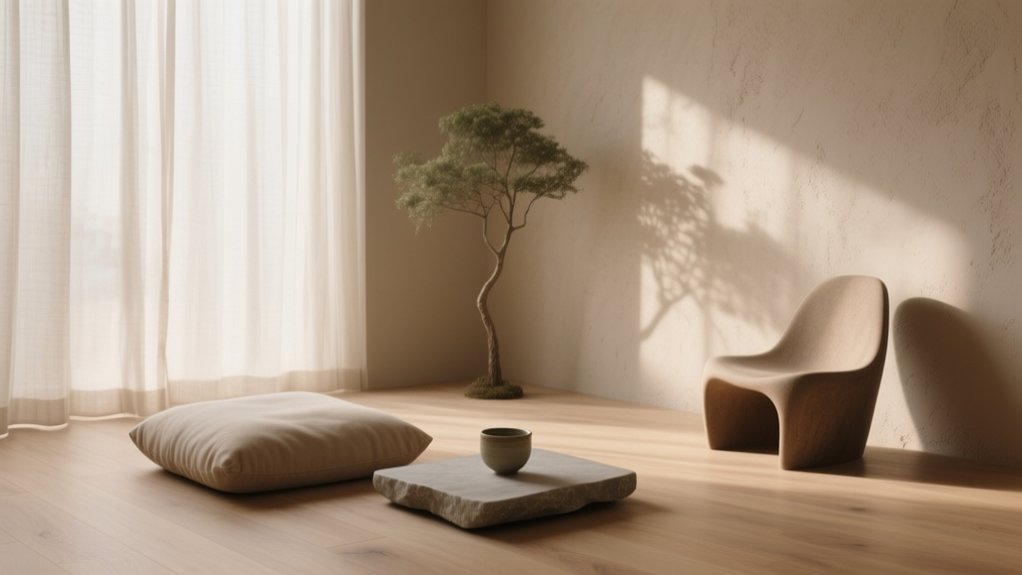

You can design for stillness by picking one goal—sleep, focus, or a nervous-system reset—then controlling measurable inputs: warm, dimmable light (<2700K) with low glare, reduced noise and reverberation via rugs and lined curtains, stable temperature, and zero surface clutter. Clear one “noise zone” first (nightstand or desk), route cables, and simplify cues. Add a small biophilic element and slow textures (linen, wool, matte wood). Next, you’ll see how to set presets and a 2-minute reset.
Key Takeaways
- Define the space’s stillness goal—sleep, focus, or nervous-system reset—and design lighting, temperature, and cues to match.
- Reduce sensory noise by clearing clutter, simplifying surfaces, managing cables, and removing visual triggers that create decision fatigue.
- Use soft, layered, low-flicker lighting with warm dimmable tones and preset “stillness scenes” to signal calm transitions.
- Choose low-saturation colors, restrained contrast, natural elements, and slow textures (linen, wool, matte wood) to lower visual and tactile stress.
- Establish a daily reset protocol—2-minute tidy, dim lights, silence notifications, and a short breathing practice—to keep the space reliably calming.
Pick Your Stillness Goal (Sleep, Focus, Reset)
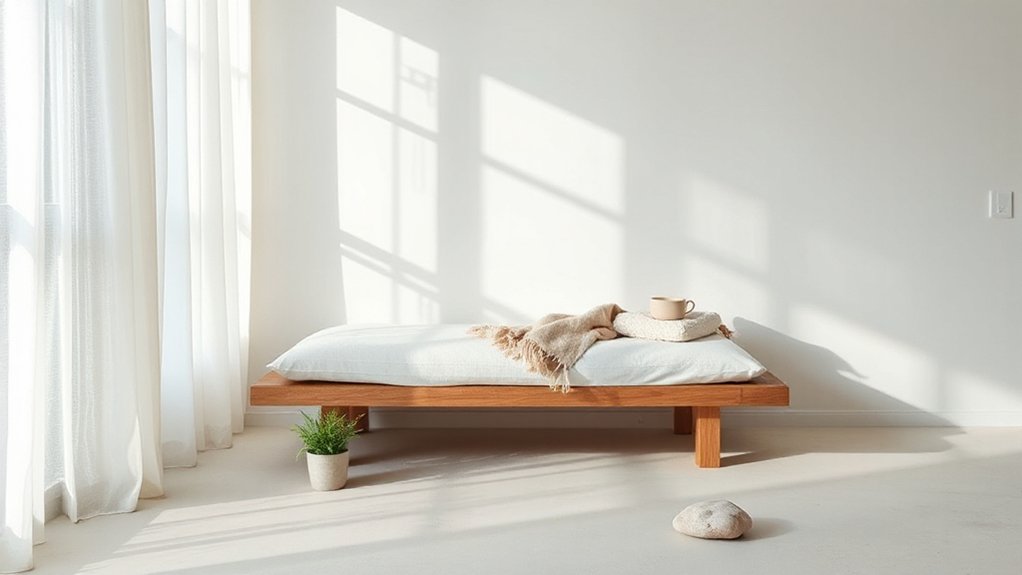
Define the outcome you want from stillness before you design for it: better sleep, deeper focus, or a fast nervous-system reset. When you name the target, you can specify measurable inputs—light level, acoustic profile, temperature, and task demands—so the space reliably produces the state you need.
For sleep, you’ll prioritize circadian support: dimmable warm lighting (<2700K), low visual contrast, and consistent thermal comfort.
For focus, you’ll tune for cognitive load: glare control, a single-purpose workstation, and predictable cues that reduce context switching.
For a reset, you’ll optimize downshifting: a recline option, slow-breath pacing prompts, and Mindfulness practices you’ll actually use.
In all three, deploy ambient soundscapes to mask peaks and stabilize attention without adding lyrics.
Start by Clearing One “Noise Zone
Before you add a single calming feature, clear one “noise zone” that’s currently spiking your cognitive load—your nightstand, desk corner, entry drop zone, or any surface that attracts piles, cables, and notifications. You’ll get the fastest ROI by reducing visual and decision clutter, not by adding décor.
Start with a 10-minute sweep: remove everything, then return only items that support your stillness goal. Route cables into a single sleeve; store chargers in a closed bin; park keys, cards, and earbuds in one tray. Set a “zero-open-tabs” rule for that surface—no mail, no receipts, no devices.
You’re designing a micro–sensory deprivation buffer: fewer cues, fewer interrupts. With the zone quiet, you can enter mindful meditation faster and reset on demand.
Use Soft, Layered Light for Stillness
Although you can’t silence every sound cue in a space, you can lower your nervous system’s alertness by engineering light that’s soft, indirect, and layered.
Specify layered ambient lighting first: dimmable ceiling coves or wall grazers that bounce light off matte surfaces, keeping luminance uniform and reducing contrast edges that trigger vigilance.
Add soft illumination at task height with shielded table lamps or under-shelf LED channels, 2700–3000K, high CRI (90+), and low flicker to prevent fatigue.
Control glare by selecting diffusers, deep shades, and fixtures with UGR-conscious optics.
Put everything on separate circuits or scenes so you can step down to a “stillness preset” at 10–30% output.
Finally, use occupancy sensors with fade-in, not snap-on, progressions.
Choose Calm Colors That Lower Visual Stress

Where do your eyes land first when you enter the room—on a calm field or on high-contrast edges? You can lower visual stress by choosing hues with low saturation and tight value ranges, so your gaze doesn’t keep “snagging” on abrupt shifts.
Apply Color psychology by favoring muted blues, gray-greens, warm off-whites, and soft clays that support slower breathing and steadier attention.
For Visual harmony, control contrast ratios between walls, trim, and large furnishings, and limit competing undertones.
- Set a dominant neutral (70%) with an LRV spread under 15 points.
- Add one secondary tone (20%) in the same temperature family.
- Use a restrained accent (10%) only for functional wayfinding, not decoration.
Add One Nature Element That Grounds the Space
Because your nervous system reads natural cues as safe and predictable, add a single biophilic anchor—one live plant, a bowl of river stones, or a solid wood surface—and give it a clear, permanent “home” in the room.
Place it within your primary sightline from the entry or seat, so your brain tags it as a reference point.
Control scale: keep the element at 5–10% of the visual field to avoid clutter.
Specify durable, low-maintenance materials (sealed oak, smooth basalt, or a pothos in a self-watering pot) and lock in consistent lighting.
If you want movement, choose a small water fountain with a closed reservoir and stable base.
If you need greenery without soil, install a compact moss wall panel.
Soften Sound: Rugs, Curtains, and Quiet Tech
Next, you’ll reduce distraction by controlling reverberation with textiles—layer a dense rug pad under area rugs and hang full-height, pleated curtains to increase sound absorption at key reflection points.
You can also specify quieter devices, from low-sone fans to damped-close hardware and silent-switch keyboards, so mechanical noise doesn’t compete with your focus.
With these upgrades, you’ll set a measurable acoustic baseline that supports stillness without changing your layout.
Textiles That Absorb Noise
- Rugs: Choose dense underlay plus ≥10 mm pile. Cover 60–80% of the floor in seating areas to cut footfall and slapback.
- Curtains: Use pleated, lined drapery (2–3× fullness) mounted ceiling-to-floor. Leave a 50–100 mm air gap for better absorption.
- Upholstery: Specify tight weaves with backed felt. Treat large surfaces like headboards and banquettes.
Quiet Tech For Calm
Where does most “mystery noise” come from once you’ve added rugs and lined curtains? It’s typically mechanical: HVAC turbulence at grilles, compressor cycling, refrigerator fans, and transformer hum from chargers. You can’t textile your way out of that, so specify quiet tech.
Start by measuring baseline dBA with a phone meter, then target sources. Swap to EC-motor fans, add vibration-isolation pads under appliances, and use soft-close hardware to stop impulse noise.
Choose mindful technology like smart thermostats that run longer, slower cycles instead of abrupt blasts.
Add calming gadgets: a low-sone air purifier (≤2 sones), a white/pink-noise machine with adjustable spectrum, and a dimmable, flicker-free lamp.
Route power via grounded strips to cut buzz.
Use Slow Textures: Linen, Wool, Wood, Clay
- Linen: Choose midweight, enzyme-washed linen for drapery. It diffuses daylight and hangs with low visual frequency.
- Wool: Use felted wool rugs or upholstery. Higher pile density reduces footfall noise and resists pilling.
- Wood + clay: Opt for matte-finished oak or ash and unglazed ceramic. They minimize specular highlights and hide fingerprints.
Keep finishes low-sheen, and sample under your actual lighting.
Build a 3-Item Stillness Corner You’ll Use
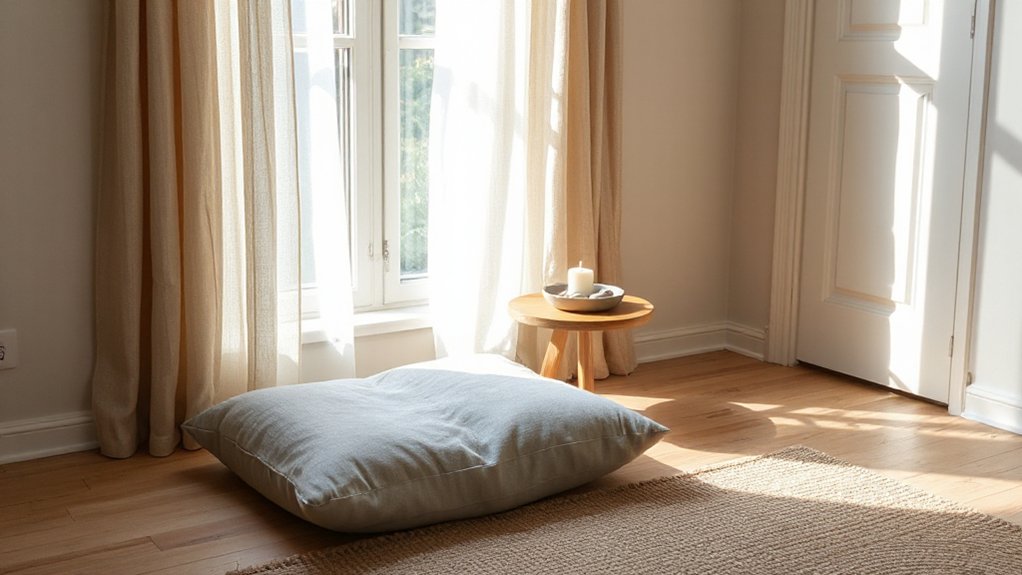
If you keep the setup to three purpose-built pieces, you’ll actually use a stillness corner instead of treating it like décor.
First, specify a grounded seat: a low chair or firm cushion set so your hips sit slightly above knees, reducing spinal load for Mindful meditation.
Second, add a light-control element: a dimmable lamp with a warm 2200–2700K LED, aimed at the wall, plus a simple blackout panel or screen to cut glare and approximate sensory deprivation without making the space unsafe.
Third, include a boundary surface: a small side table or wall ledge that holds only one timer and one notebook, preventing object creep.
Place the corner 3–6 feet from traffic paths and keep cable runs hidden for visual quiet.
Maintain Stillness With a 2-Minute Daily Reset
To maintain stillness, you’ll run a 2-minute daily reset that locks in the calm baseline you designed into your corner.
You’ll take 4 slow nasal breaths (about 5 seconds in, 5 seconds out) to recenter your attention and downshift your nervous system.
Then you’ll reset your space in under 60 seconds—return the three items to their marked positions, clear stray objects, and restore the visual order you rely on.
Breathe And Recenter
When does stillness actually hold—when your calendar’s packed and your attention keeps fragmenting? You stabilize it with a two-minute, repeatable protocol: mindful breathing that downshifts arousal and restores mental clarity. Set a timer, stay seated, and treat this like a micro-intervention you can audit.
- Inhale through your nose for 4 seconds; feel ribs expand laterally, not shoulders lifting.
- Exhale for 6 seconds; keep your jaw unclenched and tongue resting on the palate.
- On each exhale, label one sensation (“warmth,” “pressure,” “airflow”) to prevent rumination.
Run 10 cycles. If thoughts spike, return to counting without judgment. Track outcomes: heart rate settling, quieter inner speech, faster task re-entry. Use the same sequence daily so your system learns the cue and responds predictably.
Reset Your Space
How do you keep stillness from evaporating the moment your eyes land on clutter and open loops? You install a 2-minute daily reset protocol that runs like a checklist, not a mood. Set a timer.
First 30 seconds: clear the primary surface (desk, nightstand) to one intentional object; everything else goes into a tray.
Next 30: close loops—cap pens, shut drawers, stack papers to a single inbox.
Next 30: restore sensory controls—dim lights, align chair, silence notifications; this mimics mild sensory deprivation by reducing visual and auditory noise.
Final 30: stage your cue for mindful meditation: cushion centered, water filled, journal open to one page. You’ll re-enter the space already oriented to calm.
Frequently Asked Questions
How Can I Create Stillness in a Shared Space With Roommates or Family?
You’ll create stillness by zoning quiet hours, adding soft sound absorption, and defining no-clutter surfaces. Personalize decor to reduce visual noise, incorporate natural elements, and agree on lighting levels, storage, and device-free routines.
What Budget-Friendly Changes Make the Biggest Difference for a Calmer Room?
You’ll see the biggest calm boost from “gentle refinements”: swap harsh bulbs for warm LEDs, add a rug and curtains for acoustic damping, declutter surfaces. These budget upgrades and decor essentials optimize lighting, sound, visual load fast.
Which Essential Oils or Scents Support Calm Without Triggering Sensitivities?
Choose low-allergen scents: lavender (linalool-light), Roman chamomile, bergamot FCF, or cedarwood; avoid cinnamon, clove, and heavy synthetics. You’ll maximize Aromatherapy benefits with minimal diffusion and scent layering using unscented bases; patch-test first.
How Do I Design for Stillness if I Have ADHD or Anxiety?
You can design for stillness with ADHD or anxiety by testing what truly settles you, then iterating. Apply mindfulness techniques, schedule micro-break cues, prioritize sensory reduction with dimmable lighting, acoustic panels, clutter limits, and predictable layouts.
What Mistakes Most Commonly Make “Calm” Spaces Feel Cold or Sterile?
You make “calm” feel sterile by overusing white, glossy surfaces, sparse furniture, and harsh overhead lighting. Add mindful lighting layers, soft textures, warm woods, varied scale, and a few curated objects to anchor comfort.
Conclusion
You don’t design stillness by adding more—you achieve it by subtracting the right noise. While the world pushes bright screens and sharp edges, you specify layered warm light, low-contrast color, and tactile materials that slow perception. You trade echo for absorption with rugs and curtains, and swap cluttered surfaces for a three-item corner you’ll actually use. The contrast is the point: less stimulus, more control. Keep it working with a two-minute daily reset.


