
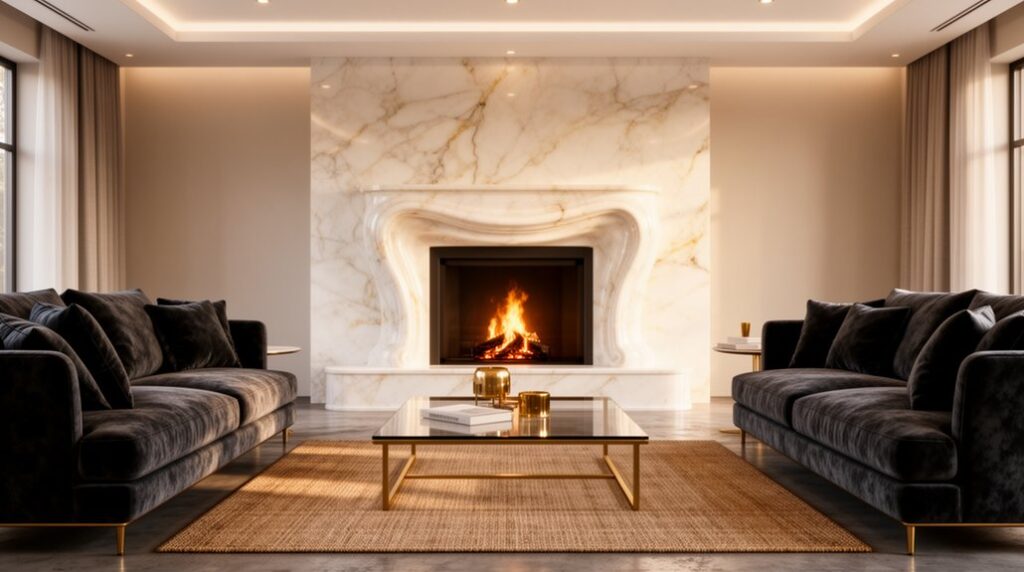

A bespoke marble fireplace elevates your living room with luxury materiality, precise proportions, and crafted detailing that create a timeless centerpiece. You gain design control over form, texture, and scale, ensuring heat distribution aligns with seating and sightlines. Choose marble colors and veining to harmonize lighting and mood, while selecting low-porosity, durable options for longevity. Paired with thoughtful lighting and coherent surroundings, it delivers sophistication and value—and you’ll discover how to refine every element as you proceed.
Why a Bespoke Marble Fireplace Elevates Luxury Living

A bespoke marble fireplace instantly signals luxury by marrying material excellence with architectural intent. When you specify a tailored unit, you align form and function, ensuring heat distribution, proportions, and sightlines complement the room’s architecture.
You gain control over texture, finish, and scale, allowing a cohesive dialogue with surrounding surfaces. Artistic craftsmanship informs every detail—from mitred edges to precise inlays—so the fireplace becomes a focal anchor that exudes refinement without overpowering the space.
Material sustainability guides your choices, encouraging responsibly sourced blocks and efficient fabrication that reduces waste and energy use. In response, the room achieves enduring value, standout acoustics, and a timeless silhouette.
Your investment yields a durable centerpiece that elevates residence quality and perceived prestige.
How to Choose Marble: Color, Veining, and Proportions
When you select marble, start with color options that harmonize your room’s palette and lighting. Then weigh how each hue will withstand with time.
Veining patterns should align with the fireplace’s proportions and surrounding architecture, guiding whether you prefer restrained or bold statements.
Proportions matter: balance slab thickness, slab size, and the room’s scale to ensure a cohesive, enduring centerpiece.
Marble Color Options
What marble color options best suit your living room’s mood and scale? Your choice should harmonize with space, light, and sculptural elements, balancing marble durability with visual impact. Consider color psychology to align atmosphere with usage, from tranquil retreats to formal showpieces.
Subtle whites and creams read as expansive and fresh, while cooler grays convey modern restraint. Rich creams with caramel veining add warmth without heaviness, and bold blacks create dramatic focal points when tempered with surrounding materials.
1) Light neutrals for openness and longevity
2) Medium grays to anchor furniture and lighting
3) Warm creams with muted veining for inviting contrast
4) Black or deep charcoal for high-contrast, gallery-like drama
Veining Patterns Proportion
Veining patterns establish the visual rhythm of marble and dictate how a fireplace reads in the room. You assess veining proportion by comparing scale, density, and placement to surrounding elements, ensuring harmony rather than competition.
High-contrast veining creates focal drama, but its rhythm must be controlled so it doesn’t overpower architectural lines or furniture silhouettes. Favor patterns with deliberate cadence across the mantle and hearth, avoiding random dispersal that disrupts visual flow.
Consider Pattern symmetry: balanced distribution of veining across surfaces yields a coherent, timeless read, whereas asymmetry can introduce dynamic tension if proportioned to the room’s geometry.
Calibrate vein thickness and repetition to mirror material progression elsewhere, reinforcing a unified, sophisticated aesthetic. Align veining contrast with lighting strategy to preserve clarity and polish.
Evaluating Marble Types for Your Space
- Identify marble with low porosity for reduced moisture uptake and easier cleaning.
- Favor harder grades to resist scratching from daily use and tools near the hearth.
- Assess sealant schedules to maintain Marble maintenance without frequent disruption.
- Prioritize non-porous finishes or polished surfaces to support Fireplace safety and cleanability.
Focus on maintenance plans, expected patina, and long-term costs to justify your choice.
Align material selection with room humidity, airflow, and heat exposure to preserve the fireplace’s integrity and aesthetic.
Proportions and Profiles: Getting the Fireplace Right
You determine the success of a marble fireplace by its scale, ensuring the opening and mantel relate clearly to the room’s dimensions.
Consider proportional profiles that balance mass and detail, so the hearth reads as a coherent feature rather than a standalone ornament.
This section pinpoints how to size and shape elements for an elegant, durable result.
Proper Scale Proportions
To get the fireplace right, start with scale: the opening should harmonize with the surrounding room and the mantel above it, not overwhelm or underwhelm the space. Marble texture informs proportion; select surface pattern that reads quietly at distance while delivering depth up close.
Fireplace placement governs balance, ensuring hearths align with seating axes and doorways. Precision here prevents visual shock and maintains room rhythm.
- Evaluate opening height against eye level for comfortable viewing.
- Align width with furniture span to avoid crowding or emptiness.
- Consider mantel mass relative to room width and ceiling height.
- Check rug and seating alignment to reinforce cohesive scale throughout.
Proportional Fireplace Profiles
Proportional profiles define how the fireplace silhouette reads from a distance and contributes to the room’s vertical rhythm. You assess proportions by mapping the hearth opening to the surrounding architecture, ensuring the profile remains legible across multiple viewing angles.
A slender, high mantle elevates the sense of height, while a broad, grounded base anchors the space. Consider the marble texture when determining line weight; strong veining can visually compress or expand the profile, so adjust outline thickness accordingly.
Fireplace placement should balance symmetry with function, aligning with seating axes and focal points without crowding architectural features. Consistent scale across adjacent elements preserves coherence, and gradation trims should follow the same proportioning logic to avoid jarring interruptions in composition.
Integrating Marble With Flooring, Walls, and Textiles
Marble integrates gracefully with flooring, walls, and textiles when you choose harmonizing tones, textures, and scales. You’ll align material cadence to preserve coherence between surfaces, ensuring the fireplace remains a focal anchor without competing patterns.
- Match marble texture to the dominant floor or wall finish, creating a unified backdrop that supports the fireplace placement.
- Balance veining by selecting complementary, restrained patterns to avoid visual clutter across surfaces.
- Use consistent edge profiles and grout choices to maintain a seamless, high-end appearance around the hearth.
- Coordinate textiles and upholstery with subtle color echoes from the marble to reinforce rhythm and depth.
Lighting Design to Highlight Marble Fireplaces
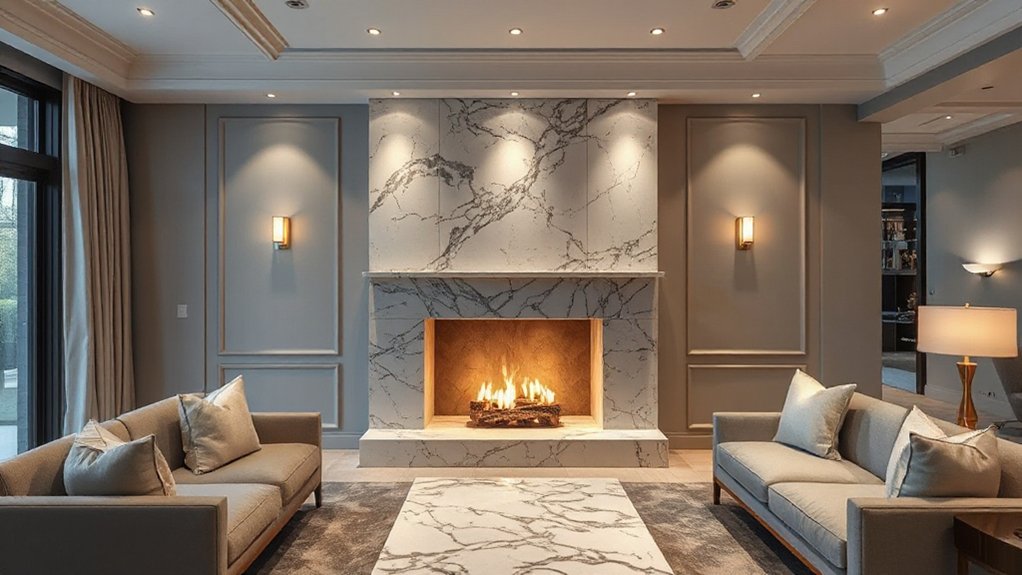
You’ll illuminate marble fireplaces with a layered lighting strategy that emphasizes texture, form, and ambiance. Begin with a combination of ambient, task, and accent layers to reveal the stone’s veining and depth without glare.
Use dimmable, color‑accurate fixtures to preserve true tones and avoid yellowing or washed-out whites. Integrate uplights at the mantle to sculpt relief, and install wall washers at a controlled distance to prevent hotspotting while maintaining even illumination on panel fronts.
Implement practical glare control and choose fixtures with shielded optics to protect architectural features. Consider acoustic and air quality implications: select fixtures with low radiant output and harmonized ventilation paths to respect Architectural acoustics and Indoor air quality in the room, ensuring comfort and precision in both lighting and environment.
Smart Tech Touchpoints: Controls, Climate, and Safety
Smart tech touchpoints unify lighting with environmental control to optimize the marble fireplace scene. You’ll harmonize heating, cooling, and air quality with adaptive sensors, ensuring comfort without waste.
Precision zoning lets you tailor ambience for seating, media, and conversation zones, while safety protocols guard against overheating and flame risks.
- Integrate smart home controls for centralized climate and lighting management.
- Use sensor-driven routines to maintain consistent temperature and air quality.
- Calibrate automatic shutoff and fault alerts to enhance safety without intrusion.
- Align device aesthetics with Modern aesthetics for seamless, cohesive design.
This approach delivers Smart home integration that respects space, performance, and energy efficiency, elevating the marble focal point with refined, reliable control.
Design Narratives: Minimalism vs. Dramatic Stone
You weigh Minimalist Stone Expression against Dramatic Veining Narratives to define a room’s voice, balancing clean lines with bold natural patterns.
Consider how Textural Quietude provides a calm counterpoint to assertive stone, guiding tactile and visual rhythm without clutter.
This discussion frames how restrained simplicity and striking geology co-create a cohesive marble fireplace narrative.
Minimalist Stone Expression
In minimalist stone expression, the fireplace becomes a quiet, intentional focal point that communicates restraint and clarity. You’ll curate forms that emphasize tactile accuracy, precise edges, and uniform grain, ensuring the hearth reads as architecture first, ornament second.
The result is an exterior of calm, with limited contrast and a restrained palette that enhances outdoor ambiance without competing with the space. The approach favors durable, low-maintenance finishes that age gracefully and reduce visual noise.
You should align the fireplace with architectural lines, window openings, and seating geometry to maintain coherence. The narrative also accommodates artistic sculptures as subtle counterpoints, carefully integrated so they inform rather than dominate.
- Establish proportion and alignment with surrounding elements
- Select stone with consistent grain and neutral undertones
- Prioritize low-contrast textures for quiet impact
- Place sculptures and seating to reinforce circulation and focus
Dramatic Veining Narratives
In this framework, you balance mineral tension against architectural restraint, ensuring the veining reads as purposeful choreography rather than randomness. You assess material compatibility, thickness, and cut to optimize flow from hearth to surrounding surfaces, preserving structural integrity while heightening visual impact.
Artistic craftsmanship becomes a measurable criterion, not just an aesthetic aspiration, as finish, seam alignment, and polish levels contribute to perceived value. Cultural influences inform motif decisions, framing veining as narrative devices that reflect heritage, geography, and craft traditions without overwhelming minimalist restraint.
Textural Quietude Balance
Textural quietude balances the boldness of dramatic stone with restrained, tactile calm, creating a fireplace that anchors the room without competing for attention. You harness minimalism by pairing matte surfaces with soft, resonant textures to achieve controlled visual weight. The result is deliberate calm that preserves drama through form rather than hue.
Focus on textural contrast to enhance perception of depth while maintaining clarity of lines. Acoustic dampening benefits from thoughtful material layering, reducing ambient glare and echo without compromising material honesty.
- Choose a restrained, tactile base material to ground the composition
- Integrate a secondary texture that moderates glare and echo
- Align stone veining with the room’s architectural rhythm
- Calibrate finish levels to preserve balance between drama and quiet
Real-World Layouts: Floor Plans That Spotlight a Fireplace
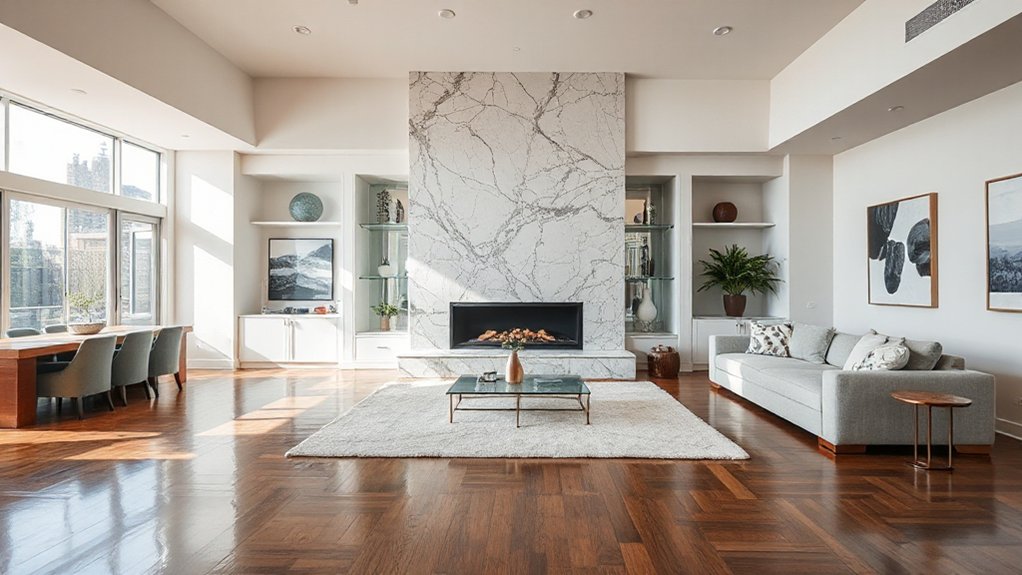
Real-world layouts that spotlight a marble fireplace prioritize clear sightlines and purposeful traffic flow, ensuring the hearth remains the focal point without competing with seating or architectural details.
In practice, you’ll place the fireplace on a primary axis visible from multiple seating zones, while keeping doorways and pathways unobstructed. Consider proportional scales: module rooms with generous margins around the hearth prevent crowding and support balanced acoustics.
Arrange furniture to frame the fireplace rather than divert attention, using low-profile consoles or built-ins that don’t compete with the marble focal point. Implement consistent material progressions to support material sustainability, selecting durable, low-maintenance finishes adjacent to the hearth.
Plan for practical access to the installation area—favor accessible venting, cleanouts, and service clearances—without sacrificing aesthetic authority or spatial clarity.
Care and Longevity: Maintenance, Sealing, and Longevity
Care and longevity begin with a clear plan for upkeep that preserves the marble’s beauty and structural integrity after installation. You’ll implement a disciplined routine that supports sustained performance, informed by marble sourcing and fireplace installation best practices. Regular checks prevent hidden damage and guarantee consistent aesthetics.
- Schedule professional sealing at intervals aligned with stone type and exposure, documenting results.
- Use pH-neutral cleaners, promptly addressing spills to minimize etching risk.
- Monitor grout lines and surrounding hearth for microfractures, performing timely repairs.
- Maintain ventilation and combustion efficiency to reduce heat cycling effects on the marble surface.
Frequently Asked Questions
What Is the Cost Range for Bespoke Marble Fireplace Projects?
You’ll typically pay $15,000 to $60,000 for bespoke marble fireplace projects, depending on complexity. Marble color options and custom mantel designs drive both material and labor costs, with precise routing, sourcing, and finishing elevating the overall price.
How Long Does Installation Typically Take From Design to Finish?
Installation typically takes 4–12 weeks from design to finish, depending on customization scope and material sourcing. You’ll coordinate design customization details, guarantee precise measurements, and oversee timely material sourcing to minimize delays and ensure flawless integration.
Can Marble Be Repaired After Heat-Related Damage or Chips?
Yes, marble can be repaired after heat damage or chips. With marble restoration, skilled technicians use heat resistant coatings and careful polishing to restore finish, color, and sheen while preserving structural integrity. Use caution; professional assessment is essential. Anachronism: “yesterday.”
What Maintenance Routine Preserves Marble’s Polish Longest?
You should implement a routine with gentle marble cleaning, then seal periodically to minimize staining; polish preservation rests on consistent dusting, avoiding acidic cleaners, and reapplying a quality marble polish as recommended by manufacturers.
Are There Safety Concerns With Pets Around Marble Fireplaces?
Yes, there are safety concerns with pets around marble fireplaces. You should monitor for marble toxicity signs, keep pets away from fresh epoxy or sealants, and use pet-safe cleaners to minimize hazards and injuries.
Conclusion
A bespoke marble fireplace isn’t just an ornament—it’s a measurable uplift to space value, function, and mood. You gain tailored proportions, controlled veining, and durable finish that ages with you. By aligning color, texture, and scale with your furnishings, you create a cohesive luxury narrative. Regular sealing preserves sheen and integrity, while smart touchpoints blend safety with elegance. Ready to elevate your room with a precise, enduring centerpiece that defines the layout and your lifestyle?


