
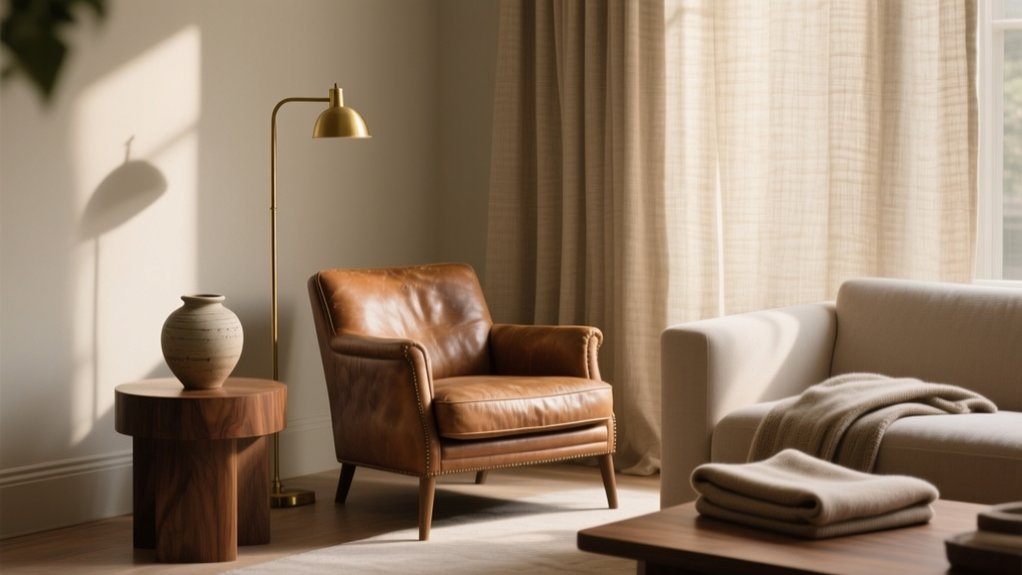

You elevate a room by tightening five quiet details. Get scale right: use a rug large enough for front legs, hang curtains high and wide, and centre art at eye level with a handspan above furniture. Layer lighting with dimmable ambient, wall or picture lights, and proper task lamps using consistent bulbs. Keep undertones aligned across paint, metals, and trims. Limit textures to 3–4. Upgrade hardware and finishes; there’s more ahead.
Get the Scale Right (Rugs, Curtains, Art)
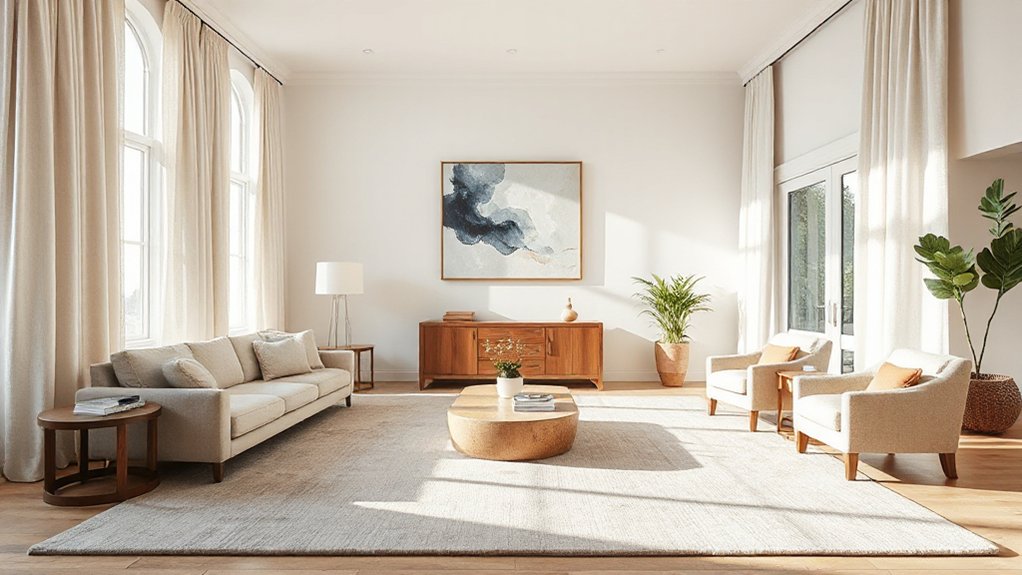
If your room feels oddly “off” despite good furniture, scale is usually the culprit. Start with the rug: in most British sitting rooms, you want the front legs of sofas and chairs on it, not marooned around a postage-stamp mat.
Hang curtains high and wide; fix the pole near the coving and let the fabric kiss the floor, so windows read taller even on a Victorian terrace.
With art, treat the wall as a composition: centre pieces at eye level, then anchor them to furniture with a gap of roughly a handspan.
Use focal point placement deliberately—fireplace, bay window, or bookcase—and support it with symmetry balance via matching lamps, frames, or paired chairs.
Layer Lighting to Elevate the Room Fast
Although you can spend a fortune on a sofa, a room won’t feel finished until you’ve layered the lighting properly.
Start with a ceiling light on a dimmer so you can set a soft Ambient glow for evenings, not a harsh blaze.
Add wall lights or picture lights to wash the vertical surfaces; it flatters cornicing and makes the room feel taller.
Then bring in task lighting where you actually live: a shaded table lamp beside the armchair, an adjustable reading light at the bed, under-cabinet strips in the kitchen.
Keep bulbs consistent in brightness and CRI so fabrics look true.
Finally, place lamps on timers or smart plugs; you’ll walk into balance, not darkness.
It’s the quickest upgrade you’ll feel.
Keep Color Undertones Consistent Room-Wide
When your room’s undertones pull in different directions, even pricey pieces can look slightly “off” without you knowing why. To restore color harmony, choose a clear temperature—warm, cool, or balanced—and stick with it from paint to upholstery to timber finishes.
You’ll spot undertones by testing samples in north and south light (especially on a grey British day). A “warm white” with yellow can clash beside a pink-beige sofa; a cool blue-grey can turn a creamy carpet slightly sallow.
Compare everything against one fixed reference, such as your largest rug or existing flooring. Then repeat that undertone in your metals and trims: brass reads warmer, chrome cooler.
Undertone consistency makes the whole room feel intentional, calm, and more expensive.
Mix 3–4 Textures for a Quiet-Luxury Look
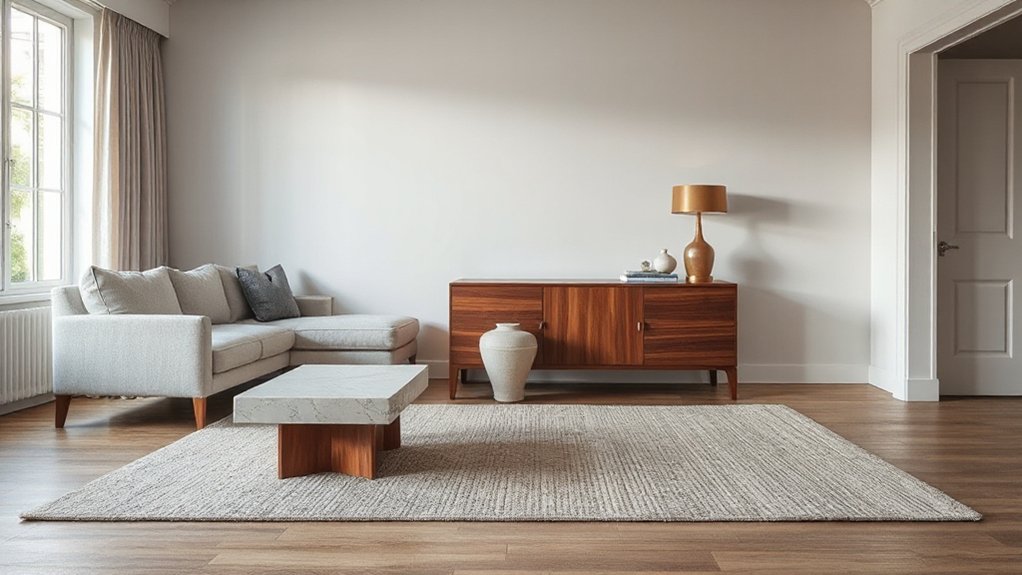
Because texture catches light long before you clock colour, a room with just three or four well-chosen finishes instantly reads as “quiet luxury” rather than flat.
Aim for disciplined textural contrast: enough variety to create depth, not so much that it feels fussy. You’ll get it right when every surface invites touch, yet the palette stays calm and cohesive.
- Start with a matte base: limewashed walls or a chalky emulsion to soften glare.
- Add a natural grain: rift-sawn oak, walnut, or painted joinery with visible brushwork.
- Bring in softness: wool bouclé, linen, or a tight herringbone for tactile layering.
- Finish with a subtle sheen: honed marble, aged brass, or glazed ceramics, used sparingly.
Swap in Elevated Hardware and Finishing Details
Texture sets the tone, but hardware delivers the tell-tale finish you notice at arm’s length. Swap flimsy knobs for weighty brass, bronzed nickel, or aged iron; you’ll feel the difference every day.
Keep the sheen consistent: pair satin taps with satin pulls, and avoid mixing mirror-polished chrome with brushed metals unless you’re doing it deliberately.
Treat hardware accents like jewellery: scale them to the joinery, align screw heads, and choose a profile that suits the era—reeded for Georgian, slim bar pulls for contemporary.
Don’t stop at cabinets. Upgrade socket plates, curtain poles, door furniture, and radiator valves so the room reads intentional.
Finally, add finishing touches: neat escutcheons, tight backplates, and clean caulk lines around ironmongery so everything looks properly specified.
Frequently Asked Questions
How Do I Make an Open-Plan Space Feel Cohesive yet Distinct?
Use colour harmony to unify walls and textiles, then mark zones with rugs, lighting, and artwork. Plan furniture flow so walkways stay clear. Repeat key finishes, vary accent shades, and anchor each area.
What Budget-Friendly Upgrades Deliver the Biggest Visual Impact Quickly?
You don’t need deep pockets—swap bulbs and shades for Lighting accents, then paint one wall using Color psychology. Add a large mirror, upgrade cushions and throws, and declutter surfaces; you’ll see instant polish.
How Can I Make a Small Room Feel Larger Without Renovating?
You’ll make a small room feel larger by using colour psychology—pale, warm neutrals—and smarter furniture placement: float pieces, keep legs visible, and clear pathways. Add a large mirror opposite the window for depth.
Which Decorating Mistakes Make a Room Look Cluttered or Cheap?
You’ll find the theory true: mismatched pieces breed visual noise. You make rooms look cluttered or cheap when you ignore colour coordination, cram furniture placement, over-accessorise, skimp on lighting, hang curtains wrongly, and neglect tidy storage.
How Do I Choose Decor That Looks Timeless Instead of Trend-Driven?
Choose enduring shapes, quality materials, and restrained patterns; you’ll sidestep fads. Build around Neutral palettes, then layer texture with wool, oak, and brass. Add Vintage accents sparingly—classic lamps, framed prints—so it feels properly British.
Conclusion
You’re curating a room the way a good gardener tends a Chelsea border: you start with scale—rug, curtain drop, art height—so nothing looks stunted. You train the light in layers, like lanterns along a gravel path. You keep undertones aligned, so colours don’t quarrel. You weave three or four textures—linen, oak, brass, wool—for quiet luxury. Then you finish with proper hardware: weighty pulls, crisp switches, neat trims.


